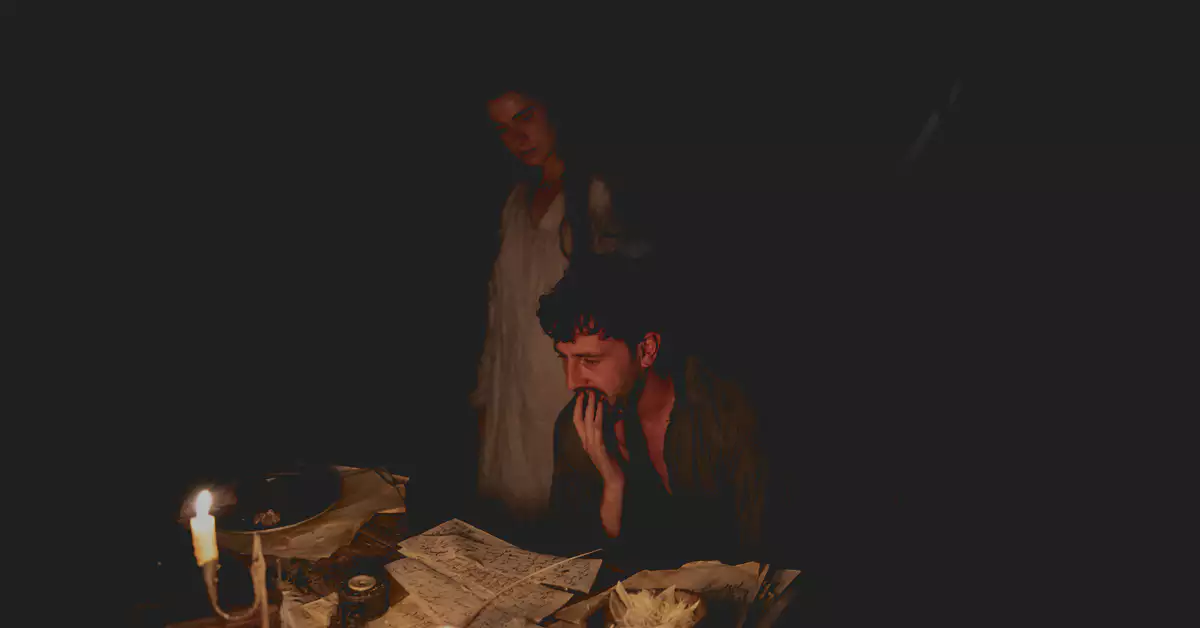
Hamnet (2025)
On proximity, the theatrical contract, and what Chloé Zhao’s Hamnet discovers about how Agnes knows things
Agnes reads a body the way other people read language. She moves through the film’s Elizabethan world with a specific intelligence: not mystical, not supernatural, but radically somatic—knowledge acquired through nearness, through the skin, through what the hands encounter. She trains a hawk to return to her arm. She reads illness before the sick person knows they are sick. She gives birth alone on a forest floor not because she is reckless but because she needs the earth under her. Her epistemology requires proximity. Distance, spatial or temporal or mediated, is what her system has no tools for.
This is the film’s defining quality, and also the problem it cannot solve. When Will leaves for London, Agnes is not simply abandoned—she is cut off from her own capacity to know. At ninety miles, she cannot read him. She cannot read the plays he writes, the grief he carries, the distance itself. Grief, for Agnes, arrives as a form of epistemological failure: the loss of Hamnet, compounded by the loss of the ability to know anything about what Will is doing, what he feels, whether his absence is flight or necessity. These failures are not separable. She loses her son and simultaneously loses access to any understanding of the man who also lost him.
The rage that accumulates across the film’s middle section is not simply the rage of abandonment. It is the rage of a specific intelligence confronting the outer limit of its reach.
Jessie Buckley plays Agnes without announcing what she’s doing. The performance operates in the register of the body ahead of language—states of being rather than emotional display, something prior to expression. When she watches the hawk, or when she holds a sick child, the camera doesn’t find a face performing understanding. It finds a body in a specific relationship to its surroundings. This is a difficult thing to achieve and Buckley achieves it consistently enough that you forget to register it as achievement. You simply believe that this woman knows things you don’t.
What the performance establishes—and what the film depends on—is that Agnes’s mode of knowing is genuine and consequential. It is not superstition dressed as wisdom. When she reads illness, she is accurate. When she attunes to the hawk, the hawk returns. The film takes her seriously as an epistemologist, and this is its most important formal decision, because everything that follows depends on the stakes being real. Agnes’s knowledge is real. Its failure, when it fails, is therefore a real failure—not the exposure of a deluded character but the exposure of a limit.
That limit arrives with Hamnet.
Agnes knows herbs, reads bodies, understands the language of living things. None of this delays her son’s death by a minute. Her atunement to the physical world—the very thing that has made her exceptional—is irrelevant to what is happening to Hamnet. This is the film’s hardest scene to watch, and not because of the staging or the performance, although both are formidable. It is hard because we have been given, across the film’s first hour, genuine respect for Agnes’s knowledge, and this scene is the scene that shows us where the knowledge stops.
Paul Mescal plays Will with a taciturnity Chloé Zhao chose deliberately—a departure from the novel, which renders him talkative. In the film, Will processes experience inward and then into language: first into silence, then into writing, then eventually onto a stage. He is not cold; he is the kind of person who cannot access what he feels until he has found the formal container for it. This is a recognizable type—artists who are inarticulate in life and articulate in work—and Mescal carries the specific discomfort of it, the simmering pressure of feelings that have no direct outlet. When Will finally speaks his grief, it will be in iambic pentameter, on a stage, to a paying audience. The directness that Agnes embodies is not available to him.
From inside her grief, Agnes reads this as absence. From outside, we might read it as a different mode of being present—one that requires time, requires distance, requires the formal structure of a play before it can become communicable. But Agnes cannot see this from where she stands. Distance is what her system cannot process, and Will’s entire relationship to feeling is mediated by the exact kind of distance she has no tools for.
What the film understands, and what takes a long time to understand, is that these are not failures of character. Agnes is not too direct; Will is not too closed. They are two different epistemologies that have, against the odds, built a life together, and that now, in grief, cannot bridge the specific gap between them.
Agnes goes to the theatre.
She does not want to. She has resisted this for years, not from ignorance but from something closer to instinct—a sense that Will’s world, the world of stages and performed language, is a world her mode of knowing cannot enter. She is right about this, as it turns out, in ways neither she nor the film quite anticipates.
In the theatre, Agnes is the wrong kind of audience member. She does not observe the theatrical contract—the agreement that says: the stage is over there, you are over here, this separation is what makes the whole enterprise work. Aesthetic distance is not incidental to how theatre functions; it is its operating condition. The stage is elevated, the lights are lowered on the audience side, the actors do not acknowledge the room—all of this engineering serves one purpose: to create a gap across which representation becomes legible. You must be at a remove to see clearly. Too close, and the illusion collapses; the actor is just a person in costume, saying lines.
Agnes disrupts this. She does not know she is supposed to maintain the gap. She tries to interact with what’s happening on stage as if it were happening in the room, in the present, with her. The people around her are disturbed. She is, by the standards of the institution, failing at the one thing the institution requires.
This failure is the film’s most important moment, and it has been read almost universally as comic or as evidence of Agnes’s foreignness to Will’s world. But I want to read it differently. Agnes’s inability to maintain aesthetic distance is not a deficiency. It is her. It is exactly the same quality that allows her to read illness, to attune to the hawk, to give birth on the forest floor. She cannot hold the theatrical distance because she cannot hold any distance. Her mode of knowing requires proximity, and the theatre has been designed specifically to prohibit proximity.
She is malfunctioning in the theatre. And the malfunction is what makes the moment possible.
The actor playing Hamlet has been trained to replicate specific mannerisms—particular gestures that belong to a specific dead child. Will has been watching his son for years, preserving what he observed, and now transfers it to another body. Agnes watches someone else move with the ghost of her son’s movement.
She reaches toward the stage.
The reaching is Agnes doing what Agnes does. She reaches for things directly; she has always reached. In any other context this is how she knows. Here, in the theatre, it is technically inadmissible—she is crossing a boundary the entire institution exists to maintain. And she does it anyway, not in defiance but in ignorance. She does not know she isn’t supposed to.
Others follow.
This is the film’s strangest and most discomforting image: Agnes’s wrong behavior is contagious. The audience members who were disturbed by her non-compliance with theatrical convention now follow her across the boundary. Her mode of watching—without managed distance, without the protective gap—becomes, for a moment, everyone’s mode. The aesthetic distance the theatre has maintained dissolves. The audience reaches toward the stage together.
What does this mean? It might mean: Agnes’s directness, her refusal of mediation, is so elemental that it overrides the institution when the conditions are right. It might mean: the theatrical experience is achievable through the abolition of aesthetic distance as well as through its maintenance—that there is more than one way to be undone by a play. Or it might mean something more troubling: that the theatrical contract exists precisely to prevent this, and that the film is endorsing a form of reception that the institution would normally prohibit.
I find myself unable to settle on which reading is correct. And this inability is not a failure of my analysis. The film holds the moment open.
But the film does not end there. It ends somewhere stranger, and the strangeness is what matters most.
When Hamlet dies in the play—the fictional son, the character who has carried something of Hamnet’s gestures across the stage—the theatre goes quiet. And Agnes sees something at the dark opening in the stage set: her son. Not the actor trained to move like him. Hamnet himself, or what Agnes’s mode of knowing makes available to her: his back first, then his face turned toward her. They exchange something in silence—a nod, her hand pressed lightly to her chest in answer. His eyes hold what he will not let fall. He turns and walks into the darkness. She watches until he is gone.
Then something releases in her. Not quite a cry, not quite a laugh, but something compressed and opening at once—the specific sound of grief that has been held at pressure for years finding the smallest exit. Then her face returns to sadness. The film ends.
This is what the essay has been building toward without quite knowing it. Agnes does not end Hamnet having accepted Will’s mode of knowing. She ends it having used her own. She sees her son—directly, personally, through a vision that Will’s play created the conditions for but did not itself produce. He built the stage; she saw what Agnes sees. Two modes meeting at one coordinate, and Agnes’s mode having the final word.
What passed between them at the dark door was not language and not theatre. It was Agnes’s hand against her chest and Hamnet’s nod and the silence in which those two gestures were sufficient—which is where Agnes has always lived, in the register that requires no translation.
Contact is what the film offers. Not synthesis, not the discovery of a shared language, not Agnes converted to Will’s mode of knowing. One moment in which her directness and his formal art met at the single coordinate of grief for a dead child. And then he walked into the dark, and what released in her when he disappeared was something prior to language, which is probably the only kind of release Agnes has ever trusted anyway.
I think the film believes this is enough. I am not entirely sure the film is right. But I watched Agnes put her hand to her chest, and for that duration, the question didn’t feel like a question.