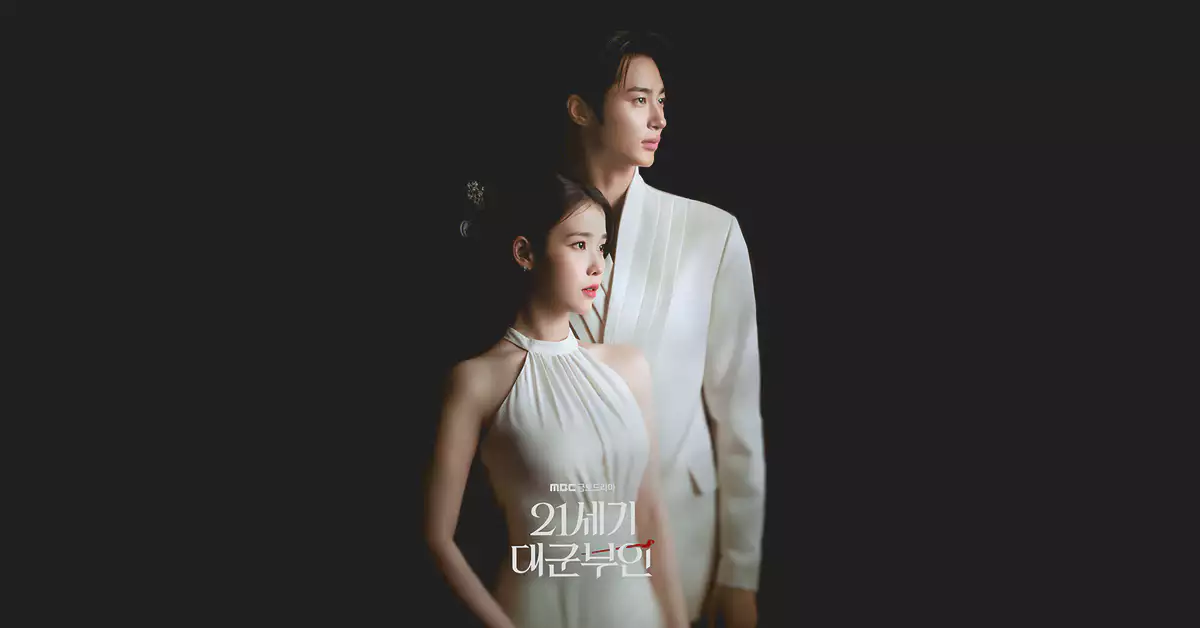
Perfect Crown Episodes 1–4
Control Issues: The First Four Episodes of Perfect Crown
Note: In the drama Perfect Crown, “Lee An Daegun” and “Lee Wan” refer to the same character. The difference in name comes from a change in royal title. “Lee Wan” is his given name, while “Lee An Daegun” is a princely title (gunho) granted by the royal family within the story.
— Feature Analysis
The fundamental structure of this work
The most useful thing you can say about Perfect Crown four episodes in is that it has not yet done the obvious thing.
The setup invites a particular kind of story — ambitious woman maneuvers her way into the royal household, resistant prince learns to feel, status gap closes as hearts open. That story exists inside these episodes, and it is told competently. But what makes the show worth watching at this stage is the discipline with which it keeps complicating its own romantic logic. Every time the drama moves toward warmth, it quietly reintroduces the problem of power. Every time the characters seem to understand each other, the structure reminds them — and us — why understanding alone is not enough.
Hee-ju’s Precision
Seong Hee-ju (IU) is not trying to change the world. This is important to establish early, because her energy reads so much like rebellion that it is easy to mistake her intent. She does not want to dismantle the system that has disadvantaged her. She wants access to it. The distinction is what gives her character its specific intelligence.
Everything she does in the first four episodes operates through this logic. She identifies the structural gap — a regent who needs political legitimacy, a marriage market that undervalues her, a royal household that requires a public face — and moves to position herself at the point where those needs intersect. It is less seduction than contract negotiation, and the show is sharp enough to let that remain true even as the emotional temperature between Hee-ju and Lee Wan begins to change.
IU plays this with an unusual kind of control. The character’s desire is always visible but never performed. When Hee-ju smiles at a camera, you can see the calculation underneath the smile. When she softens — and she does begin to soften — the show makes sure you also see how unfamiliar that softness feels to her. A woman who has spent her entire life converting vulnerability into fuel does not simply relax. The small moments the show uses to register her change are physical rather than verbal: sleep, proximity, stillness. The body yields before the strategy does.
Lee Wan’s Problem
Byeon Woo-seok’s Lee Wan has a different kind of precision problem. Where Hee-ju knows exactly what she wants and pursues it without apology, Lee Wan has spent years dismantling his own capacity to want things. The character’s history — a temperament suppressed by royal obligation, a title changed multiple times to reduce his perceived threat, a life lived at the edge of power without permission to touch it — has produced a man who is genuinely difficult to read, including by himself.
His initial resistance to Hee-ju is not arrogance, though she reads it that way at first. It is something more structurally interesting: a person who has learned to refuse things that attract him, because attraction has historically led to consequences. The regency has not changed this pattern — it has amplified it. He now holds real power and remains convinced he does not want it.
The confession that arrives later — that he does want the throne — lands hard precisely because of how carefully the show has established his practice of self-denial. It is not a villain’s reveal. It is a man finally acknowledging a desire he has been suppressing for years, in the presence of the only person who has been honest about her own desires from the start. The structural irony is clean: she teaches him to want again by wanting so openly herself.
The Fire, the Contract, the Kiss
Three scenes carry the architecture of the first four episodes.
The palace fire is where the show establishes that this world is genuinely dangerous — not in the soft way of romantic comedies where danger functions as pretext for closeness, but in the harder way where institutional violence leaves marks. The misunderstanding that generates the fire’s aftermath is not resolved neatly. It becomes the first evidence that Hee-ju and Lee Wan will repeatedly harm each other on their way to understanding each other.
The contract scene is the drama’s sharpest piece of writing so far. Two people who cannot speak the same emotional language agree to a relationship in purely transactional terms — and the show resists the impulse to immediately romanticize this. The transaction is real. The coldness is real. Lee Wan’s challenge to Hee-ju — prove you can move an entire nation — is not a test of love. It is a test of competence. And she passes it. The romantic drama convention would have her win his heart in that sequence. Perfect Crown has her win his respect instead, and keeps the heart in reserve.
The paparazzi kiss is where the show acknowledges that it is playing two games at once. On the surface: a staged moment of public intimacy designed to manage optics. Underneath: the first time either of them has chosen the other in a way that cannot be retracted. The crowd outside the palace gates, the eggs, the hostile press — all of it arrives immediately after, making sure the drama doesn’t let the moment stay soft for long.
What the Show Knows
Perfect Crown understands something that many dramas in this genre treat as secondary: that the romance and the power structure are not separate threads to be woven together at the finale. They are the same thread. Hee-ju cannot want Lee Wan outside of the fact that he represents access to a world she has been excluded from. Lee Wan cannot want Hee-ju outside of the fact that she represents a kind of freedom his position has never permitted. The feelings, when they come, arrive entangled with everything else. The show does not try to separate them, and it is right not to.
The car sequence at the end of the fourth episode — brakes failed, control lost, Hee-ju’s instinct toward the child king rather than herself — is the drama’s most explicit statement about how far she has already moved from her starting position. She entered this world as an outsider executing a strategy. Four episodes later, she is acting to protect it. The question the show has been building is not whether she will fall in love. It is whether love, in this particular world, is distinguishable from becoming complicit.
Lee Wan throwing himself into the collision is the counter-statement. He did not calculate that. He will have to live with what it means.
Four episodes in, Perfect Crown is a show that knows what it is doing and has the craft to do it without announcing itself. The genre scaffolding is in place. What’s interesting is what keeps pressing against it from the inside.