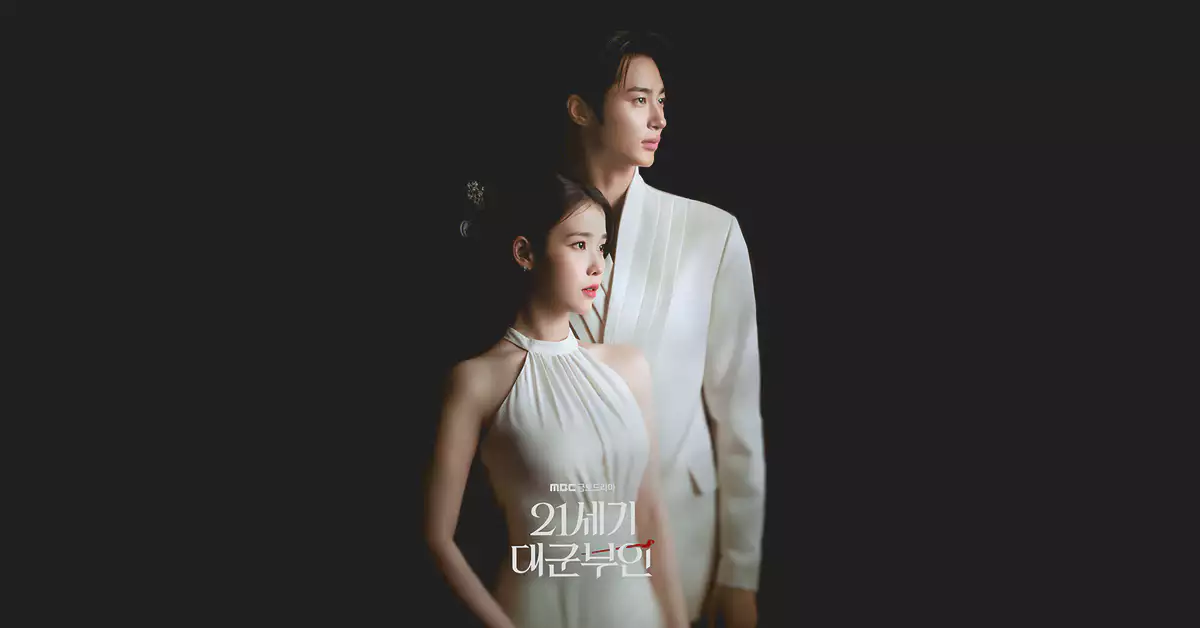
Perfect Crown
Power Without Inheritance: The World of Perfect Crown and What Each Character Wants
Note: The drama is officially titled ‘Perfect Crown’ in English, while its original Korean title is ’21st Century Grand Princess Consort’ (21세기 대군부인).
— Feature Analysis
Deep dive into the narrative
There is a particular kind of story that refuses to stay in its genre.
On the surface, Perfect Crown looks like a romantic comedy about class collision: a self-made heiress schemes her way into the royal household, a brooding prince resists everything including his own desires, sparks fly in a palace corridor. That reading is available, and it is probably enough to carry a Friday-Saturday timeslot.
But underneath the familiar architecture of the Korean romantic drama, something more structurally interesting is happening. The show has built a world with a genuine internal logic — one that uses the fantasy of an alternate Korean monarchy not as escapist decoration but as a pressure system. Strip the trappings away and what remains is a drama about the gap between the power you are born with and the power you take.
The World as Argument
The premise is deceptively simple. In this version of South Korea, Crown Prince Munhyo survived, ascended, and the royal lineage never broke. The result: a constitutional monarchy that made it to the 21st century intact, where aristocratic bloodlines still carry social weight and a chaebol worth billions is, technically, still a commoner.
What the show understands — and what makes this premise interesting rather than merely whimsical — is that the fantasy is really a diagram. Stack the three power structures against one another: royal authority (symbolic, ancient, untouchable), political power (institutional, maneuverable, generational), and capital (vast, modern, status-less), and the drama’s central argument becomes visible. None of these three forms of power is complete. Each needs something the others have. The collision between them is not an accident of plot — it is the plot.
Seong Hee-joo (IU): The Woman With Everything Except the One Thing That Matters
IU plays Seong Hee-ju, CEO of Castle Beauty and second child of the country’s largest conglomerate, and the character is constructed around a very specific irony: she is the most capable person in any room she enters, and in this particular world, capability alone cannot buy her a seat at the right table.
She is a commoner. She is illegitimate. And in a society where bloodline still functions as social infrastructure, those two facts eclipse everything she has built. The marriage market — which in this world is also a political market — does not care about her track record. It reads her paperwork and finds two defects.
The drama’s writers have made a sharp decision here. They could have made Hee-ju simply sympathetic — the underdog the audience roots for from a comfortable distance. Instead, she is abrasive, calculating, openly self-interested. “Better to win dirty than to lose clean.” She is not trying to reform the system. She is trying to use it better than the people who built it. That distinction matters, and it is what makes her interesting.
The character move that sets the story in motion is equally sharp. Faced with a marriage market that undervalues her, she doesn’t accept its terms — she escalates. If she has to play the game, she will aim for the highest-value piece on the board. She sets her sights on Lee An Daegun, which is either an act of audacity or an act of precision, depending on your angle.
Lee An Daegun (Byeon Woo-seok): The Man Who Learned to Want Nothing
Byeon Woo-seok’s Lee An is the drama’s counterweight, and his situation is the structural mirror of Hee-ju’s. Where she has everything except status, he has status in excess of anything he can actually use.
Second son of the king. Not the heir, not invisible — something worse: permanently adjacent to power, permanently excluded from it. The royal household trained him to suppress his own competitive fire, and he was disciplined enough to succeed. By the time the story begins, he is a man who has become very good at wanting nothing.
Then his brother dies. His five-year-old nephew becomes king. Lee An becomes regent, and the nickname follows immediately: the 21st-century Suyang Daegun. The historical reference lands with real weight in a Korean context — Suyang Daegun was the prince who orchestrated a coup and became Sejo of Joseon, a name attached permanently to both political acumen and moral ambiguity. The show is not being subtle about the structural trap it has placed its male lead in.
The meeting with Hee-ju functions as a recognition scene. Both are people who learned to want differently from what they actually desire. The difference is that she acts on the gap between her desires and her reality; he has spent years trying to eliminate the gap by eliminating the desire. The drama’s question, as far as Lee An is concerned, is whether that kind of self-suppression is discipline or damage.
The Third and Fourth Positions—Min Jung-woo (No Sang-hyeon) & Yoon Yi-rang (Gong Seung-yeon)—
Min Jung-woo (No Sang-hyeon) is the show’s most politically interesting figure — a Prime Minister from a dynasty of Prime Ministers who is nonetheless genuinely unpredictable. The character refuses the easier version of himself: he doesn’t play the election-season market visit, because he goes to those markets regularly anyway. He collects supercars. He shifts political allegiances without apparent anxiety. What’s visible from the outside looks like opportunism. What’s underneath, the show suggests, might be something stranger.
His friendship with Lee An is the drama’s load-bearing relationship outside the central romance. Two men who both understand the experience of wearing a public face that doesn’t match the interior — one by choice, one by royal obligation. The friendship has real warmth, and the show is clearly interested in what it costs them when institutional interests begin to pull against personal ones.
Yun Yi-rang (Gong Seung-yeon) is positioned as the drama’s structural opposite to Hee-ju. Where Hee-ju attacks the order from outside, Yi-rang has fully internalized it. Born into a family that has produced queens for generations, she has become the ideal product of that system — composed, unreadable, correct at every moment. The private counter-life she keeps, centered on an old and unspoken feeling toward Lee An, is the drama’s quietest engine. Her line — “If I had known you would become king, I wouldn’t have given up” — is one of the better character-establishing moments in the promotional material: efficient, revealing, slightly chilling.
What the Show Is Actually Asking
The ensemble the show has assembled is built around a single underlying question, and it is one worth taking seriously: what is the relationship between power and choice?
Hee-ju and Lee An are both people without real freedom — one because the system refuses to recognize her regardless of achievement, the other because the system has already decided his role for him. The romance between them is not incidental to this theme. It is the drama’s proposed answer. Two people who have each been denied the ability to simply choose find each other in the space where official structures don’t quite reach, and in choosing each other, discover what choosing actually feels like.
The Prometheus and Pandora references in the show’s promotional material are neither accidental nor decorative. Fire stolen, boxes opened — the show is interested in transgression as a human constant. The class order in this world wants to be permanent. The drama’s argument is that permanence is always a political claim, not a natural state.
Whether Perfect Crown delivers on that argument across a full season is a different question. But the architecture is there. The world is constructed with more deliberateness than the romantic-comedy frame usually requires. And in IU and Byeon Woo-seok, the show has leads capable of working in registers beyond the genre’s defaults.
The hammer is already in her hand.
FAQ
Key details about Perfect Crown (2026)
When does Perfect Crown air?
Perfect Crown airs every Friday and Saturday at 9:40 PM (KST) on MBC, running from April 10 to May 16, 2026, with new episodes released weekly across its two-night broadcast schedule.
Where can I watch Perfect Crown?
Perfect Crown is broadcast on MBC in South Korea and is available globally via streaming on Disney+.
Who are the main actors in Perfect Crown?
Perfect Crown stars IU, Byeon Woo-seok, Noh Sang-hyun, and Gong Seung-yeon, bringing together a cast that bridges established presence and emerging momentum in Korean television.
Is Perfect Crown based on a novel or webtoon?
Perfect Crown is an original series, written by Yoo Ji-won and developed from the winning script of the 2022 MBC drama screenplay competition.
How many episodes does Perfect Crown have?
Perfect Crown consists of 12 episodes, concluding with its final broadcast on May 16, 2026.