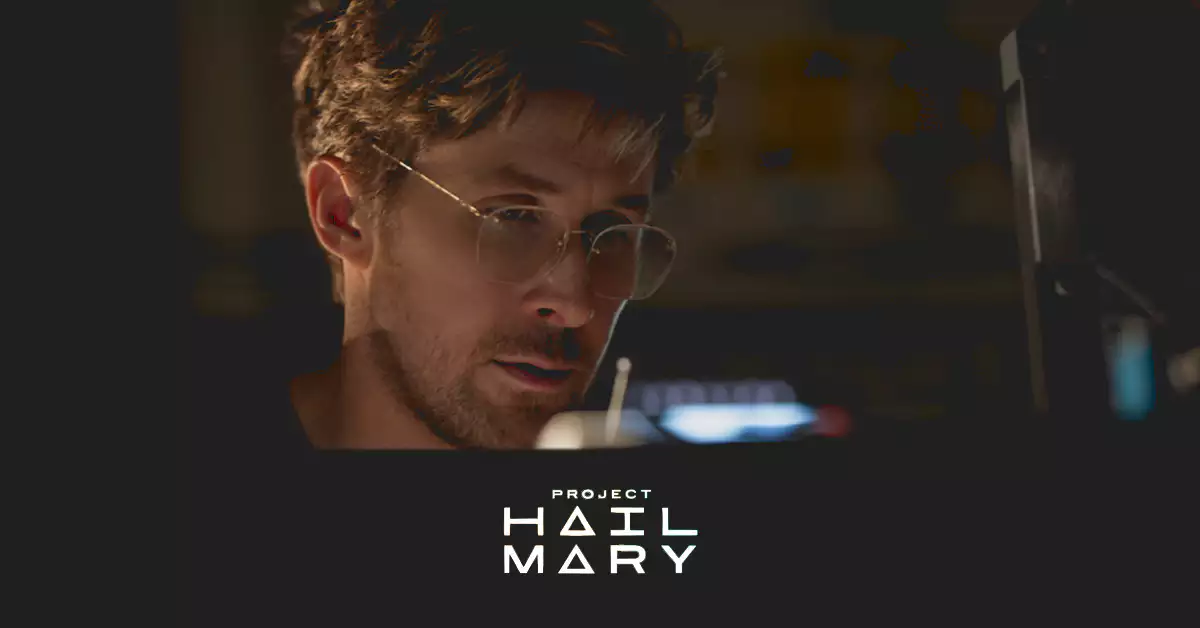
Project Hail Mary (2026)
On Phil Lord and Christopher Miller’s Project Hail Mary and what it costs to become legible
Ryland Grace wakes up and cannot remember his name. He cannot remember where he is, or why, or what the room he is lying in is for. What he can do is run a calculation. Without deciding to, without willing it, without any memory that this is something he knows how to do: he starts working out the problem in front of him. His mind functions before his identity does. Skills before selfhood. And the film’s opening question—the one it will spend two and a half hours answering—is whether these two things are separable at all.
The amnesia is usually discussed as a structural device, a way to reveal backstory incrementally without front-loading exposition. It is that. But it is also something else, and the something else is where the film’s actual argument lives. Grace does not know who he is. He has to find out. And the method by which he finds out—by watching what he does when no one is telling him who to be—turns out to be the same method by which he will eventually come to know Rocky. The film proposes that becoming known to another consciousness and becoming known to yourself are not two different projects. They are one project, run in parallel, using the same tools.
There is a scene early in the film in which Grace, still deep in the fog of recovered memory, delivers a eulogy for his dead crewmates. He barely knew them. He barely knows himself. He improvises in the way that people improvise when they have no script and cannot yet feel the full weight of what has happened: with humor, with deflection, with the odd comfort of human ritual being performed even when its meaning has not yet arrived. The eulogies are not good eulogies. They are also not unsuccessful ones. Something gets said. Something is honored. The film is not making a joke at Grace’s expense; it is watching him discover, in real time, that he is the kind of person who performs ceremony for the dead even when he doesn’t know who the dead are. That he does this—this specific thing, this small act of ritual dignity—is information about who he is. He discovers it by watching himself do it.
This is the film’s central formal operation, and it runs through every scene. Grace does not decide to care about Rocky. He finds out that he does. He does not choose to be funny in the face of fear; the jokes arrive before he has assessed the situation. He does not resolve that he will be an optimist—the optimism is there in the calculations, in the willingness to keep trying, in the quality of attention he brings to each new problem. He is always slightly behind his own character, catching up to himself through the evidence of his actions.
This creates a strange relationship between Grace and the audience. We are watching a man discover who he is in the same way he is: by watching what he does. The amnesia that might have been a gimmick becomes instead the film’s most honest proposition: that identity is not something you possess before your actions, but something you find out about yourself through them.
Rocky complicates this in the most productive way possible.
To communicate with a being whose perceptual world shares no reference points with your own, you have to start from zero. Not from what you know about language, not from your assumptions about how minds work, not from your intuitions about what another consciousness might want—from zero. The rulers and clocks and numbers, the mimicked movements, the homemade translation device: these are not clever solutions. They are the result of stripping away everything that was assumed. And what they require of Grace is not intelligence in the sense of having the right ideas. What they require is the willingness to stop being legible in the usual way.
This is the cost the film is actually tracking. To become legible to Rocky, Grace has to become, temporarily, illegible to everything else. He cannot rely on language. He cannot use the shorthand that humans use with each other. He cannot assume shared context, shared history, shared embodiment. He is as alien to Rocky as Rocky is to him. And this mutually alien condition is the condition the film is interested in—not as obstacle, but as the specific form that genuine encounter takes.
What it costs: the comfort of assumed understanding. The efficiency of dealing with someone who already gets your references. The ability to be lazy about clarity because the other person is filling in the gaps. Becoming legible to Rocky means accepting that nothing will be filled in, that every meaning has to be built from the ground up, that the relationship will only be as deep as the work that went into building the language it runs on.
What it produces: a relationship in which nothing is assumed. Which means, among other things, a relationship in which nothing is taken for granted.
Ryan Gosling’s performance is organized around what might be called the curiosity of the self-discovered. He plays Grace not as someone who knows who he is and is expressing it, but as someone who is perpetually interested in what he turns out to be. The jokes land the way they do not because Gosling is being funny in the service of character, but because Grace seems genuinely surprised that he’s funny, genuinely pleased that this turns out to be one of his available responses. When he laughs with Rocky—and the film earns those laughs slowly, across dozens of small exchanges, through the accumulation of shared problems and shared absurdities—the laughter has the specific quality of something unexpected. He didn’t know this was available to him.
The performance history matters here. Gosling has spent much of his career playing men who contain more than they reveal—whose interiority is present but withheld, whose feelings arrive at the surface in a compressed, controlled form. What changes in this film, and what makes it genuinely different from his earlier work, is that the withholding isn’t strategic. Grace doesn’t have a self to protect. He’s finding out what it is. The openness in Gosling’s performance is not vulnerability in the usual emotional sense; it is the specific openness of someone who doesn’t yet know what he’s going to feel and is genuinely curious to find out.
This is why the relationship with Rocky works at a level beyond the interspecies-buddy-comedy reading. Rocky is the person who eventually gives Grace’s self-knowledge its hardest test. Because when the question becomes whether to return to Earth or stay—and this is not a sentimental question, not a sacrifice question, but a question about who Grace has found out he actually is—the film has spent two hours building the only answer the character could give. The man who emerged from the amnesia, who discovered himself through the work of becoming legible to an alien, who found out he was funny and curious and loyal and incapable of leaving someone who needed him: that man cannot go home. Not because it would be wrong. Because home, he has found out, is not where he came from.
There is a parallel movement in the film that the argument about Grace almost makes you forget. Eva Stratt, in a bar, with colleagues, in an unplanned moment mid-project, chooses a song. The choice is immediate, uncalculated—and immediately legible as something true about her that her professional mode keeps out of sight. Sandra Hüller plays Stratt with bone-dry calculation for most of her screen time, and in this moment lets something else through without appearing to try. Grace watches and recognizes it, because he is, without knowing it yet, becoming the kind of person who notices when a self emerges through action rather than intention.
The problem I keep running into is that Stratt goes back. The administrator returns. The warmth the song briefly allowed to become visible closes again. If identity is discovered through action, the discovery doesn’t seem to hold for her, or at least the film doesn’t show it holding. Either the self that emerged in the karaoke bar wasn’t her real self—it was a temporary departure—or identity is more contextual than the essay’s argument allows for. Stratt is the film’s minor key, and it keeps playing against what I’ve been claiming.
“We need a new word.” The phrase arrives near the film’s end, and has been read as charming, as funny, as the appropriate coda to a story about the limits of existing language. All of this is right. But there is something else in it, something more uncomfortable. The absence of a word for what Grace and Rocky are is not a gap in the lexicon. It is evidence of genuine novelty. Something has been made that did not exist before, that does not fit the existing categories, that requires new vocabulary because the old vocabulary was built to describe old kinds of things.
This is what the film proposes is possible—not as aspiration, not as wish-fulfillment, but as the specific consequence of the work it has shown us. If you strip away assumption, if you build from zero, if you stay with the difficulty of making yourself legible to a consciousness that shares nothing obvious with yours, what you get at the other end is not understanding in the usual sense. You get something that requires a new word. The category of friend doesn’t cover it because friend assumes a prior similarity, a shared world that the friendship operates within. What Grace and Rocky have is prior to that. It is the relationship that made the shared world.
Then the film gives us its actual final image. Grace wakes to an alarm, on a planet that is not Earth. Rocky knocks. And then: a classroom, and students who look like Rocky, and Grace standing where he always stood—at the front of the room, with a question. “What’s the speed of light? Who can tell me?” The Eridn students move their appendages in something that might be eagerness. Grace smiles. Applauds. Blackout.
The film began with Grace as a teacher on Earth. It ends with Grace as a teacher on Erid. I had thought, writing the earlier sections of this essay, that I knew what this meant: the actions through which Grace discovered himself had pointed, all along, to the person who stands in front of a room with a question. The discovery, arrived at.
But here is what I hadn’t accounted for. Grace eventually gets his memories back. Not all at once—slowly, in the flashback structure running through the film—but by the end, he knows who he was before. And who he was matches who he found out he was. The Ryland Grace who fled academic controversy to hide in a middle-school classroom is recognizably the same person as the Grace who built a translation device from a ruler and a clock and couldn’t leave his friend.
Which means the amnesia might not be revealing discovery at all. It might be revealing essence. The film might be saying: strip away memory, strip away biography, strip away everything accumulated on top—and what remains is who you really are. Which is not identity constituted through action. That is identity as something prior to action, something the actions only clarify.
I can’t settle this. The film holds both readings available and doesn’t adjudicate between them. If discovery: Grace earned who he is through the work of the film. If revelation: he always was who he is, and the amnesia was the instrument that made it visible. The question of which is true changes everything the teaching scene means—and I’m watching the Eridn students raise their appendages, and Grace smiling, and the screen going dark, and I cannot tell which version I’m seeing.
What’s the speed of light? Who can tell me? Something new was made, and there is still no word for it. Whether the man asking the question knows exactly who he is, or whether the film has simply arranged for him to look like he does—the blackout arrives before I can be certain. That uncertainty might be the most honest thing I can offer about a film that is, underneath its warmth and its humor and its enormous heart, genuinely strange.