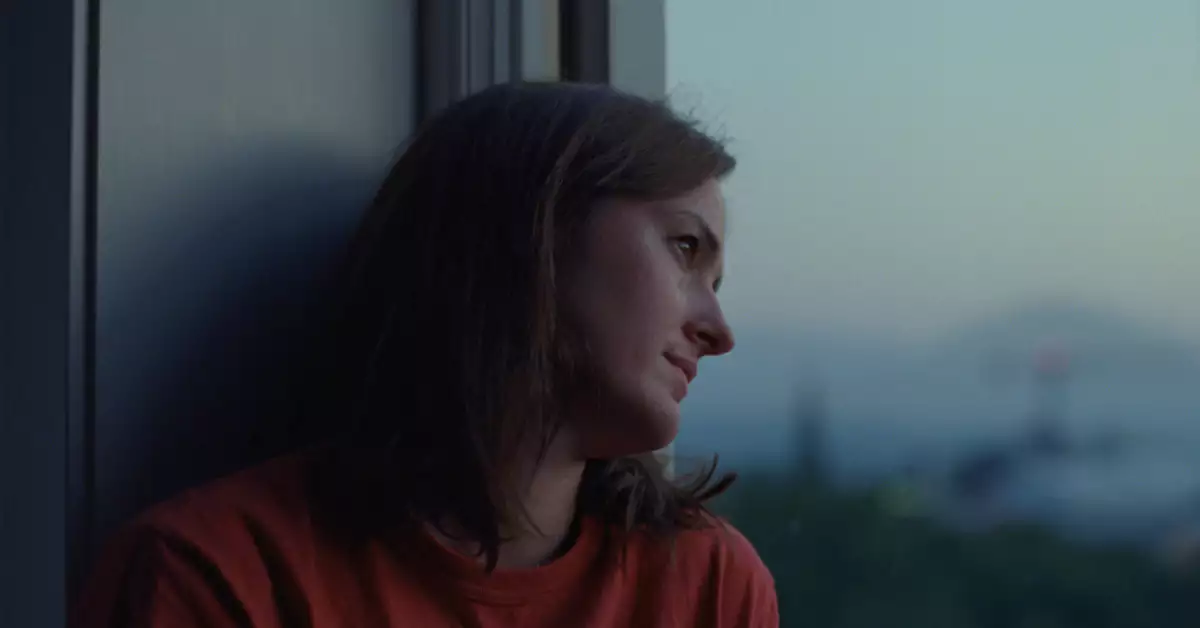
On Joachim Trier’s Sentimental Value and how people learn to feel through form
A dress tears. Nora, minutes from taking the stage, in a panic that has arrived not as feeling but as physical fact — the silk splitting, the structured form of the performance costume giving way at the seam. A stage manager appears, and a wardrobe person, and they address the tear with the speed of professional problem-solvers: duct tape, assessment, the calculation of what holds and what doesn’t. Nora is pushed onto the stage.
What the scene shows is not that the performance must go on — that’s the institution talking, and every film about theater finds a way to say it. What it shows is more specific: Nora panics at the seam between her private self and the public one. The dress is the seal. When it tears, what leaks is something she cannot manage. The crew tapes it back. The seal holds. She goes on — not because she has resolved the panic but because the institution has absorbed it, repaired the container, and moved the contents to where they need to be.
This is how Nora lives. Not in resolution but in the ongoing management of the seal.
Her father has a different system. Gustav, played by Stellan Skarsgård with an intelligence that refuses sympathy and refuses contempt in equal measure, processes nothing directly. When he was seven, he came home, knocked on a door, and saw something in his mother’s face he didn’t have the language to read. He went back outside. She went back in. The door closed. What he has spent his working life doing is returning to that door — not to the house, not to his mother, but to the door — with a camera. He has made films about grief, about mothers, about old houses and what they hold.
In a cinema — a retrospective screening of an old film of his — he sits with the refusal Nora has just handed him. The film cuts, and there on the screen is Agnes as a child: his direction, her face, something he made decades ago from the particular material of a daughter’s childhood. And he is moved. Not guilty. Moved. The art is alive to him in a way that his family is not, and this is not callousness. It is the consequence of having organized the self around the formal act of making. Gustav processes through cinema. The editing suite, the careful distance of aesthetic control, the years that stand between experience and finished work — all of this gives him a container in which what would otherwise be unbearable becomes, instead, material. He does not feel his grief directly. He converts it.
The conversion is what makes life manageable, and the conversion is also what made him a filmmaker, and the conversion is also what made him a failure at the ordinary negotiations of family life.
Nora and Gustav are the same person running the same compulsion through different machinery.
This is what the film quietly insists on and what Nora cannot bear to acknowledge. She has built a remarkable stage career not despite what she inherited from her father but because of it. She too requires a container for what she feels — the role, the script, the stage, the audience. She too can only access certain registers of emotion through formal structure. She too has learned to feel at one remove from direct experience.
Their apparent opposition is a sameness running through different instruments. His is slow, mediated, aestheticized over years; hers is immediate, unrepeatable, present-tense but still formal, still held by the container of the performance. She performs her grief. He films it. The difference is in the speed of the conversion and the degree of control; the underlying structure is the same.
When Nora reads his script and sets it down, what she is recognizing — before she has articulated it, in the body, before the words — is herself. Not her grief. Herself. The specific shape of her compulsion, reproduced in a different instrument, pointed at shared material. She sees, in his formal structure, the formal structure she uses. And she refuses not because the script is wrong, not because the art isn’t good, but because accepting the role would mean submitting to his container. It would mean letting his mediation organize the material she holds through her own.
He has aestheticized his failure at fatherhood. She has built a career on the same kind of displacement. His request is that she now let him aestheticize her, too.
Rachel Kemp arrives from Los Angeles and appears, for a time, to offer a way through. She is American. She doesn’t speak Norwegian. She has no stake in the history of this house, this family, this specific grief. Elle Fanning plays her with the quality of someone genuinely present to what is in front of her — not performing presence, but having it. She is the ideal formal vessel: capable, skilled, unencumbered by prior content.
And the material gets through to her — partway. During a script reading, she enters the character’s grief with such intensity that she is moved to tears, and the woman Gustav has placed beside her, a stranger named Ingrid who was only there to receive her gaze, is drawn in too. The two of them — who share no history, no family, no connection to this house — find themselves embracing as if they were mother and daughter. Afterward, Rachel turns to Gustav and says something he hadn’t expected: she wants there to be a mother in the scene to hug. Something shifts in his face. She has named, from the outside, what he didn’t fully know he’d written: not only a son who failed to stay, but a child who needed a parent to be present. Through the material, and through her, something got through to him.
But she cannot find what the film’s central scene requires. She understands the grief. She cannot understand why a mother who has a loving son would choose to die while he’s at school. This specific logic — the interior architecture of that particular choice — is not accessible from the outside. And eventually she names something else directly: she points out that Gustav had asked her to dye her hair the same color as his daughter’s. He had been trying to make her into Nora. Both of them arrive at the same honest recognition, from different directions. She steps back. He admits he let her down. What she couldn’t reach, and what he had been unable to stop asking for through her, Gustav and his daughters carry in their bodies — transmitted not through explanation but through the particular quality of a childhood shaped by this kind of loss.
The passage Rachel read aloud passes to Nora. It ends with something that sounds like a confession: I need home. I need to have a home. Nora reads it aloud — at Agnes’s request, not Gustav’s — and what stops her mid-reading is not only her father’s loneliness. The passage captures something Gustav had no way of knowing to write: the specific quality of a crisis Nora has felt in her own body, in a room Gustav was not in, where Agnes was. He wrote it without being present for what it echoes. She sets down the pages. She agrees. She performs.
Agnes works in the national archives. She reads testimony. She sits with documents recording what her grandmother Karin said after surviving the occupation — surviving, and then not surviving the survival — and she reads in the specific language required to make experience into record. She reads and does not convert what she reads into anything else. She goes home to the house and keeps it in order.
Neither Gustav’s cinema nor Nora’s theatre is available to Agnes as a mode of managing what she holds. She holds it without managing it. The history is present in her body and she doesn’t turn it into anything. She is doing something that has no audience, no formal structure to receive it, no container to make it transmissible. She is with the grief without form.
Trier films Agnes with the awareness that the camera is itself a problem here. Every frame that includes her includes the question of what the camera does when it turns toward someone who refuses to convert experience into form. The camera has no neutral mode; it makes of everything it sees a representation, a formal object, a material. Agnes resists this. The film can describe her but it cannot quite reach her without doing the very thing she refuses. She is the figure the film needs and cannot hold.
The film-within-film ends. The version Gustav has made — in which the boy comes back for a forgotten phone, and the mother says go, and the scene cuts before what happens next — is done. The death doesn’t happen on screen. It happened in history. These are different things, and the gap between them is what Gustav has spent his career standing inside.
He calls cut. And Nora and Gustav look at each other across the set.
I have been arguing that these are two people who can only feel at one remove — who have organized themselves around formal containers so thoroughly that direct experience without mediation has become something close to impossible for them. And the film put this to the test: the material required someone who carried the wound from the inside, not just someone with emotional availability. Rachel knew the passage. She didn’t know what the passage knew about Nora. The formal container alone was not enough. Nora came. She performed not cleanly — she performed truly, which is different. The container held. The conversion happened. And now the cut has been called.
What I expected the film to show: two people who don’t know how to be without their instruments, looking at each other across a gap that form has spent a lifetime widening.
What the film shows: something I cannot name with the vocabulary the essay has built. Not forgiveness. Not resolution. Not the catharsis that Trier has made too many careful films to offer. Something more modest and stranger — the bare fact of attending to the same moment at the same time, stripped of formal structure. The essay doesn’t have a word for this. The argument predicted it would be unbearable. It isn’t, quite. Something passes between them that the argument doesn’t account for, and the film rests there without explaining it.
The door in Gustav’s film stayed open a few seconds longer than the real door did. The door in the house closed on a summer day decades ago and is still closed. Agnes keeps the house. Gustav keeps making films. The seal on the dress is repaired, and Nora goes on.
What the camera cannot contain: the moment after the cut, stripped of form, the specific quality of two people looking at each other with nothing left to perform. The camera shows it anyway. It records. It cannot reach what it records. It goes on.