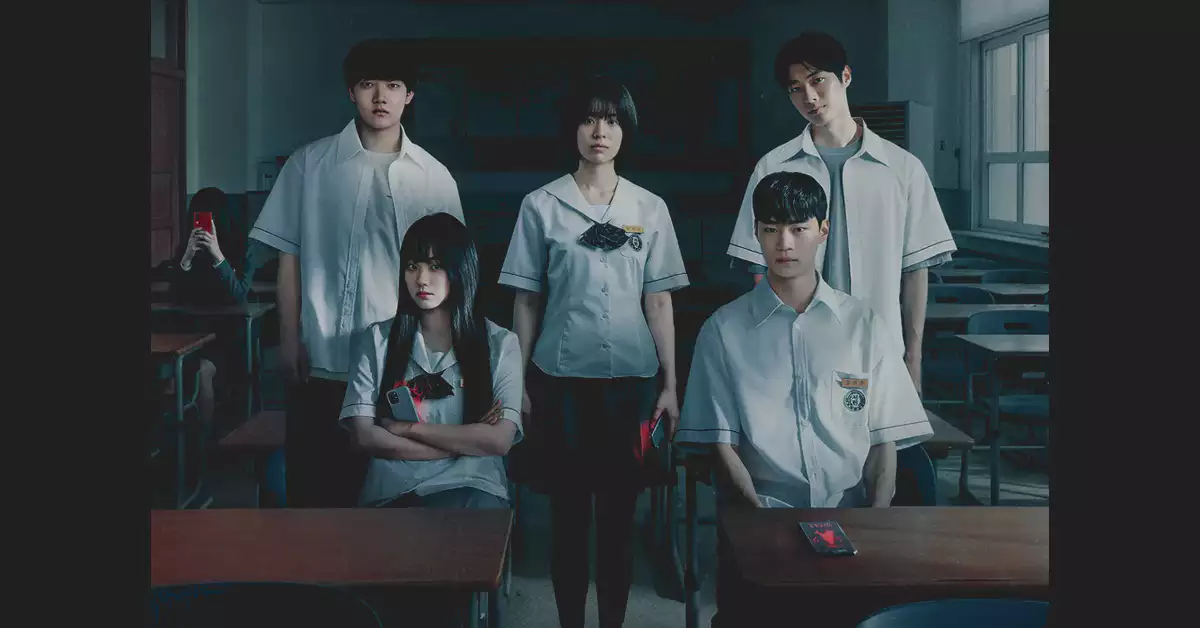
Netflix | 8 Episodes | April 24, 2026 | Full spoilers throughout. For plot summary, cast, and ending explained: see [If Wishes Could Kill — Review & Complete Guide].
At some point, the curse lost its face.
In the horror films that defined the genre’s last century, curses lived in things you could point to: abandoned wells, rotting houses, objects stained with old grief. They required a physical encounter, a moment of trespass, a door that shouldn’t have been opened. If Wishes Could Kill relocates all of that to a smartphone application, and the move is more unsettling than it first appears — because the app called Girigo doesn’t feel foreign. It feels like something we already use.
We live, after all, inside interfaces that predict our desires before we’ve formed them. Algorithms suggest what we want to watch next; recommendation engines have learned to anticipate preferences we haven’t articulated; search engines complete our questions before we finish asking. The digital world has built itself around the logic of desire: enter what you want, wait for the result. If Wishes Could Kill takes this landscape as its starting point and asks what happens when that loop closes with absolute literalism. You enter a wish. The wish is granted. And then you pay.
The show’s intelligence begins with the scale of its first wish.
Choi Hyeong-uk is not a student who wants to rule the world, achieve immortality, or undo some past catastrophe. He wants to score well on a mathematics exam. That’s it. The smallness of the desire is the point. If Wishes Could Kill doesn’t traffic in grand villainous ambitions or mythic bargains with supernatural powers. It begins, deliberately and precisely, with the most ordinary kind of human lack: the gap between who you are and who you want to be, measured in a single test score.
The curse doesn’t require extraordinary people. It requires ordinary ones.
What makes the Girigo system genuinely disturbing — more disturbing than any single horror sequence in the show — is the way it refuses to let desire stay private.
We tell ourselves that what we want is our own business. A wish, by definition, seems like the most interior of acts: a thought you hold before it becomes action, a hope that exists only in the space between your mind and the world. But If Wishes Could Kill insists otherwise, methodically. Every wish in the series moves outward and lands somewhere else. Kim Gun-u wishes for his girlfriend’s training schedule to be cancelled — a gesture framed as love, and maybe it is — and that wish becomes the mechanism by which another person’s timer begins. Im Na-ri makes a wish she doesn’t believe will work, less out of malice than out of something like boredom and alcohol and the need to perform indifference to things that have hurt her. Two people die because of it.
The show returns to this again and again: the wish you make in private becomes the catastrophe someone else inherits. Desire, the series argues, is not a solitary act. It has always been relational. The only thing that changed is that now there’s an app to make the causality visible.
Na-ri is the character the series handles most carefully, and most honestly.
She is not a villain in any useful sense. The word implies intention, a plan, a sustained commitment to causing harm. Na-ri has none of that. What she has instead is a version of something much more familiar: the loneliness of someone who has never quite found her footing inside the group she wants to belong to, who watches the relationships of others with a mixture of longing and resentment she can’t fully separate, who has learned to perform a kind of social confidence that masks how precarious her actual position feels.
The moment she opens Girigo and makes the wish, she does not believe it’s real. She is doing something closer to shouting into a void, testing whether anyone is listening, performing skepticism to prove the whole thing is as meaningless as she suspects. The cruelty of the series — and it is genuinely cruel here, in the way good drama can be — is that the void answers.
In the digital age, the distance between imagination and consequence has collapsed in ways we’re still learning to account for. A message sent in a moment of anger doesn’t disappear when the anger fades. A post published in a moment of pain doesn’t retract itself. If Wishes Could Kill encodes this collapse into its central mechanics. Na-ri’s joke becomes a death. The question of responsibility, when the gap between intending and causing has narrowed to almost nothing, doesn’t resolve cleanly. The show doesn’t let it.
Underneath the wonhon and the spirit gates and the procedural investigation for the red phone, what If Wishes Could Kill is actually about is memory.
Girigo is not really an application. It is a storage device for unprocessed grief — for the grievances, betrayals, jealousies, and regrets that communities accumulate and never quite expel. The show’s structure makes this argument formally: only once the audience has watched the present-day consequences for several episodes does the series go back to reveal the origin, and what it reveals is not a monster but a sequence of wounds inflicted between people who were, once, genuinely close to each other. The curse didn’t begin with evil. It began with ordinary human pain that had nowhere to go.
The flashback at Seorin High School, placed with deliberate strategy at the show’s midpoint, functions as a near-standalone short film — a complete story of two teenagers, Kwon Si-won and Do Hye-ryeong, whose friendship breaks in a way that neither of them fully intended and both of them fully caused. Si-won exposes something private about Hye-ryeong. Hye-ryeong, in the aftermath of that exposure, reaches for the only instrument of restitution available to her. Both of them are wounded. Both of them wound. The curse that follows is not punishment for villainy. It’s what happens when pain has nowhere to go and a means to go somewhere finally appears.
This is the insight the show’s horror is built around: the curse is not something that arrives from outside. It grows from the inside, fed by what communities fail to address, carrying forward unprocessed across years and generations until the debt comes due.
The sequence in which Se-a passes through the honmun — the three spiritual thresholds required to sever her bond with the curse — is the series at its most mythologically deliberate.
The warning is categorical: do not look back. Whatever appears behind you, whatever voice calls out, do not turn.
The warning is, of course, as old as myth itself. Orpheus descended to retrieve Eurydice from the dead with the same condition: walk forward, do not look back. He looked back. She returned to death.
What makes the parallel more than decorative is that the show understands why Orpheus looked back — and why Se-a does the same. The prohibition is not unreasonable. It’s impossible. You cannot walk away from the people you have loved and lost without wanting, at least once, to see them again. Se-a’s parents are behind her in the spirit threshold — the specific shape of a grief she has been carrying since a car accident she survived and they didn’t. The honmun is not a test of bravery. It’s a test of whether you can stop looking backward long enough to move.
The curse, this scene proposes, is not only something inflicted on Se-a from outside. It is something she has been partly sustaining herself — the force of a past she hasn’t been able to release, holding her in place.
The series’ sharpest structural move is the reversal it saves for the final episodes.
For most of its run, If Wishes Could Kill arranges its evidence to suggest a relatively legible origin story: a victim’s curse, a dead girl’s revenge, a straight line of causality from Hye-ryeong’s suffering to the present crisis. The reveal that Kwon Si-won — not Hye-ryeong — created the Girigo application complicates this considerably. The victim and the architect turn out to be the same person, and the architecture turns out to have been built from something other than innocence.
What the show is reaching toward here aligns with a shift that has been developing across the most interesting work in Korean horror over the past decade. The monster used to come from somewhere else — from the margins, from the supernatural, from a force that could be cleanly opposed. Increasingly, the genre’s most compelling entries locate the threat in the center of the community, in the accumulated damage done by people to each other, in the wounds that pass between people who are not strangers. There is no figure here who is simply guilty. There are only people who hurt each other, and the instruments that made those hurts permanent.
If Wishes Could Kill is not without its failures.
The back half of the series accelerates in ways that don’t always serve the story — setups compressed into scenes that needed longer to breathe, resolutions that arrive before they feel fully earned. The shamanic cosmology that powers the show’s mythology is rich, and occasionally the series leans on it without doing the work of making its rules feel fully coherent. These are real weaknesses, not minor ones.
But the ambition underneath those weaknesses is also real. The show is trying to combine the social specificity of the teen ensemble with the metaphysical weight of folk horror, to make the emotional logic of a high school friendship group continuous with the emotional logic of a generational curse. That it mostly succeeds is not something to be casual about.
What the series is ultimately asking is a question it never states directly.
Is your wish truly your own?
And if someone else pays the price for it — if the desire you thought was private and interior and harmless turns out to cost something that you never intended to spend — can you still call it a wish? Or does it become something else, at that point? Something closer to a debt incurred before you understood what you were signing?
The Girigo app is a horror device. But it is also, less comfortably, a mirror. The interface in which you enter your desires and wait for results is not science fiction. It is the basic structure of the digital world we inhabit — accelerated, literalized, made fatal. What If Wishes Could Kill argues, underneath the curses and the spirit gates and the red phone, is that we have always been living in this system. We just didn’t have a word for what it cost.
The screen goes dark. The curse is broken. Two desks remain empty.
What stays with you is not the horror. It is the question of what you wanted, and who paid for it, and whether you knew.
See also: [If Wishes Could Kill — Review & Complete Guide] · [What We Ask For: The Moral Geometry of If Wishes Could Kill]