On Lee Jong-pil’s Pavane and the grief that can only exist when you know what you’re mourning
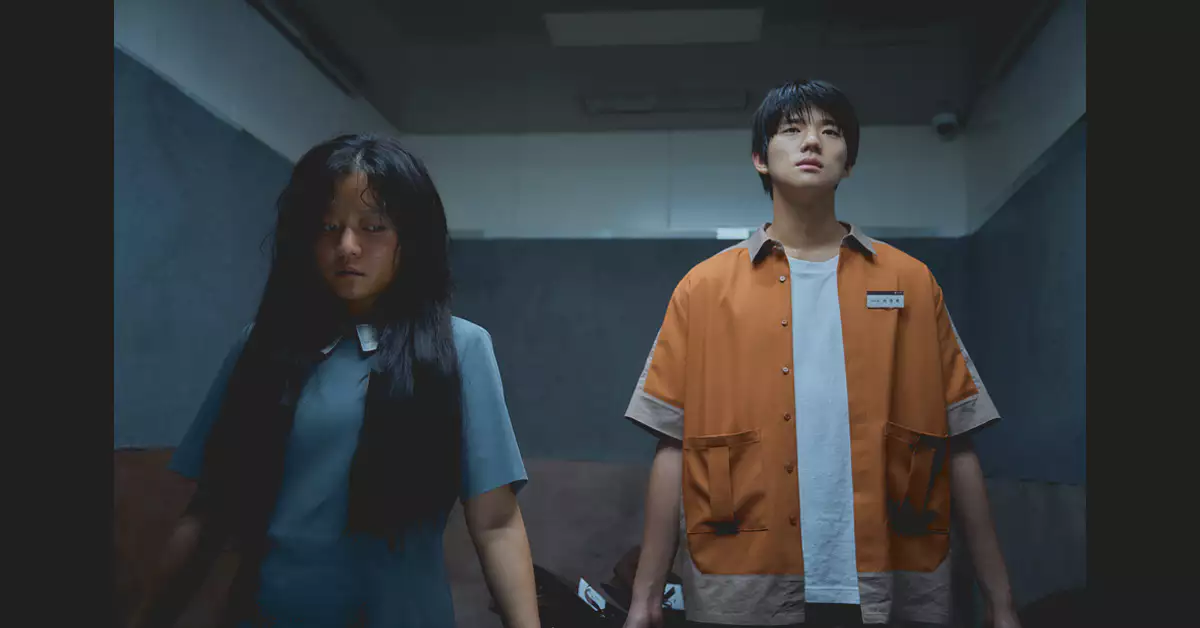
The department store’s walkie-talkie system runs on a protocol of ironic call signs. “Kindness” is one department. “Touching” is another. The formal communication of a retail hierarchy dressed in words that describe what the store’s social economy denies to certain of its workers: the dignity of being treated with kindness, the acknowledgment of being touched by anything other than contempt. Mi-jeong (Ko A-sung) — who works in the basement, who has been shuffled between departments that would not have her, who is called “dinosaur” by colleagues who find her solitude somehow threatening — calls herself into this system every day. Kindness, basement storage here. Understood.
She doesn’t have a phone. She got rid of it because the only calls she ever received were from debt collectors. So when Yo-han (Byun Yohan) wants to give Gyeong-rok (Moon Sang-min) a way to reach her, he sets up a dedicated walkie-talkie channel. Channel 17. A private frequency, or what they believed was a private frequency.
Testing. Kindness. Touching.
And then: I like you, Mi-jeong.
A beat of silence.
I like you too.
I told you to switch the channel. Damn it.
The love confession of two people who had organized their entire lives around the expectation of invisibility was broadcast to every department in the store. The most private thing either of them had ever said was simultaneously the most public declaration either had ever made. Pavane, Lee Jong-pil’s film now streaming on Netflix, is a film about this kind of transmission — what gets through, to whom, and what the failure of transmission costs.
Mi-jeong lives in a room without a mirror. Not because she can’t afford one but because — as Ko A-sung worked out in preparation for the role — she is someone who does not look at herself by choice. When she needs to check her appearance, she goes to the bathroom and uses the mirror on the wall there: the one she didn’t install. A mirror that exists independently of her will. When she begins wearing makeup — in the tentative, surprised phase of being newly in love — she improvises with the mirror on an armoire door, pulling a small table up to it and spreading her things across it. A mirror she found, angled for a different purpose. The camera sees this arrangement and understands that Mi-jeong cannot look at herself in a way that she chose.
What Gyeong-rok does, by contrast, is almost shockingly simple. He looks at her. He asks about her voice, her lunch, the radio station she listens to. The script, as Ko A-sung noted, doesn’t contain a single line in which Gyeong-rok evaluates how Mi-jeong looks. He sees her — not her appearance, but the thing beneath it — and this is the most disturbing and destabilizing event of her adult life.
She listens to FM 93.1 because it doesn’t play commercials. In a building that exists to sell things to people, in a city that exists to organize people into buyers and sellers, there is this frequency that doesn’t interrupt the music with the demands of commerce. She found it the way people find small private refuges: by accident, by necessity, by the specific quality of relief that comes from finding the thing that doesn’t ask you to want something.
This is Mi-jeong’s interior life: invisible when she chooses it, heard only by strangers when the radio speaks to no one in particular. And then channel 17 accidentally becomes public. And then Gyeong-rok confesses his feelings at the top of his voice at a snow-covered bus stop — having stepped off the bus still idling behind him — because some things cannot wait for the right moment. And then their love is announced to hundreds of people before they have had a chance to understand it themselves.
The film turns on a story Mi-jeong tells Gyeong-rok early in their acquaintance. He has been talking — more than he expected to — about his situation: the parking lot job, the dance career he set aside, the money he’s saving to see the aurora in Iceland because he watched a video about it after his military service and something in him didn’t let go. He is a young man whose soul is somewhere behind him, trying to wait without knowing how long waiting takes. And Mi-jeong — who has received very little from the world, who has been given no reason to offer anyone anything — gives him something.
When riding at speed, she tells him, a Native American horseman might stop and get off — not to rest, but to wait for his soul to catch up. A soul can fall behind. You have to give it time to find you again.
Something happens in Gyeong-rok’s face. But the more interesting thing is what happens in Mi-jeong’s face as she says it. She has just offered someone a framework that also applies to herself. Her life has not been a failure of ambition. She has been waiting for something she couldn’t name, and the act of naming it for someone else is one of the ways people learn what they have been feeling.
The story returns at the end of the film, in the mouth of Yo-han, the friend who survives to write the book that tells the story we have just watched. He says it about Gyeong-rok. Perhaps he got off the horse for a moment. Maybe he’s waiting for us somewhere. Yo-han has taken what Mi-jeong gave Gyeong-rok and converted it into the only way he can bear to say that his friend is dead. The metaphor has migrated: from a gift Mi-jeong offered, into something Gyeong-rok carried, into a way of grieving Yo-han now holds. And through the book, it returns to Mi-jeong. She gave it. It traveled. It comes back.
Yo-han tells another story earlier in the film, in a bar. As he tells it — reaching the moment when only the fridge light is left — he turns the lights off himself. He calls it the real ending of Cinderella. The prince leaves. Cinderella stays. She raises the child alone, fills the refrigerator with cabbage and radishes and green onions — kimchi ingredients for a child who will only eat her food — and then she dies. The child doesn’t cry at the funeral. They come home and throw everything out of the fridge. The night goes pitch-black. The only light is from the open refrigerator door. And it’s only when the child stands there, alone in the dark, staring at that fridge light, that the tears come.
This is Yo-han’s theory of grief. It doesn’t arrive in the public moment of loss. It comes later, in private, when you are alone with the remnant — the light from an empty appliance, the memory of food someone made for you — with no one left to witness you.
He tells this story and the lights come back on and they don’t discuss it again directly. But it is the film’s theory of mourning, stated plainly before the mourning has begun. And it applies to Yo-han himself, who wears wristbands that hide old scars from losses he has never been able to speak directly. He knows this darkness from the inside.
Here is what happened. On December 24th, Gyeong-rok found Mi-jeong’s address and went to find her. They reconciled, made plans for New Year’s Eve, for everything after. He was going home. On the icy road, his bus collided with a truck. Mi-jeong didn’t know any of this. On New Year’s Eve, she stood outside Kentucky Pub — their bar — and waited through the day and into the dark, until only the streetlight remained. He didn’t come.
Mi-jeong had been trained, over the course of a lifetime, to expect exactly this outcome. She had been shuffled between departments that wouldn’t have her. She had been called a dinosaur. The loan shark had told her she wasn’t even worth selling off. The world had spent thirty-some years installing in her the conviction that when someone doesn’t show up, it’s because you weren’t worth showing up for. She waited, and then she left. She believed she had been abandoned.
This is the film’s cruelest formal gesture: the gap in transmission. What happened to Gyeong-rok couldn’t reach Mi-jeong because he couldn’t send it. She received only his absence. And from his absence, she constructed the most available explanation — the one she had been rehearsing her whole life.
She didn’t truly lose him on December 24th. She lost him years later, reading Yo-han’s novel. That was when she found out. That was when she could stand, as it were, in the dark kitchen, alone, staring at the fridge light.
“The ending,” she tells Yo-han on the phone. “It’s too much of a happy ending.” In the novel, Gyeong-rok survives the accident but loses much of his memory. Mi-jeong knows this isn’t what happened. The real ending is harder. But the book has given her, at last, the correct information: not abandoned. In an accident. He came.
“I wanted to write it that way,” Yo-han says.
The film ends with Yo-han being interviewed about his book, five years on. He is asked whether his two friends are doing well. A pause. “Of course. Because youth lasts forever.”
This is not quite a lie and not quite a truth. The book has made Gyeong-rok and Mi-jeong permanent in the way that written things become permanent — fixed in the specific moment they occupied, prior to the accident, prior to the departure, when they were alive together in the strange and difficult fact of being loved by each other despite having no practice at it. Youth lasts forever because the book commits it to paper. The book is the proof.
The book’s title is Pavane for a Dead Princess. The same as the Ravel piece. The pavane, as a dance form, requires that you know you are being watched — every step deliberate, every movement shaped by the awareness of an audience. Ravel wrote his version as an imagining of a princess who may never have existed, performing the dance for no one. The music doesn’t mourn someone real. It mourns a possibility.
The aurora in Iceland — which the director shot himself, no crew, just the two actors and a camera bought on arrival — was captured this way because it couldn’t be captured any other way. A full production apparatus would have made it spectacle. This required a different kind of witness: a single person watching two other people, at the edge of the world, stripped of everything except the willingness to see. The aurora is Yo-han’s imagination of what Mi-jeong and Gyeong-rok had together: the imagined moment, now recorded, now permanent.
What I find I cannot settle, looking back at this film, is the arithmetic of Mi-jeong’s grief. She reads the book and now knows she wasn’t abandoned. This is the correct information. But for the years she didn’t have it, her grief was the grief of rejection — and you cannot simply exchange one grief for another. The new information arrives in her body alongside the old. She knows now. She carries now what it feels like to have known the wrong thing for that long. And you cannot subtract the years the wrong knowledge occupied.
The dancing continues. The pavane continues. Youth lasts forever, and it also ends. Both things remain true simultaneously, without resolution, the way Ravel’s music holds both the imagined princess and the certainty that she’s gone — present the way things we loved remain present, which is to say: imperfectly, indelibly, in the gap between what we know and what we still feel.