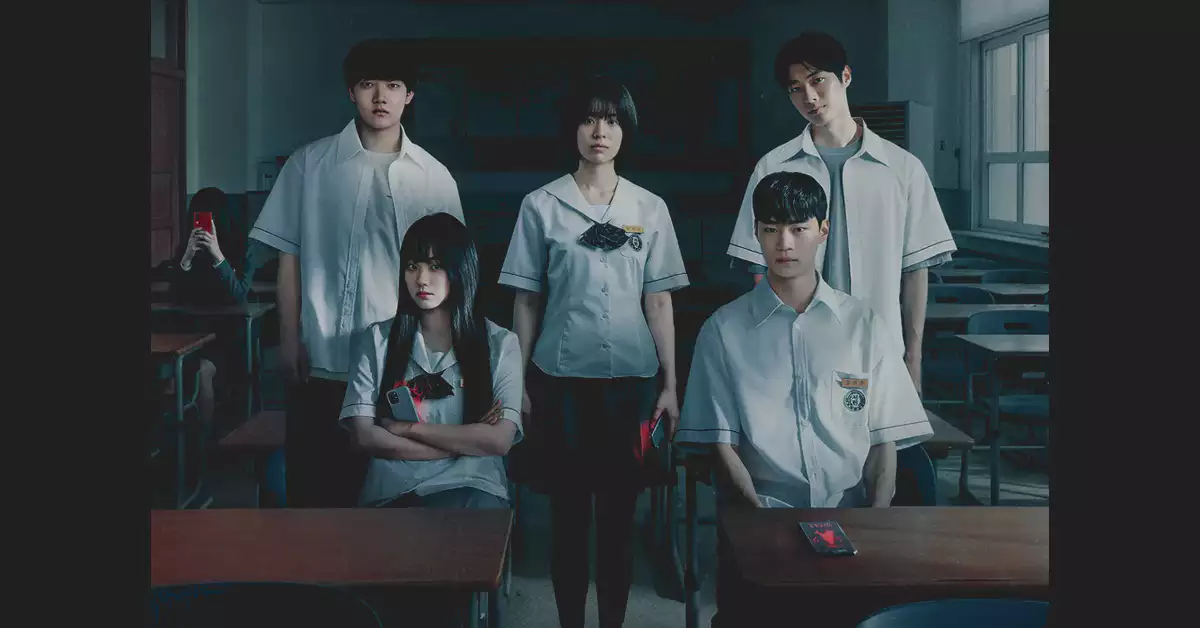
| Platform | Netflix (Global) |
| Episodes | 8 (complete) |
| Premiere | April 24, 2026 |
| Genre | Korean Supernatural Horror |
| Director | Co-directed by Park Yoon-seo (박윤서) |
| Language | Korean |
| Cast | Jeon So-young, Baek Sunho, Kang Mina, Hyun Woo-seok, Lee Hyo-je, Jeon So-nee, Roh Jae-won, Lee Sang-hee, Kim Sia, Choi Ju-eun |
| Rating | ★★★★☆ 8.2 / 10 |
First, the Honest Assessment
If Wishes Could Kill is not a perfect series. It is, however, a remarkably well-engineered one — and in a genre where competence is rare, engineering matters. By the time the finale arrives, the show has successfully pulled off something genuinely difficult: it has layered traditional Korean shamanistic mythology under a teen ensemble format, sustained that combination across eight episodes without losing either tone, and structured its storytelling with enough formal intelligence to reward repeat viewing.
Netflix ranked it #1 in non-English programming. That figure reflects genuine quality, not just algorithmic luck.
This review covers everything — plot, analysis, the ending explained, and what the post-credits scene sets up for a potential Season 2. Full spoilers throughout.
The Premise: What Is the Girigo App?
The Girigo (기리고) app grants wishes. That’s the surface pitch, and it’s intentionally ordinary — there’s no dramatic introduction, no sinister marketing, no demonic interface. The app simply appears on a phone, accepts a name and birthdate, and listens.
What the app doesn’t tell you: every granted wish starts a countdown. When that timer expires, consequences arrive. The most severe outcome, for the most transgressive wishes, is death within 24 hours of fulfillment.
The show reveals one more rule gradually: when a new wish is granted and a new timer begins, any existing timer pauses. This creates a chain reaction of frozen and reactivated countdowns that drives the plot’s central tension — and ensures that no character is ever fully safe, even when their own timer appears to have stopped.
Girigo is not a technology story dressed in supernatural clothing. It is, the show ultimately argues, a digital conduit for donti (동티) — a concept from Korean shamanistic tradition referring to spiritual retribution when a sacred boundary is violated. The app doesn’t create curses. It routes them.
The Story: Three Acts
Act I — The App and Its First Consequences (Episodes 1–2)
Choi Hyeong-uk (Lee Hyo-je) is not a student who aces mathematics exams. Which is why, when he scores a perfect mark, his friends take notice. Under pressure, he mentions the Girigo app — something he found, something he used, something he’d rather not explain. Shortly after, a timer appears on his phone. Phone calls arrive from friends who deny having called. His upcoming birthday party seems to be collapsing around him in ways he can’t trace.
Separately, Yu Se-a (Jeon So-young) is a nationally competitive track athlete who has just been selected for the national reserve squad. She’s secretly dating Kim Gun-u (Baek Sunho), who lives in the apartment directly above hers. When Se-a tells Gun-u she can’t attend Hyeong-uk’s birthday party because of weekend training, Gun-u opens Girigo one evening while they’re together at her apartment and wishes for the training to be cancelled. The wish is framed as affection. It is, functionally, a small act of possessiveness.
The training is cancelled. Se-a comes home early. But Gun-u now has a timer.
Hyeong-uk’s behavior deteriorates rapidly. By the end of Episode 1, he is dead — the curse claiming him in the manner the show depicts with restraint rather than spectacle. The death lands as loss, not sensation. Then, in the episode’s final beat: a timer appears on Se-a’s phone. She has used Girigo herself — to save Gun-u. The cliffhanger is clean and earned.
Im Na-ri (Kang Mina) watches Se-a and Gun-u from the margins throughout these episodes. She has feelings for Gun-u. She notices things. She is being set up for a much larger role.
Act II — The Investigation, the Spirit Gates, and the Hidden Origin (Episodes 3–6)
Kang Ha-jun (Hyun Woo-seok), the group’s technically capable member and Haetsal’s younger brother, discovers that Se-a used Girigo. The group is brought to Haetsal (Jeon So-nee), a practicing mudang (Korean shaman), who immediately names what they’re dealing with.
The Girigo app, Haetsal explains, is a conduit for wonhon — a malevolent spirit — operating through donti. Se-a now has a spirit attached to her. To sever it, she must pass through the honmun (혼문): three spiritual thresholds accessible only through shamanistic ritual.
The honmun sequence is the series’ most visually and emotionally ambitious passage. Se-a moves through a space where Hyeong-uk’s ghost appears — and then, far more devastatingly, her parents, who died in a car accident years before. She was raised by her aunt, a doctor who is often away. The grief has never left.
Haetsal’s warning is explicit: do not look back. Whatever appears behind you, do not turn.
She looks back. She cannot help it.
The parallel to the myth of Orpheus and Eurydice is deliberate and structurally important. Haetsal intervenes at personal cost to pull Se-a clear. The honmun attempt is incomplete; the full curse remains. What they need is the red phone — the physical object in which the original curse is anchored.
Investigation follows. Ha-jun traces digital evidence through Hyeong-uk’s laptop, finding Min-su, Hyeong-uk’s Discord contact, who provides the origin post for the Girigo app. Two names surface: Kwon Si-won (Choi Ju-eun) and Do Hye-ryeong (Kim Sia), former students at Seorin High School. Witness testimony is contradictory about which of them is the shaman’s daughter. A visit to a shamanic shop yields polaroid photographs of both girls in Seorin High uniforms, and a vision pointing toward the investigation’s next step.
Meanwhile, app records expose a third wish-maker in their own circle: Na-ri. And they reveal something darker — that Hyeong-uk’s death was not an incidental curse casualty but the result of someone’s deliberate wish.
Episode 5 excavates Na-ri’s perspective, and the show is at its most morally interesting here. Na-ri leads a double life — her visible existence within the friend group, and a separate social world with older students. At a gathering where senior Dong-jae seems already familiar with Girigo and another student, Hui-jin, is clearly hiding something, a drunk Na-ri impulsively opens the app. She doesn’t believe it works. She wishes for the deaths of Hyeong-uk and Dong-jae, more or less to prove the app is meaningless.
Both die the next day.
Na-ri is not a villain in any simple sense. She made a catastrophic choice in a moment when consequences felt safely fictional — a failure mode the show treats as deeply, uncomfortably human. The subsequent revelation that her own timer has mysteriously paused leads her to understand the cascade rule: Gun-u’s fulfilled wish created a new timer, cancelling hers. She tries to warn the group. The curse, by this point, has already engineered enough misunderstanding to make communication nearly impossible.
Na-ri and Gun-u finally meet to clear the air. At that moment, a red thread enters Na-ri’s body. The possession has begun. Bang-ul (Roh Jae-won) — Haetsal’s husband and fellow shaman — saves Gun-u from the possessed Na-ri.
Episode 6 is the series’ formal masterstroke: a near-standalone episode set three years before the present, centering entirely on Si-won and Hye-ryeong.
Si-won carries the social stigma of being the daughter of a mudang — Eop-sun (Lee Sang-hee), the shaman whose presence, even in limited screen time, shifts the entire register of the scenes she inhabits. Hye-ryeong is Si-won’s closest friend, privately fascinated by shamanism but careful not to show it out of respect for Si-won’s discomfort with her own heritage.
When Si-won’s identity as the shaman’s daughter is exposed at school, the social fallout is swift. Si-won retaliates by spreading a recording of Hye-ryeong’s private feelings for classmate Han Gi-tae — a public humiliation precisely calibrated to destroy. Hye-ryeong, shattered beyond recovery, turns to a deolmi curse doll given to her by Eop-sun and makes a wish for Si-won and Gi-tae’s deaths.
The wish is granted. Si-won and Gi-tae die.
The episode functions as the emotional and causal origin of everything. Positioned at the series’ midpoint rather than at the beginning, it works because five episodes of accumulated mystery give Hye-ryeong’s story the weight it deserves on impact.
Act III — The Truth Inverted, and the Curse Broken (Episodes 7–8)
The final two episodes operate at blockbuster scale, with the structural logic of a parallel climax: two character pairs moving through different spaces toward the same goal.
What distinguishes this climax from genre convention is that both active combat pairs are women. Se-a and the possessed Na-ri fight at Seorin High; Haetsal coordinates remotely while Se-a and others converge on the red phone’s location. The show makes no special announcement about this — it simply proceeds, as if it’s obvious.
Ha-jun fractures a bone shielding Se-a. Bang-ul sustains a severe penetrating wound from the wonhon’s telekinetic attacks — a driverless truck, a utility pole moved by force. Ha-jun gets Bang-ul to a hospital. Se-a and Gun-u press on alone toward the abandoned factory district.
Here the series delivers its central reversal: the assumption that Hye-ryeong created the Girigo app is wrong.
The creator of Girigo is Kwon Si-won, daughter of the shaman Eop-sun. Not the victim. The architect.
How a deceased Si-won created a digital application is left to the show’s supernatural logic — she is, at this point, a wonhon, and the app is her instrument. The show treats this ambiguity as appropriate. What matters is that the red phone they need to destroy is Si-won’s, not Hye-ryeong’s.
Na-ri’s spirit cuts the ritual silk thread linking Se-a to Haetsal. Se-a’s mind begins to fracture. Gun-u, trusting an authentic voice message from Haetsal, takes Se-a to the shaman’s house. Haetsal deploys everything she has left to free Se-a’s mind.
In the final confrontation, Se-a drives Haetsal’s ritual arrow into Si-won’s red phone.
The Girigo system collapses. The curse is broken.
Seorin High’s corridors return to ordinary noise. But Hyeong-uk’s desk is empty. Na-ri’s desk is empty. The show doesn’t look away from this.
Post-credits: Min-su — Hyeong-uk’s Discord friend, who helped the group trace the digital origin — finds Na-ri’s phone. Season 2’s premise is in his hands.
The Architecture: Why This Series Works
Genre as a Moving Target
Episode 1 plays like a teen drama. Around the midpoint of Episode 2, it pivots into slasher territory. By Episode 3, it’s a full occult procedural. The show manages each transition without losing the fundamental warmth of the ensemble — the humor persists, the friendships matter, the stakes remain personal even when they become supernatural.
This tonal discipline is the series’ most underrated achievement.
The Dualization Technique
The series consistently splits what might be a single character’s function across two people. Haetsal cannot leave her house — she is, in her way, as trapped as Se-a is by grief. So her husband Bang-ul operates as her field agent: he goes to locations, photographs evidence, makes calls. Haetsal processes and relays. Knowledge and action are separated.
The same split occurs in a quieter moment: when the group needs to impersonate Hyeong-uk in a Discord chat with Min-su, Se-a decides what to say while Ha-jun types. Speaker and actor are separate.
During possession sequences, the technique becomes internal: the body (controlled by the wonhon) fights against the mind (fighting back). The most philosophically interesting dualization is the wish-death pairing itself — a wish is something desired, a positive act; the death that follows is its antithesis.
Episode 6 as the Hidden Episode 1
Chronologically, the Si-won and Hye-ryeong story precedes everything else by three years. If told in order, it would be Episode 1. The show places it sixth, and this is the single smartest structural decision it makes.
Positioned early, the origin story would answer questions the audience hasn’t yet learned to ask. Positioned at the midpoint — after Hyeong-uk and Dong-jae are dead, after Na-ri’s guilt is exposed, after the group is fracturing — it lands with the full weight of consequence.
The Wish Taxonomy
The series constructs a precise moral geometry around its four wish-makers.
Map them on two axes: selfish vs. selfless, and sincere vs. impulsive.
- Se-a: made a wish to save Gun-u. Selfless, sincere. → Survives.
- Gun-u: made a wish to free Se-a’s weekend, out of affection. Selfless, impulsive. → Survives.
- Hyeong-uk: made a wish for his own academic performance. Selfish. → Dies.
- Na-ri: made a wish for others’ deaths as a dare, not believing it real. Harmful, impulsive. → Dies.
The pattern holds: the survivors wished for someone. The dead wished against, or for themselves alone. Ha-jun, notably, never completes a wish at all — someone with unrequited feelings who spends eight episodes ensuring other people’s survival.
The Mythology: Two Systems, One Argument
Orpheus and Eurydice
The honmun sequence is a direct citation of the Greek myth. Se-a is warned: do not look back. She does. The myth’s prohibition has always been an impossible demand — a test designed to fail, because looking back is what grief does. The series uses this not to punish Se-a but to identify her. Her inability not to look back is the same quality that makes her the right person to fix what the past broke. The failure and the qualification are the same thing.
Korean Mudang Tradition
The shamanistic cosmology operating through If Wishes Could Kill is not atmosphere. The donti framework provides a working set of rules: spiritual retribution follows when sacred order is violated. The honmun is a ritual construct with specific requirements. The deolmi curse doll is a real category of shamanistic object. Eop-sun (Lee Sang-hee), Si-won’s mother, carries the tradition’s weight in every scene she occupies — her limited screen time lands with disproportionate force precisely because she represents a lineage the story takes seriously.
The Fairy Tale Lineage
If Wishes Could Kill also sits within the long tradition of wish-gone-wrong stories — the folk tale where three wishes are squandered because the wisher doesn’t know what they actually want. The 24-hour death timer after wish fulfillment encodes this tradition digitally: your dream is granted, and it kills you. If fulfilling your wish is the end, then the gap between wishing and having — the time spent moving toward something — is where life actually happens.
Character Highlights
Yu Se-a (Jeon So-young): The load-bearing performance. Se-a is active and investigative, never passive. Jeon So-young never lets the grief become passivity. The eye work is particularly precise — Se-a is always thinking, even in scenes where she has no lines.
Haetsal (Jeon So-nee): The show’s secret weapon. She could easily become a Wikipedia article with a face — all exposition, no interiority. Jeon So-nee prevents this. Haetsal is funny, pragmatic, and visibly at cost throughout. The visual parallel between Haetsal and Se-a — identical framing in tight close-up, both with short hair while every other female character wears long — is the series’ most elegant piece of visual argument. They share the same problem in different registers.
Eop-sun (Lee Sang-hee): Si-won’s shaman mother. Appears primarily in Episode 6 flashbacks. Every scene she occupies shifts in atmosphere. A master class in doing a great deal with limited screen time.
Im Na-ri (Kang Mina): The series’ most morally complex role — guilty without being a villain, a victim of the curse without being innocent. Kang Mina plays the weight without performing it.
Kang Ha-jun (Hyun Woo-seok): Earns his position as the exposition anchor by also absorbing physical consequences. The bone fracture he sustains protecting Se-a says more about him than dialogue could.
Critical Assessment
What works: The genre blending is disciplined. The dualization structural technique generates consistent dramatic efficiency. Episode 6’s placement is the right call and the show executes it with confidence. The curse’s internal rules are established early and never violated for convenience. The characters actively pursue solutions rather than passively enduring horror — an unusual and welcome choice.
What doesn’t: Episodes 3 and 4 carry the heaviest expository load and occasionally sag under it. The romance between Se-a and Gun-u is structurally central but emotionally underwritten. The relationship generates plot mechanics without generating much emotional investment. Some secondary figures exist only as functions.
If You Have Questions (Full Spoilers)
What is the Girigo app and how does it work?
Girigo is a wish-granting app that functions as a conduit for donti — shamanistic curse energy. Users enter their name and birthdate, make a wish, and the wish is granted. A countdown timer then begins. When it expires, consequences follow, including death. A key mechanic: when a new wish is fulfilled and a new timer starts, any existing timers pause.
Who created the Girigo app?
Kwon Si-won (Choi Ju-eun), daughter of the shaman Eop-sun. The show leads the audience to believe Hye-ryeong created it — this is the central misdirection and its most satisfying reversal.
Why does a timer appear on Se-a’s phone at the end of Episode 2?
Se-a used Girigo herself — to make a wish to save Gun-u, who had his own timer running from his earlier wish. Her timer appearing is the Episode 2 cliffhanger and triggers the main investigation arc.
What does the ending mean?
Se-a drives a ritual arrow into Si-won’s red phone — the physical anchor of the entire curse. The system collapses. The curse is broken. But Hyeong-uk and Na-ri are not restored. Breaking the mechanism does not undo its damage.
Who is Eop-sun and how does she connect to the story?
Eop-sun (Lee Sang-hee) is Kwon Si-won’s mother and a practicing mudang. She gave Do Hye-ryeong the deolmi curse doll that Hye-ryeong used to make her fatal wish. Through Si-won’s shamanic inheritance from Eop-sun, the Girigo app was created.
Will there be a Season 2?
Unconfirmed as of publication. The post-credits scene — Min-su discovering Na-ri’s phone — is an unambiguous setup for a continuation.
Where It Ranks in K-Horror
If Wishes Could Kill maintains coherent internal mythology, executes its structural conceits without cheating, and treats Korean shamanistic tradition with genuine respect rather than as exotic decoration. Against recent entries: more formally disciplined than Hellbound, more emotionally grounded than The Uncanny Counter, more tonally consistent than Sweet Home in its later seasons. The closest comparison remains The Guest (2018) — another series that fused mudang tradition with contemporary horror mechanics and treated both seriously.
See also: [The App We Already Live In: On If Wishes Could Kill and Digital Desire] · [What We Ask For: The Moral Geometry of If Wishes Could Kill]