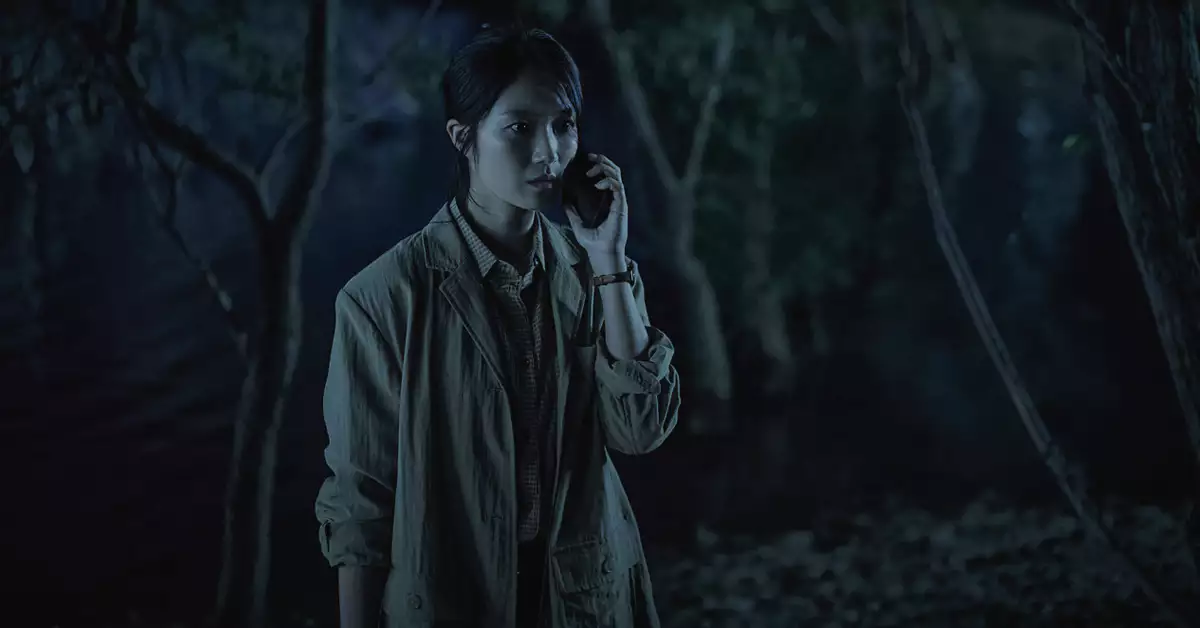
dir. Lee Sangmin | South Korea | 2026 | 95 min. Starring: Kim Hyeyoon, Lee Jong-won, Kim Jun Han, Kim Young-sung, Oh Dongmin, Yoon Jaechan, Jang Daa
Gaston Bachelard, who spent his philosophical career thinking about what the four elements do to the imagination, wrote about the specific terror of dark water — not the fear of drowning, which is a fear about what happens to a body, but a quieter fear that precedes it. The fear of opacity. The fear of a surface that will not let you through. He believed that still, turbid water is the element most native to the unconscious because it holds the same logic: something is down there, something is moving, and you will not see it until it is too late to do anything other than have seen it.
I have been standing at the edge of that water my whole reading life. I recognize it the moment I walk into Salmokji: Whispering Water, the debut feature of director Lee Sangmin, which opens not with a ghost but with footage: a road-view camera making its way toward a reservoir in South Chungcheong Province — not mounted on a vehicle, as the terrain allows no roads, but carried by hand through unmapped ground by someone hired to document what the system’s automated routes cannot reach. In the footage, at the edge of a reservoir, there is a shape. It should not be there. It is. And now it is in the data. Archived. Official. Part of the record.
This is where the film begins. And it is, I think, exactly where the interesting questions are.
Jorge Luis Borges wrote a story — one paragraph, barely two hundred words — about an empire that built a map the exact size of the empire. Every road, every house, every river at 1:1 scale. When the empire fell into decline, the map was abandoned. It rotted in the western deserts. Borges doesn’t say this is a tragedy, exactly. He’s more interested in what it means that the map could be built at all — that the dream of total representation exists, and that it always produces something other than what it promises.
We have not abandoned the empire. We have automated it.
Korea’s road-view photography system has comprehensively documented the country’s roads, rural byways, and forgotten paths. The fictional premise of Salmokji is that this system’s camera captured something anomalous at a reservoir of the same name, and that the company responsible for the documentation dispatches a small crew to retake the images — to replace the contaminated record with a clean one. The task is administrative: update the data. Restore the accuracy of the map.
The task is also, it becomes clear, a category error. You cannot administrate Salmokji. It does not resolve.
What Lee Sangmin has understood — and built a film around — is that the horror of our current moment is not the failure of surveillance but its success. The camera sees something. The motion detector triggers. The ghost box — a device that scans radio frequencies in real time, used by paranormal investigators who believe the dead can shape static into language — produces sounds that might be syllables. Every instrument is working correctly. Every instrument confirms the presence of something. Not one of them can say what.
The data is accurate. The data is useless. This is the distinction that most horror films in the found-footage tradition refuse to make: they use technology as revelation, as the mechanism by which what was hidden becomes visible. Salmokji refuses the comfort of that promise. The technology does not reveal. It detects. Detection and revelation, the film insists, are not the same thing, and the gap between them is where the reservoir lives.
I keep thinking about the ghost box. About what it actually is.
It works by scanning radio frequencies rapidly — dozens per second — and broadcasting the resulting audio fragments in real time: white noise, half-bars of music, something that sounds like breathing, something that sounds like a name. The theory is that entities can manipulate these fragments to communicate. The noise arrives from the environment; the meaning, if there is meaning, arrives from elsewhere.
Walter Benjamin, writing in 1936 about the decline of the storyteller, was trying to name something that was already being lost: the specific authority of a story told aloud, in person, by someone who had been somewhere and come back with the experience still inside them. He believed the story existed in the voice, not on the page — that something essential leaked away each time a tale was written down, and leaked further away when it was broadcast, and further still when it was processed into data. What survived was information. What was lost was wisdom. Information tells you what happened. Wisdom knows what it means.
The ghost box is a machine that produces information without wisdom. It sounds like speech without being speech. It sounds like someone trying to tell you something without being able to get the words out. The horror is not the possibility of what it might be saying. The horror is the experience of listening to something that might be language, might be static, might be a voice that has lost the body that language requires — and being unable, no matter how long you listen, to be sure of the difference.
Salmokji deploys the ghost box with careful restraint. It does not provide a message. It provides the experience of listening for one.
The water ghosts of Korean folklore — mul-gwishin — are not, for Western audiences, immediately legible. They are not ghosts in the Gothic European sense, individuals with grievances and histories and unfinished business. They are spirits of the drowned, and they are defined by method more than personality: they draw the living into the water to join them, propagating themselves through victims, functioning less like characters and more like a condition. An ongoing process of the water itself.
There is an old question, in the folklore, about whether you should fear the ghost or the water. The ghost needs the water. But the water was there before the ghost and will be there after. At some point, the question stops making sense.
I remember standing at the edge of a reservoir when I was young — I don’t think it matters where — and noticing that I couldn’t account for my own reflection. The water was that ordinary turbid color, green-grey, opaque without being dramatic about it, and the surface showed me something adjacent to myself: a shape where I was, moving when I moved, with edges that didn’t quite hold. I stood there longer than I should have, not understanding what I was waiting for. Understanding that I was waiting for something.
Lee Sangmin visited the actual Salmokji reservoir before beginning production, and spent a night there. In his account of that night, he mentions the willow trees at the water’s edge — the way their branches drape to the surface like hair. He mentions the stone cairns, twenty or thirty of them, standing at human height, visible from a distance as what might be people standing still. He mentions the sound of the water at night.
He does not say he was afraid. He says he got the world of the film from that night. Which is more or less the same thing.
What Lee achieves in the film — and it is a real achievement, distinctive in Korean horror — is the dissolution of the boundary between the ghost and its location. The water ghosts of Salmokji are not in the reservoir. They are the reservoir, or continuous with it, spread through it, present in the turbidity that prevents any clear vision of the bottom. They surface like water plants. They move through scenes like fog. They do not appear from a particular direction because they do not have a particular direction. The willow branches hang. The cairns stand. The surface moves. No single element is the source of what you’re feeling. The whole landscape is.
This is a much older form of dread than the haunted house — older, really, than the category of “haunted.” It is the fear of a landscape that will not be navigated, that actively resists the maps drawn of it, that persists beneath and outside every coordinate system brought to bear on it. Pre-modern Korean cosmology understood rivers and forests and mountains as inhabited by presences that preceded human settlement and did not require human cooperation to continue. Lee does not approach this worldview as folklore, as something quaint to be invoked and then safely contained. He uses it as the film’s operating logic, which means using the instruments of modernity — the cameras, the sensors, the ghost boxes — not to dispel it but to demonstrate that it endures.
The lead character’s name is Suin, and she is played by Kim Hyeyoon with a quietness that the film earns slowly.
Suin has been to Salmokji before. She came, she felt the wrongness of the place, and she left before completing her work — passing the assignment to her senior colleague Gyoshik (Kim Jun Han), who went in her place and did not come back. She has returned because guilt is the only engine strong enough to bring her here again.
Lee has spoken, in various interviews, about his interest in horror that is driven by characters managing the consequences of concealed mistakes. He cites A Hard Day — Kim Seong-hun’s 2014 thriller of escalating cover-up — as an influence. What this interest reveals is a filmmaker who understands that guilt is not simply an emotional state but a way of organizing perception. When you know you are responsible for something, the world reorganizes itself around that knowledge. Ordinary things become evidence. The neutral becomes accusatory. A shape at the water’s edge becomes exactly as dangerous as you feared it would be.
At Salmokji, Suin’s guilt has — and the film allows this to remain implicit, which is the right choice — given the place permission. She returned carrying the thing that the reservoir recognizes. The horror that follows is not punishment. It is completion. The geometry of her situation closing.
Kim Hyeyoon does not play this as performance. She plays it as ongoing management. The specific tightness around the eyes that processes information and delays its consequences. The quality of stillness that belongs to someone controlling fear in real time, choosing each second not to let it show, because showing it would mean it is real. Suin returned because she had to, and she now must exist, as calmly as possible, in the presence of what that choice cost her.
The ensemble around her is organized as a taxonomy of responses to the inexplicable. Gyeongtae (Kim Young-sung) and his brother Gyeongjun (Oh Dongmin) represent the failure of competence: Gyeongtae has the camera, Gyeongjun has his training as a naval diver, and neither tool means anything at Salmokji. Sejung (Jang Daa), who runs a horror content channel, has the most complicated relationship to what happens — she has learned to distinguish between fear that looks good and fear that is real, and Salmokji eventually refuses to cooperate with that distinction. Seongbin (Yoon Jaechan) undergoes a shift that the film handles with admirable economy: what it looks like before and after are very different things, and what happened between them the film doesn’t quite show you.
A formal observation: Salmokji is the first Korean live-action feature to use a four-faced ScreenX presentation, projecting onto the left wall, the right wall, and the ceiling of the theater as well as the forward screen. Lee planned for this from the beginning of development.
The standard theatrical contract preserves one sanctuary: behind the viewer, where the projector sits, where the emergency exits are, where the familiar world persists unmediated. Four-faced ScreenX ends this contract. The image is now in your peripheral vision, overhead, at every angle you weren’t watching. You are inside the image. The screen is no longer where you look at something. The screen is where you are.
This is precisely what Salmokji does to the people who enter it. The reservoir is not a backdrop against which horror occurs. It is the thing that is happening, from every direction at once. The ScreenX format does not add spectacle to this film. It adds fidelity.
Salmokji arrives at a moment when Korean cinema is under more international scrutiny than at any previous point — when global audiences who found their way in through Parasite have explored widely and developed real appetites for Korean genre work on its own terms, rather than filtered through familiar categories.
Korean horror has resources that Western genre traditions are only beginning to encounter: a ghost-story culture of richness and specificity, folk frameworks that differ substantially from European supernatural lore, and a cinema that has learned to hybridize the local and the global without losing what makes the local distinct. The mul-gwishin is not a Western ghost. The turbid reservoir is not a Western setting. The fear of a landscape that actively refuses to be mapped is not, or not primarily, a Western fear.
And yet I do not think it is only a Korean film that can produce this experience in a viewer. Because the argument at the film’s center — that the world exceeds its documentation, that data confirms and cannot interpret, that certain spaces operate by principles that no camera will reach — belongs to everyone who has ever looked at footage and felt the gap between what was recorded and what was there. Which is, increasingly, all of us.
The film ends at the water. The surface is dark and still, and it does not reflect the sky correctly. It reflects something else — something patient, something that existed before the road-view camera drove past and will exist when the servers storing the corrected footage are eventually decommissioned, when the data migrates to a format that no longer renders quite right.
You look at it. You keep looking.
Not because you expect to see through it. Because you cannot stop expecting to.
Salmokji: Whispering Water is currently screening in Korean theaters. In Korean with English subtitles. 95 minutes. Not rated; contains sustained horror imagery and intense sequences.