What the Road View Captured: On Lee Sangmin’s Salmokji: Whispering Water
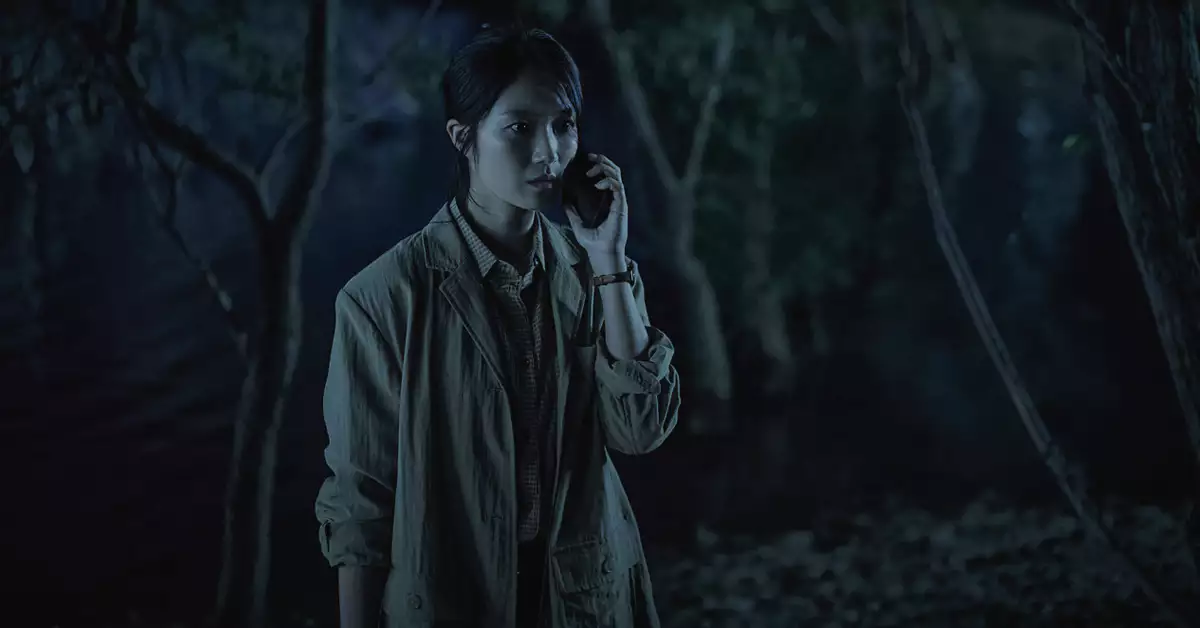
dir. Lee Sangmin | South Korea | 2026 | 95 min. Starring: Kim Hyeyoon, Lee Jong-won, Kim Jun Han, Kim Young-sung, Oh Dongmin, Yoon Jaechan, Jang Daa
Most horror films are built around a question the audience has already answered: why don’t they just leave?
We can see the danger. We know the location is compromised. The characters — through curiosity, or courage, or catastrophic judgment — stay anyway. The gap between what the audience knows and what the characters choose to do is the genre’s most reliable engine. Lee Sangmin’s Salmokji: Whispering Water runs on different fuel. Its protagonist is not there because she doesn’t understand the danger. She has already been to Salmokji reservoir. She felt what was wrong about it, chose to leave, and sent her senior colleague in her place. He has since disappeared.
She has come back because she cannot do otherwise.
This is the distinction that makes Salmokji — Lee Sangmin’s debut feature — quietly distinctive within Korean horror: its central character is not navigating fear. She is navigating guilt. And the film has understood, with impressive precision for a first feature, that guilt is a more reliable engine for dread than curiosity. Curiosity can be satisfied. Guilt cannot.
The Setup
The premise begins in a company meeting room.
Onroad Media, which handles road-view photography for Korea’s major mapping service, has a problem: their existing footage of Salmokji — a reservoir in South Chungcheong Province — contains a shape that shouldn’t be there. The footage has begun circulating in horror circles, accumulating commentary. The company’s solution is procedurally tidy: dispatch a crew to retake the images on foot through terrain no vehicle can navigate, replace the anomalous footage with clean documentation. Update the record. Suin (Kim Hyeyoon), the PD who previously visited and left the job unfinished, volunteers to lead.
The crew that assembles around her covers a spectrum of relationships to the paranormal. Road-view photographers Gyeongtae (Kim Young-sung) and his brother Gyeongjun (Oh Dongmin) have come primarily to do a job and secondarily to fish; they don’t believe in ghosts, and more importantly, they don’t believe the work will take long. Sejung (Jang Daa), who runs a horror YouTube channel, has the professional ghost-hunter’s practiced relationship to the uncanny — she believes in ghosts the way a journalist believes in news, as a category that generates content. Seongbin (Yoon Jaechan), Suin’s junior colleague, arrives with equipment and skepticism in roughly equal measure.
Then there is Gyoshik (Kim Jun Han), the missing senior PD — who reappears at the reservoir without warning, without explanation, and with something different behind his eyes that only Suin notices. Everyone else takes his return at face value. Suin cannot afford to.
She is the only one who has been here before. She is also the only one who already knows, in her body if not in her reasoning, that the task cannot be completed.
The Horror of an Open Space
The first thing Salmokji does well is its setting.
Standard Korean horror — and horror in general — tends toward enclosure: the apartment building, the hospital corridor, the school. Enclosed spaces produce pressure that filmmakers can control. Salmokji is outdoors. The sky is visible. There is no ceiling. You can see the trees, the hills, the path you came in on.
None of this helps. The crew cannot leave — not because they are physically blocked, but because they keep returning to the same points. The path loops. Direction stops functioning as direction. The place has its own geometry, and it doesn’t match the one they arrived with. The horror here is not the horror of walls closing in. It is the horror of losing north.
Lee handles this spatial logic with considerable control. The environments are shot to feel both entirely natural — real trees, real water, real light — and subtly wrong. Willows drag their branches to the surface like hair. Stone cairns, twenty or thirty of them, stand at the water’s edge at precisely the height of standing people. Sounds arrive from angles that don’t match their apparent sources. The 360-degree camera that Gyeongtae carries through the terrain catches shapes in the periphery that vanish when reviewed directly.
The reservoir is not presenting itself as a horror location. It is simply declining to behave as a normal one.
The water ghosts — mul-gwishin, spirits of the drowned in Korean folk tradition — are handled with genuine visual invention. They do not materialize as humanoid figures with backstories and grievances. They float at angles that corpses describe. They move like water plants freed from the sediment. They exist at the threshold between the water and everything else, and that threshold in Salmokji is wider than it should be. The production design dressed them to dissolve into the natural environment: roughened fabric the color and texture of bark, wet hair obscuring faces. The ghosts are hard to see not because they are hidden but because they have become part of the landscape.
What Guilt Does to a Space
Lee has spoken about his interest in horror built around characters managing the consequences of concealed mistakes. His touchstone is A Hard Day (끝까지 간다, 2014), Kim Seong-hun’s thriller in which the attempt to cover a single catastrophic accident spirals into something larger. What Lee draws from that model is a specific psychological insight: guilt reorganizes perception. When you know you are responsible for something, ordinary events become accusatory. The neutral becomes evidence. A shape at the water’s edge becomes exactly as dangerous as you feared it would be.
At Salmokji, Suin’s guilt has given the place permission. She returned carrying the thing the reservoir recognizes. What follows is not random. It is proportional.
The ensemble around her functions as a taxonomy of how different temperaments process the inexplicable. Gyeongtae and Gyeongjun are protected, initially, by task-orientation — they are here to photograph and then fish, and this narrowness of purpose insulates them until the reservoir decides it doesn’t. Sejung processes everything through the lens of content before she allows it to register as experience, and Salmokji is patient enough to wait for the moment when that buffer fails. Seongbin undergoes the film’s most significant interior shift — two versions of the same character with a gap between them that the film leaves almost entirely implicit — and Yoon Jaechan handles the transition with the economy the film requires.
The late arrival, Gitae (Lee Jong-won), enters after the situation has already deteriorated, which means he registers the abnormality that the others have begun to normalize. He is the character through whom we remember that this is not normal. Lee Jong-won’s steadiness reads as warmth rather than blandness, and in an ensemble that otherwise runs on varying registers of fear and disbelief, that warmth is structurally necessary.
Kim Hyeyoon
The film belongs to Kim Hyeyoon, and she earns it.
The role demands something more difficult than fear. Suin has already made her internal accounting before the film begins — assigned responsibility, calibrated the debt, decided to return and face it. What Kim Hyeyoon plays, for the film’s first two thirds, is someone maintaining an internal equilibrium under accumulating pressure. Not suppressing her fear heroically. Simply managing it. The specific discipline of a person who understands that breaking down would mean admitting it is as bad as she thinks.
This performance is constructed from small things. The tightening around the eyes that precedes what would, in a less controlled performance, become a reaction shot. The quality of attention Suin brings to each new development — scanning, categorizing, updating her model of the situation. The moments when the management visibly costs her something. She is not the most extroverted presence in the ensemble. She is the one the film keeps returning to.
Director Lee Sangmin has cited The Girl on a Bulldozer (불도저에 탄 소녀) as what drew him to Kim Hyeyoon — the sharpness of her energy in that film, the sense of a performer who can hold intensity without letting it spill into excess. In Salmokji, she does something different with those same qualities: contains them, directs them inward, makes restraint into its own form of expression.
Lee Sangmin’s Direction
Salmokji is a first feature in the ways that first features often are: some ensemble members serve their narrative function more than they discover their own lives, and a few mid-section scare sequences lean on formula before the film’s final movement recovers its best atmospherics. These are the limitations of compression, not of vision.
What Lee demonstrates throughout is a spatial imagination that is genuinely unusual — a sense of how to make an environment feel inhabited without reducing it to individual ghosts with individual grievances. He understands sound: the splash with no visible source, the thing moving underwater where nothing should be moving, the skipping stone that should have stopped by now returning across the water. He understands how to make the natural world feel wrong without altering it visibly.
The decision to build the film from the outset for four-faced ScreenX — projecting onto the left wall, right wall, and ceiling as well as the forward screen, in the first such use for a Korean live-action feature — responds to something specific in Salmokji‘s horror logic. The reservoir’s danger is not directional. It doesn’t arrive from a particular angle. Standard theatrical presentation preserves one sanctuary: behind the viewer, where the projector sits, where the exit is. Four-faced ScreenX removes this. The format doesn’t add spectacle. It removes an escape route.
In the Context of Korean Horror
Korean horror has spent a decade demonstrating to international audiences that it operates from premises and folk traditions that European and American horror don’t share. The Wailing (2016) remains the benchmark of its ambitions: a film that used the supernatural as the occasion for an inquiry into how human beings construct explanations for the inexplicable, and what those explanations cost them.
Salmokji is a different kind of project. It operates within genre conventions rather than dismantling them. It is not trying to be The Wailing. It is trying to be the film that makes you feel, for ninety-five minutes, that you are standing at the edge of a reservoir that does not want you there and will not tell you why.
In that aim — contained, atmospheric, technically assured — it succeeds. The mul-gwishin is not a Western ghost. The landscape it inhabits is not organized according to Western cosmological assumptions. Lee Sangmin has taken a folk tradition that Korean horror has largely bypassed in favor of other supernatural frameworks and found in it a visual language that the genre hadn’t yet exhausted. That alone would make the film worth watching.
That it is also a precise character study of a woman returning to a place she should have stayed to finish, and what that return costs — that is what makes it a film worth thinking about afterward.
Salmokji: Whispering Water is currently screening in Korean theaters. In Korean with English subtitles. 95 minutes. Not rated; contains sustained horror imagery and intense sequences.