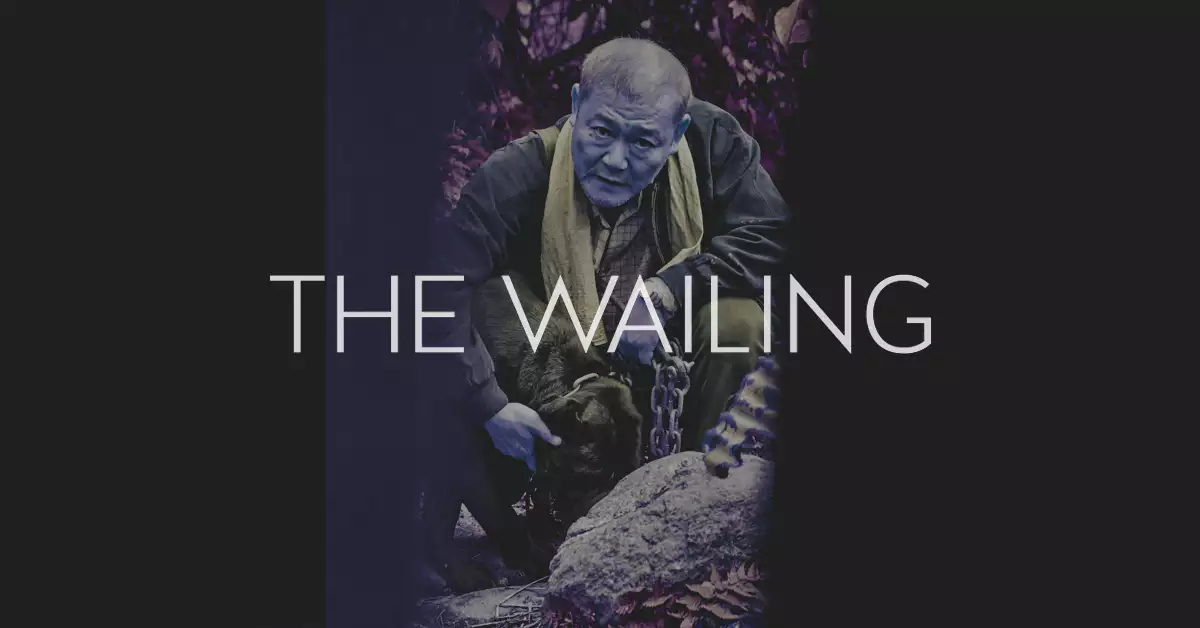
On Na Hong-jin’s The Wailing and the investigator who cannot stop investigating
Hyo-jin is sick. Her father has come to her room. He sits across from her and he asks: do you know about a Japanese man living in the village? Have you met him?
She tells him to get out.
He does not stop asking.
Jong-gu (Kwak Do-won) is a policeman. This means something specific in The Wailing — not just a profession but a way of being in the world, a set of tools so habituated they have become involuntary. He enters every situation positioned to gather evidence, evaluate testimony, reconstruct the sequence of events from material trace. His daughter is running a fever, behaving strangely, writing things in notebooks she denies writing. His response is to open an investigation. There is something almost tender about this. He is trying to help her. Solving the case is all he knows how to do.
Na Hong-jin’s film has been subjected, in the decade since its Cannes premiere, to more forensic analysis than almost any Korean work of its generation — extended explications of who is actually evil, what the ritual scene proves, whether the woman in white is protector or demon. Na Hong-jin has mostly watched from a distance, endorsing the open ending, which is accurate in the narrow sense and misleading in every other. The film is not ambiguous about what it wants to show. It has made up its mind about Jong-gu. It simply disagrees, profoundly, about where his failure is located.
A policeman is a specific kind of witness. He is trained in the evaluation of physical evidence, the reconstruction of events from material trace, the adjudication between competing testimonies. He knows the difference between what was directly observed and what was inferred, between what can be committed to in a report and what must remain speculation. These tools exist because the world is regularly unclear — crimes happen without witnesses, people lie, memory is imperfect. The investigative apparatus does not guarantee truth. It is a method for navigating uncertainty toward something actionable.
The Wailing dismantles this apparatus component by component.
The Japanese stranger (Jun Kunimura) is seen eating raw deer on the mountain. By the time this report reaches Jong-gu, it has become: he devours flesh. Physical evidence from the stranger’s house — photographs, ceremony objects, items belonging to the victims — is obtained illegally and burned before it can be formally examined. The shaman Il-gwang (Hwang Jung-min) provides testimony about the nature of the evil that cannot be independently verified and is subsequently contradicted by other testimony. Moo-myung (Chun Woo-hee), the woman in white, provides testimony that directly contradicts Il-gwang’s. Both accounts are internally plausible. Neither can be corroborated. Jong-gu must adjudicate between them using only his read of each witness’s credibility — and both have been deliberately established as ambiguous by the time this adjudication becomes necessary.
This is not an unusual situation for an investigator. Witnesses routinely disagree. Physical evidence is frequently contaminated or incomplete. The task is to work through interference toward something you can commit to. What makes The Wailing something other than a standard story about the limits of rationalism is what it has arranged on the other side of the investigation. The film’s evil does not exist beyond evidence. It thinks in evidence. It has manufactured a false crime scene for a policeman to investigate — photographs that look like murder documentation, ceremonies that look like rituals of destruction, appearances at crime scenes that look like the signature of a killer. Every piece of evidence that reaches Jong-gu has been placed there because it is exactly what an investigator would expect to find.
And here is what the film requires several viewings to make fully visible: Jong-gu’s investigation is not simply the wrong instrument for this job. It is the mechanism through which the harm operates. When Moo-myung tells him, near the end, that his daughter’s suffering came about because her father “suspected another, tried to kill him, and finally did kill him” — she is not describing Jong-gu’s failure to solve the crime. She is describing his role in creating it. His act of investigative violence, driving the stranger off the mountain road, is what accelerates the possession of his daughter. The case he has been trying to solve is a case he has been making, in the act of trying to solve it.
Roughly two-thirds through the film, Na Hong-jin stages the sequence that everyone who has seen The Wailing still carries: the parallel cross-cut between the shaman’s exorcism at Jong-gu’s house and the Japanese stranger performing a ritual on the mountain. Il-gwang dances and beats drums and the ceremony is ecstatic and brutal. The cross-cutting implies combat — two practitioners on opposite sides of a battle, one trying to save the girl while the other works against her. The grammar is legible. We read it the way we read all such sequences in horror cinema: as a binary, a conflict, a race between forces with incompatible intentions.
The film then informs us we were wrong. Il-gwang and the stranger were, all along, working toward the same end. What looked like combat was collaboration. The protective ceremony was the mechanism of harm.
The retroactive correction does not come from inside the scene. It comes from outside — a phone call, testimony, a voice telling us that what we witnessed was not what we witnessed. This is the film using against its audience the precise instrument the evil uses against Jong-gu. We saw with our own eyes. We are told our eyes were wrong. We are asked to trust the voice instead.
The experience of watching The Wailing is not analogous to Jong-gu’s experience. It is structurally identical.
Toward the end of the film, at a crossroads in the dark, Moo-myung tells Jong-gu to wait. She has set a trap for the demon. When it is snared, the rooster will cry three times. Wait until the third cry. Then go home.
At this same moment, his phone rings. Il-gwang’s voice is urgent: come home now. Whatever the woman tells you, do not believe her. Come immediately.
Two testimonies. Irreconcilable. No time to gather further evidence. Somewhere in the dark, the rooster begins.
Jong-gu cannot hold the uncertainty. He leaves. He trusts the voice that offered the more complete narrative — the voice that named the error, identified the true threat, provided a destination. An investigator, when paralyzed by incompatible accounts, will reach for the account that most resembles a case. Il-gwang’s call was a case: clear suspect, clear action, clear urgency. Moo-myung’s instruction was only a condition: wait. There is nothing to investigate in waiting. He goes home before the third crow.
While Jong-gu stands at the crossroads making this choice, the film cuts to a cave above the village. A different crisis of verification is playing out simultaneously. The young deacon Yang E-sam, who has been drawn into this by his uncle and his patchy Japanese and his poorly-understood proximity to the sacred, stands before the Japanese stranger. The stranger shows him his hands and his feet and speaks the verse from Luke that opened the film: Why are you troubled? Why do doubts arise in your hearts? Touch me and see. A ghost does not have flesh and bones, as you see I have.
This was Christ’s proof to his disciples that the resurrection was real — an invitation to physical verification, the body as its own evidence. The disciples needed no leap of faith; they were invited to touch, to confirm through sensation that what stood before them was flesh. And the stranger does have flesh and bones. He can be touched. He bleeds. The conventional proof of presence is available.
It means nothing, because Yang E-sam’s question is not whether the stranger has a body. It is what the body contains. Touch cannot verify that. The verse designed to resolve doubt through physical contact has become, in the stranger’s mouth, in this cave, while the rooster crows at the crossroads where Jong-gu no longer stands — the instrument of further uncertainty. The tool of verification is now the device of confusion. The evidence has become the trap.
The film holds both crises in the same moment. At the crossroads: testimony cannot be adjudicated. In the cave: physical evidence cannot be interpreted. The two standard instruments of the investigation — witness evaluation and material verification — fail simultaneously, in different places, while the crow count runs out. This is not coincidence. The film has staged the simultaneous collapse of every method Jong-gu was trained in. It collapsed them while he was somewhere between the two, heading home.
The shaman had explained it earlier, in the way that explanations in this film have of being simultaneously accurate and useless: If you go fishing, do you know what you’ll catch? / He’s just fishing. Not even he knows what he’ll catch. / He just threw out the bait, and your daughter bit it.
This is the thing the investigation cannot metabolize. There is no motive directed at Hyo-jin specifically. There is no sequence of cause and effect that, if reconstructed correctly, would reveal why her and not someone else. The evil is random in the way that catastrophe is random — not chaotic, not meaningless, but organized around a logic that has nothing to do with the particular person it destroys. There is no case to solve because there was no crime in the sense Jong-gu means: no intent, no target, no reason. He threw out bait. She bit.
An investigator needs a motive. He needs a sequence. He needs the harm to have a structure he can identify, locate, and remove. And so he builds one — out of rumor, testimony, the fragments of evidence that the evil has arranged for him to find. He builds a case. The case is the mechanism of his daughter’s destruction.
Jong-gu comes home. In the final images, Hyo-jin stands and looks at him. Her face is her face. Her eyes are her eyes. Nothing has changed on the surface.
“Daddy’s a policeman,” he says. “I’ll take care of everything.”
He is still reconstructing events, still identifying the suspect, still believing there is something that can be established and acted upon. The investigation continues. It cannot be otherwise. He is not a man who chose investigation as a response to this particular situation — he is a man for whom the investigative mode has become consciousness itself, the only way he can be present to any situation at all. He could not have chosen differently. The investigation was never a strategy. It was just what he is.
I am watching Hyo-jin’s face and I cannot tell, from watching, what it contains. I have spent the film being trained to read signs — to see evidence in photographs, intention in ritual, guilt in appearances at crime scenes — and every sign I have read has been constructed to be misread. The face that looks back at me now gives me nothing to work with. This is not a situation analogous to Jong-gu’s. It is his situation. The investigation I have been conducting from my seat in the theater — who is really evil, whether the ritual scene proves collusion, what would have happened had Jong-gu waited for the third crow — has brought me here. Not to a resolution. To a face.
The Wailing is not, finally, about the failure of rationalism against the supernatural. It is about something more precise: the investigator as a specific kind of person, formed by a specific kind of tool, placed inside a situation that has been built around that tool’s vulnerabilities. The evil in Gokseong does not overpower Jong-gu’s epistemology. It uses it. It thinks in evidence, manufactures cases, provides suspects, arranges the landscape of inquiry so that every investigative act is a step toward catastrophe. The investigation doesn’t fail to save Hyo-jin. The investigation is the thing.
And none of this could have been told to Jong-gu in advance. He would have investigated the warning.
In the dark, somewhere above the village, a fish moves through water toward something it does not yet know is bait.