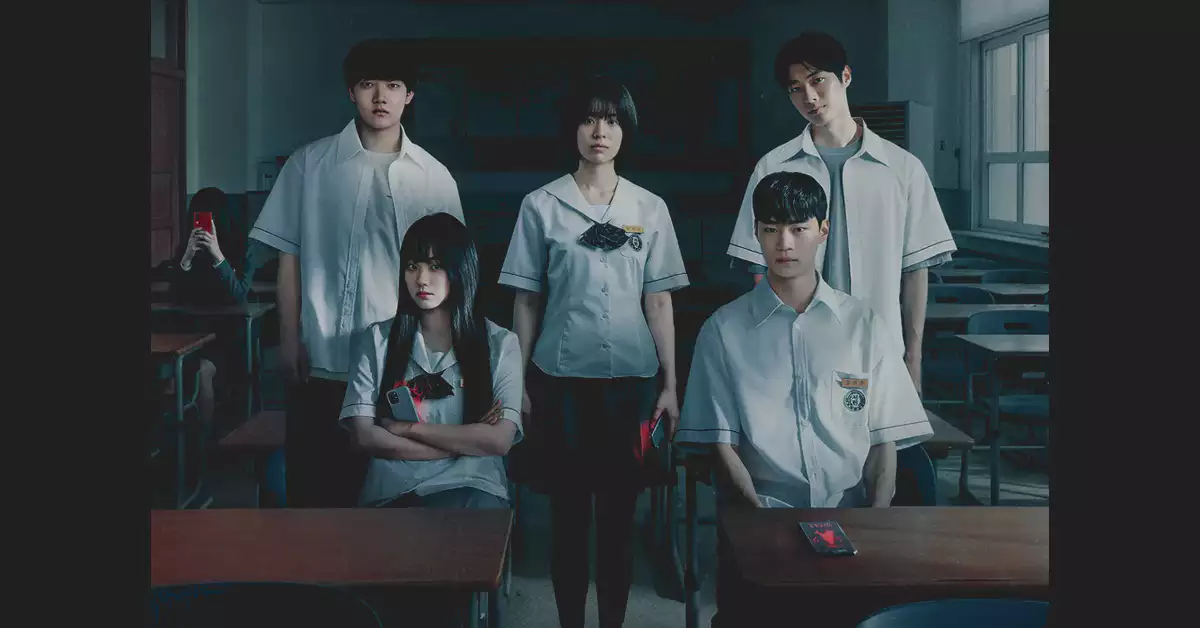
Netflix | 8 Episodes | April 24, 2026 | Full spoilers throughout. For plot summary, cast, and ending explained: see [If Wishes Could Kill — Review & Complete Guide].
The thing that interests me most about If Wishes Could Kill isn’t the curse. It’s the coordinate system.
Four characters use the Girigo app across eight episodes. Two survive. The division isn’t random, and the show never announces it. You have to notice it yourself, which is part of the point. Map the four wishers on two axes — how selfish was the wish, and how seriously was it meant? — and the pattern appears. Yu Se-a (Jeon So-young) made her wish for someone else, in full earnest. Kim Gun-u (Baek Sunho) made his for someone else, impulsively, out of something that resembles love. Both survive. Choi Hyeong-uk (Lee Hyo-je) wished for himself. Im Na-ri (Kang Mina) made a wish that carried harm, in a moment she didn’t believe would have consequences. Both die.
This is the moral logic underneath the horror mechanics. The show never states it. It trusts you to find the pattern, and trusts the pattern to say something that an explicit argument couldn’t: that desire directed toward others — even imperfect, self-interested desire — is not the same as desire that curves back on itself or outward toward harm. The survivors wish for. The dead wish against, or for themselves alone.
I don’t know if the writers plotted this deliberately or discovered it while building the story. It doesn’t change what it does when you see it.
Kang Ha-jun (Hyun Woo-seok) is the character who never actually makes his wish. He opens the app. He has reasons. He closes it again.
He has unrequited feelings for someone who is with someone else — the most traditional of justifications for making a selfish wish, the kind that almost every story would grant him. He doesn’t. He spends eight episodes making sure other people survive instead. The show pays almost no attention to this, which is how I know it’s intentional. Characters who silently choose the harder thing are usually the ones the story believes in most.
What the series gets most right is something I didn’t expect it to attempt: taking Korean shamanistic tradition seriously on its own terms rather than using it as exotic atmosphere.
Haetsal (Jeon So-nee), the mudang whose knowledge drives most of the investigation, is not mystical furniture. She’s a working professional in an inherited trade, one that carries real costs — she’s confined to her house by forces the show doesn’t fully explain and doesn’t need to, because the confinement is both literally true and thematically resonant. She is as trapped by her practice as Se-a is by her grief. The visual rhyming the series does with these two characters — identical framing, identical shot scale, the small detail that both have short hair while every other female character has long — is the most elegant piece of visual argument in the show. They are the same problem in different registers.
The concept of donti — spiritual retribution following a violation of sacred order — gives the Girigo system coherent internal logic. A wish is a transgression. It reaches past what you’re entitled to. The retribution isn’t cruelty; it’s accounting. What makes the series genuinely interesting is that it treats this accounting as operating through relationships. The debt doesn’t fall only on the person who made the wish. It radiates outward, through the connections between people, until someone stops it or everyone has paid.
This is both a supernatural claim and, I think, a true one. The things we want aren’t contained inside us. They move through the people around us. The show just makes the mechanism visible.
The structural decision I keep returning to: Episode 6 is, chronologically, Episode 1.
Everything the series eventually reveals about its origin — the two girls at Seorin High School three years before, the friendship that broke in ways neither of them fully intended and both of them fully caused — is the event from which all present suffering descends. A conventional show would present this first, establish the cause, and let you spend eight episodes watching the effect approach. If Wishes Could Kill inverts this. You watch the effects for five episodes before you understand the cause. And what that inversion produces is something that the conventional structure couldn’t: not dread, but grief. By the time the flashback arrives, you already know what Do Hye-ryeong’s wish produces. You’ve watched it happen to people you’ve spent time with. Understanding why she made it adds weight rather than information.
The episode functions as a near-standalone piece, and the tragedy of Hye-ryeong (Kim Sia) and Kwon Si-won (Choi Ju-eun) is legible and complete on its own terms. What I find affecting is that neither of them is wrong in any simple sense. Si-won was genuinely hurt. Hye-ryeong was genuinely destroyed. The curse isn’t the result of evil finding a means. It’s the result of ordinary human pain that had nowhere to go finding a means instead.
This is the recurring pattern in the best recent Korean horror, and I think it’s a genuine insight: the monster grows from the inside. It isn’t imported. It’s cultivated, accidentally, by people who loved each other and then didn’t know what to do with what remained.
Na-ri is guilty. There is no version of events in which what she did is acceptable, and the show doesn’t offer one. She made a wish she knew carried harm, in a moment of intoxication and performed skepticism, and two people died because of it. She is responsible for that, and the show holds that clearly.
She is also someone whose capacity for judgment had been quietly eroding for long enough that in the crucial moment, it failed entirely. The wish she makes is not a planned act of malice. It’s what happens when skepticism becomes a form of armor — when you perform not-believing in order to avoid the vulnerability of actually caring — and the armor proves to be not armor at all.
The possession that follows is the curse using her as an instrument, not punishment for what she did. But the ease with which she becomes an instrument — the way the fractures in her were already there, waiting — feels like the show’s honest answer to its own question. The curse doesn’t need to break someone. It just needs someone already partway broken.
The show can’t quite decide whether to forgive her, and I respect that ambiguity. Kang Mina earns what the writing almost earns: guilt carried not as performance but as weight.
The honmun sequence, where Se-a must pass through three spiritual thresholds without looking back, is the series’ most deliberately mythic passage.
The Orpheus parallel is exact enough that you don’t need me to explain it. Orpheus descended for Eurydice and was told not to look back. He looked back. She returned to death. The condition is the same, the failure is the same, the loss is the same. What the series adds, and what makes it more than allusion, is a reading of why the prohibition fails. It fails because looking back is what grief does. You cannot walk away from your dead without wanting, once, to see them again. Se-a’s parents are behind her in the spirit threshold. She knows she shouldn’t turn. She turns.
The show does not punish her for this in any final sense. It costs her — Haetsal intervenes at personal cost to pull her out — but the show is not making an argument about discipline or restraint. It’s making an argument about what kind of person Se-a is. She cannot stop caring about the people behind her. This quality is what puts her in danger throughout the series. It is also what makes her the one who can fix what the past broke. The failure and the qualification are the same thing.
I find this genuinely moving. Not because it’s sentimental — it isn’t — but because it’s true. The prohibition that love makes impossible is also the quality that makes love worth having.
Some honest reservations.
The romance between Se-a and Gun-u is structurally essential and emotionally thin. Gun-u’s wish to cancel her training is the inciting mechanism; everything flows from that choice. The show needs the relationship to carry weight, and it never fully builds that weight. The actors work with what they’re given, but what they’re given is more sketch than character.
The later episodes accelerate in ways that occasionally feel like compression rather than momentum. The exact mechanics of how Si-won — who, by the logic of the flashback, died as a result of Hye-ryeong’s wish — came to construct the Girigo application is left in a productive ambiguity that some viewers will find frustrating. I find it acceptable but not fully satisfying. The show’s supernatural framework can hold the question. I wanted it to try to answer it anyway.
These are real weaknesses. They don’t undo what the show does well, but they’re the reason it falls short of the category it occasionally seems to reach for.
Here is what I think the series is actually about, underneath the app and the curses and the red phone.
It is about the difference between a wish and a life.
A wish is an endpoint: you want something, and either you get it or you don’t. A life is the time between the wanting and the having — or, more often, the time spent moving toward something that keeps receding, and everything that happens in that movement. The Girigo mechanic — wish granted, timer starts, death follows twenty-four hours later — encodes a dark proposition: that fulfillment is not the point. That the point is what you do with the gap. That arriving at what you wanted, if it costs you the time to want other things and be changed by the wanting, is not an achievement but a foreclosure.
This is a very old story, and the series knows it. It appears in Grimm, in Ovid, in every tradition that has ever noticed that humans are better at wanting than at knowing what they want. If Wishes Could Kill retells it through the vocabulary of contemporary Korean horror — donti, wonhon, the ritual precision of the mudang — and it uses that vocabulary seriously, not decoratively.
The app is not the point. The app is the occasion. What the show is actually asking is something it puts to you in the negative space around every scene: if the gap between your wish and its fulfillment is where you actually live, what are you doing with it? And who are you doing it for?
In the post-credits scene, Min-su finds Na-ri’s phone.
I don’t know whether Season 2 exists yet. But the image stays with me: an ordinary person picking up an ordinary object that is not ordinary at all, not knowing what he’s holding. The curse doesn’t announce itself. It waits for someone to open the interface and enter what they want.
We are all, at all times, one wish away. That’s not a horror premise.
That’s just how desire works.
See also: [If Wishes Could Kill — Review & Complete Guide] · [The App We Already Live In: On If Wishes Could Kill and Digital Desire]