The sentence arrives before the novel begins. It is placed as a foreword, before chapter one, before Sinclair’s childhood, before Franz Kromer and the stolen apples and Max Demian’s first appearance at the school gate. “I wanted only to try to live in accord with the promptings of my true self.” Then the question that follows it: “Why was that so difficult?”
The difficulty, presumably, is what the novel will explain. Two hundred pages of explanation, a war, a dying teacher, a woman who is also a mother who is also an archetype, and at the end Sinclair looking into a dark mirror and seeing someone else’s face. Two hundred pages to answer why it was so difficult — and the novel does not quite answer. It enacts the difficulty. It demonstrates, repeatedly and with great commitment, that the journey toward the self keeps arriving somewhere other than the self.
This should probably bother us more than it does.
The sentence makes a specific claim. Not that Sinclair found his true self. Not that the journey was completed. The claim is about trying — about the attempt to live according to what wanted to emerge from inside him. The past tense is important: the narrator is looking back. He has arrived somewhere. From that somewhere, he is telling us how hard it was to get here.
But the grammar is doing something subtle. “What wanted to emerge from me” — was von selber aus mir heraus wollte — positions the true self as already formed, already straining outward, already knowing its direction. The self is not made in the process of living. It pre-exists the process, waiting to emerge. All Sinclair needs to do is allow it.
The question is whether the novel bears this out.
Sinclair at ten or eleven is in crisis. He has told a lie — a boastful story about stolen apples — to impress an older boy named Franz Kromer, who is everything Sinclair’s house is not: rough, working-class, contemptuous of the orderly world of the father. Kromer, seizing the lie as a weapon, begins to blackmail Sinclair. The blackmail is psychological before it is financial: Kromer has found the exact point where Sinclair’s two worlds — the bright world of the father’s house and the dark world outside it — press against each other, and he has put his thumb on that point.
Sinclair cannot resolve this from within. He tries. He pays Kromer with his savings, his grandmother’s watch, everything he has. Kromer takes it and wants more. The crisis intensifies for weeks, and the resolution, when it comes, does not come from Sinclair’s inner resources or his emerging true self. It comes from Max Demian, who speaks to Kromer quietly at the school gate and after that the blackmail stops.
We are never told precisely what Demian said or did. The novel makes this opacity deliberate: Demian’s power operates outside Sinclair’s comprehension. What matters is that the first crisis in the novel — the first pressure on the boundary between the two worlds, the first test of who Sinclair is — is resolved not by Sinclair but by someone else.
This pattern does not change. At every subsequent crisis, Demian appears or a Demian-surrogate appears, and the crisis resolves through encounter with an external guide. Pistorius the organist will give Sinclair the concept of Abraxas when Sinclair needs a god. Eva will embody the feminine archetype when Sinclair needs to love something beyond himself. The novel’s structure is not: Sinclair discovers his true self. It is: Sinclair meets a sequence of teachers who give him better and better frameworks for understanding who he already is.
This is not obviously a failure. But it is in some tension with the opening sentence’s claim.
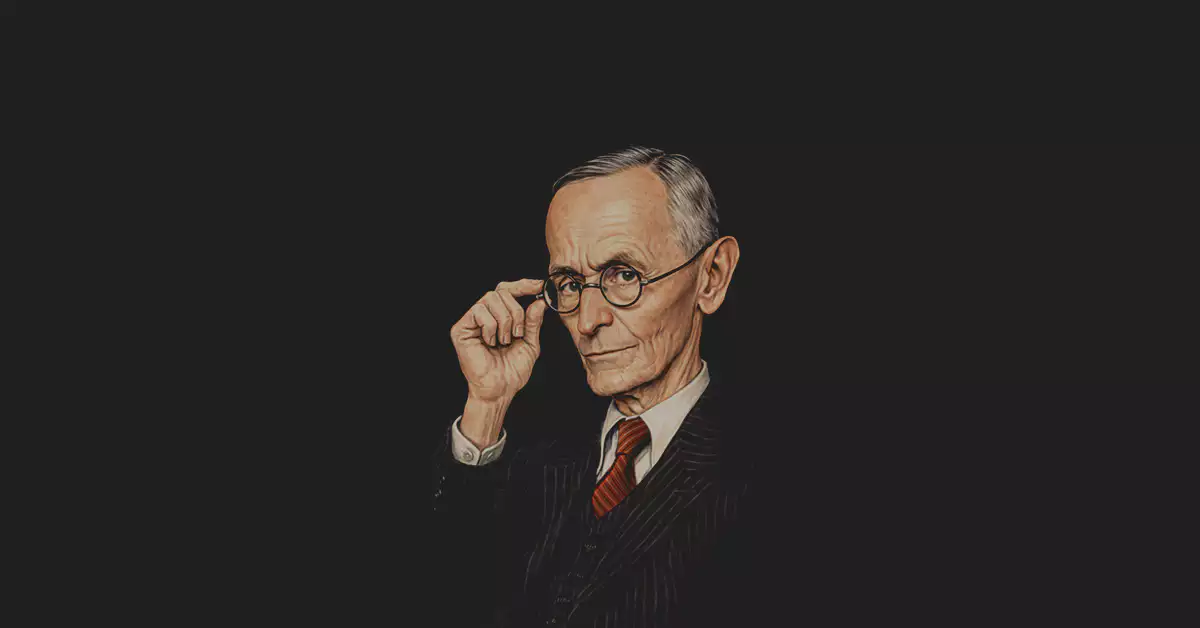
In 1919, a novel appeared in Germany under the name of Emil Sinclair.
The author was described as a young man, essentially unknown. The novel won the Fontane Prize, which was awarded to new writers of exceptional promise. Critics praised the authenticity of the voice — something immediate and unprocessed about it, the rawness of genuine youth.
Hermann Hesse was forty-two years old.
He had published Peter Camenzind in 1904, Beneath the Wheel in 1906, Demian was his ninth or tenth significant work depending on how you count. He was not an unknown. He was the kind of author who could not publish this particular book under his own name — not because it would have been poorly received, but because the book required a different author to exist at all.
When Hesse acknowledged the authorship, some time after the prize was awarded, the Fontane Prize was returned. The young man Emil Sinclair had never existed. But the novel he supposedly wrote had been read by hundreds of thousands of people who believed they were reading a young man’s genuine account of his own emergence.
I want to stop here, because this fact is stranger than it first appears.
A novel about finding one’s authentic self — a novel whose central project is the discovery of what wants to emerge from inside a person, uncorrupted by social expectation and conventional morality — was written by a man inhabiting a false identity. The author was not who he said he was. The authenticity that readers felt so immediately was the authenticity of a performance.
The obvious response is that this is hypocrisy, or at least irony. But I don’t think that’s quite right. The pseudonym might be the most honest thing about the novel. Hesse needed to not be Hesse to write this book. The established author, the husband, the man with a biography and a reputation — that Hesse could not access what Demian required. Emil Sinclair, unburdened by an existing self, could.
Which means the novel’s opening sentence is truer than the novel perhaps knows. Hesse tried to live what wanted to emerge from him. To do it, he had to kill Hermann Hesse and become someone else. The pseudonym is not a contradiction of the project. It is the project, taken seriously enough to actually cost something.
But this creates a problem that the novel does not examine and that I want to examine now, before the essay loses its nerve.
If Hesse needed to become Emil Sinclair to access the authentic self that wanted to emerge from him — if the authentic self required a fictional container to become legible — then what is the authentic self? It is not, apparently, the self that exists in ordinary life, with its known face and accumulated history. It is a self that only becomes accessible through an act of self-invention, through the deliberate creation of a persona that is not you.
The novel’s opening sentence says the self is already inside you, waiting to get out. Hesse’s actual process of writing the novel says the self must be constructed through a willed act of becoming-other. These are not the same claim. They might, in fact, be opposites.
Sinclair, in the novel, has the same experience. His true self does not emerge from within in any unmediated way. It emerges through his encounters with Demian, who gives it a name; through Pistorius, who gives it a theology; through Eva, who gives it a body and a face. The self that Sinclair discovers is built from materials provided by others. It is not what was always inside him. It is what he assembled from the best of what he was offered.
This might be the only way selves are ever discovered. But if so, the opening sentence is describing something more complicated than it admits.
The sentence is past tense. I keep returning to this.
Sinclair the narrator has arrived somewhere. From that somewhere, he looks back and says: I tried to live what wanted to emerge from me. Why was it so difficult? The question implies that he knows the answer now. The difficulty is behind him. He has clarity in retrospect that he lacked in the moment.
But what clarity? The novel ends with Sinclair wounded in a field hospital during the First World War, looking at the man on the adjacent mattress and recognizing Demian — who should not be there, who may be dying, who speaks to him in a near-whisper and then disappears into the face of a stranger. The morning after, Sinclair looks into what the novel calls a dark mirror and sees his own face, and the face has become Demian’s.
This is the arrived-somewhere. Sinclair’s face is Demian’s face. The self he found is the self he projected onto another person and then internalized. The emergence was real. But what emerged was not, finally, distinguishable from the best image of what he wanted to be.
Is this a failure or an achievement? The Jungian answer — and Hesse was in Jungian analysis when he wrote this book, working with J.B. Lang, one of Jung’s most devoted disciples — is that this is the achievement. Demian was always Sinclair’s animus, his inner ideal, and the work of individuation is to make the inner ideal one’s own rather than keeping it projected outward onto an actual person. By the end, Sinclair has withdrawn the projection. Demian lives inside him. The integration is complete.
I find this reading available. I also find it, under pressure, somewhat too convenient.
If individuation means making your projected ideal into your own internalized image — if the self you find at the end is the self you projected onto your most admired person and then retrieved — then the self you find is not what was already inside you waiting to emerge. It is what you borrowed from outside and made your own. The process is real and the result may be genuine. But the opening sentence’s claim — that there was always something inside wanting to get out, and the difficulty was in letting it — describes a different process than the one the novel actually portrays.
Here I want to turn the essay’s argument against itself, because I have been making the argument too easily.
I have been saying: the novel claims the self is inside, already formed, wanting to emerge; but Sinclair’s development is externally mediated at every stage; therefore the novel fails to deliver what its opening sentence promises.
But this argument depends on knowing what “the self that wants to emerge” would look like if it actually emerged. And I don’t know this. No one does. The concept of an authentic inner self that exists prior to and independent of all social shaping is a philosophical claim that has been contested for at least two centuries. There may not be such a self. The self may be, in some fundamental sense, always a construction — built from encounters, shaped by teachers and mirrors and the faces of people we project our ideals onto.
If this is right, then Sinclair’s development is not a failure to achieve authentic emergence. It is what authentic emergence looks like in practice: a series of encounters with people and ideas that help you build the self you will eventually inhabit. Demian, Pistorius, Eva — they are not obstacles to Sinclair’s emergence but materials for it. The self that assembles itself from these materials is still genuinely Sinclair’s. It was not there before the encounters, but it belongs to him now.
The novel’s opening sentence may be naively Romantic in its claim that the self pre-exists social experience and merely needs to be allowed to emerge. But the novel’s actual content is more sophisticated: it shows what the emergence process really involves. The sentence is a simplified manifesto for a complicated reality. This is not unusual in manifestos.
So I am left with a less clean conclusion than I wanted. The novel does not quite deliver what its opening sentence promises. But the promise may have been wrong in a way that matters — may have been wrong in the same way that Hesse needed to be wrong about who Emil Sinclair was in order to say what needed to be said.
Hesse eventually acknowledged the pseudonym. But the question of which self wrote the book — Emil Sinclair, or Hermann Hesse, or the self that Hesse was trying to become at forty-two while undergoing analysis and living through the catastrophe of the First World War — is not as settled as the biographical record suggests.
The novel opens in the voice of someone who has arrived. The narrator knows, in retrospect, how difficult it was. He is telling us the story from a position of clarity he did not have when the story was happening. This is the convention of the retrospective Bildungsroman: the older, wiser self narrates the younger, confused self’s education.
But the clarity Sinclair achieves by the end of the novel is not the clarity the opening sentence implies. He does not emerge as a self that was always there. He emerges as the image he internalized from the most compelling person he ever encountered. He becomes the mirror of his own projection.
That is what wanted to emerge from him. A reflection. The difficulty was not in letting it out. The difficulty was in recognizing, when it came, that this — a borrowed face, returned — was what inside him had always meant.
The novel knows this at the end, in the dark mirror, in the face that is Demian’s and Sinclair’s simultaneously. What the novel does not quite know is that the opening sentence already contained this problem. “What wanted to emerge from me” — it never specifies what that is. It assumes we know. It assumes there is something to know.
I have been reading this novel for a long time, and I am still not certain the assumption holds.