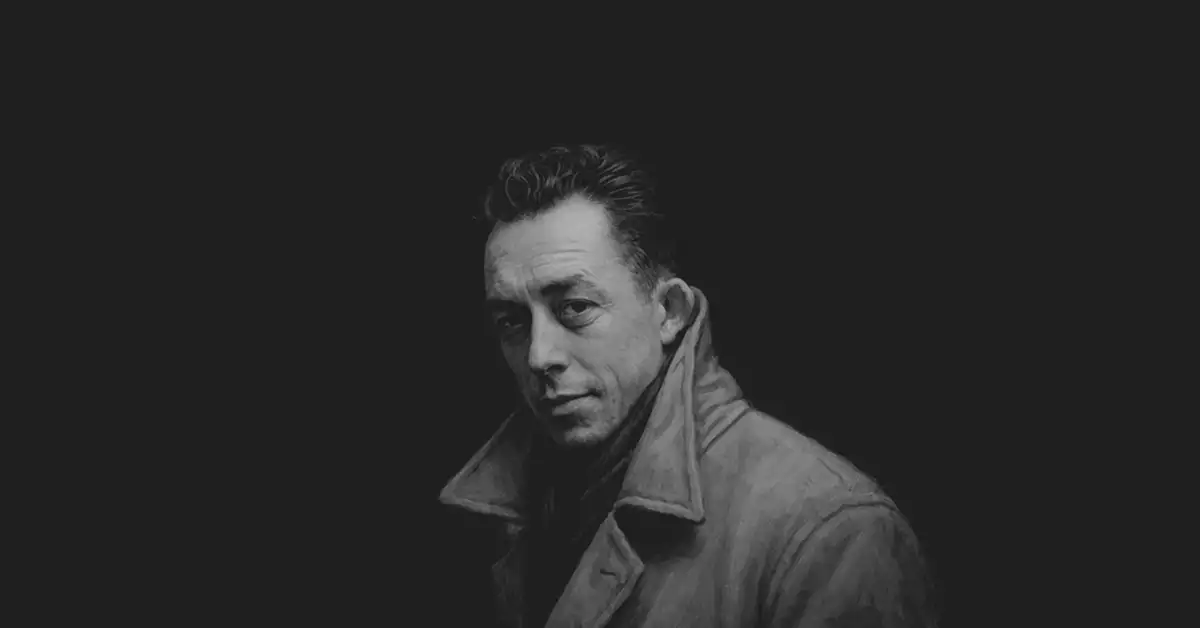
On January 4, 1960, Albert Camus was killed in a car accident on a road near the village of Villeblevin, in the Yonne department of northern France. He was forty-six. He had recently turned down an offer to take the train — his return ticket was in his pocket. The car, driven by his publisher’s nephew, hit a plane tree at speed and broke apart. Camus was killed instantly. Michel Gallimard, who was driving, died five days later. His wife and daughter, also in the car, survived.
In the wreckage, investigators found a briefcase. In the briefcase, among other papers, was a partial manuscript of a novel Camus had been working on for several years. He called it The First Man. It was the most autobiographical thing he had written: set in Algiers, in the poverty of his childhood, in the specific texture of a life shared between European settlers and the city’s Arab and Berber population in ways that none of his published fiction had directly confronted.
The manuscript was found, was preserved, and was published thirty-four years later by Camus’s daughter. It exists now as a partial thing — not a novel but the beginning of one, the rough draft of something that never arrived at its own conclusion. Reading it requires a specific kind of attention, because what you are reading is not what Camus would have shown you. It is what he was working on before he died. The distinction is real and it matters.
The Stranger was published in 1942. The First Man, begun in the late 1950s, represents Camus’s late attempt to return to Algeria and to his own origins — to write, directly and without the protection of fiction’s typical distance, about who he was and where he came from. The novel follows a character named Jacques Cormery, who is tracing the father he never knew — Camus’s own father died in the First World War when Camus was less than a year old — and who moves through an Algerian childhood that is clearly Camus’s own: the poverty, the illiterate mother who worked as a cleaning woman, the grandmother’s severity, the teacher who became a mentor, the specific sensory world of Algiers in the 1920s and 1930s.
What the manuscript gives us that The Stranger does not is texture. The Algerian working-class world of Camus’s childhood was populated by people of all backgrounds — European settlers, Arab and Berber Algerians, Sephardic Jews — all of them poor, all of them navigating the same narrow material conditions. The manuscript describes a childhood world in which the colonial divide, though real and structurally enforced, was crossed by the daily proximities of poverty: the Arab neighbors, the shared streets, the common experience of having nothing.
This is not the Algeria of The Stranger. In The Stranger, Algeria is the sun and the beach and the category of Arab. The Arabs in the novel are presences without interiority, defined by their relationship to the plot and the sun and the European man who kills one of them. The novel was written by someone who knew a more complex Algeria than this — who had grown up alongside Arab and Berber children, who had shared a city with them, who understood at some level the specific texture of a shared colonial poverty. And yet The Stranger does not contain that complexity. It contains the colonial grammar, the categories, the beach.
The First Man is the evidence that Camus knew the difference.
In December 1957, Camus accepted the Nobel Prize for Literature. On the steps of Stockholm University, a young Algerian student challenged him: why was he silent on the question of Algerian independence? The question was pointed and, for Camus, painful. The Algerian War of Independence had been ongoing since 1954. Camus, whose homeland was the subject of that war, had been largely silent — not indifferent, but unable to find a position he could publicly hold without either abandoning his principles about violence or abandoning his attachment to the European Algerian community to which he belonged.
His response to the student has been quoted and condemned ever since. He said, in substance: I have always condemned terrorism. But I cannot condemn terrorism that kills Algerian fighters if I am unwilling to condemn terrorism that kills civilians in the streets of Algiers, which could include my mother or my family. Between justice and my mother, I choose my mother.
The statement was attacked immediately and has been attacked since. It seemed to place a personal loyalty above a political justice. It seemed to prioritize the safety of one European woman over the political liberation of an entire colonized population. Coming from the man who had written about the absurd condition of humanity and the need to rebel against injustice, it seemed like a retreat into something smaller than his own philosophy.
The First Man contextualizes the statement without redeeming it.
The mother in the manuscript — the character who is clearly Camus’s own mother — is a woman of extraordinary ordinary presence. She barely speaks. She is almost entirely silent in a way that the novel renders as dignity rather than absence. She cleans other people’s houses. She listens, without fully comprehending, to the radio. She loves her son with a love that has no vocabulary for itself because she has never been given a vocabulary for anything. She is the woman Camus chose over justice in Stockholm, and reading her in the manuscript, you understand something about why — not agree with it, but understand the emotional reality from which the statement came.
This is what The First Man does. It provides the interior of a relationship that the Nobel statement could not make visible. It does not make the statement right. It makes it human in ways that the statement alone, stripped of its emotional roots, could not convey.
Here I want to apply pressure to what this essay has been doing.
I have been using The First Man as evidence that Camus was more complex than The Stranger suggests — that he knew an Algeria of shared poverty and daily proximity, that he was trying to write himself back into a more honest relationship with his homeland, that the unfinished manuscript represents a movement toward something better than the finished novel’s colonial grammar.
This is the most convenient argument available, and I should name its convenience.
The series has spent eight essays tracking what happens when a reading system takes a text and produces from it exactly what it was looking for. The court takes Meursault’s funeral behavior and produces a murderer. The translator takes maman and produces a cold man or a warm one. The philosophical vocabulary takes the novel and produces either an absurdist hero or an existentialist man. In each case, the reading finds the Meursault it needs.
Reading The First Man as a corrective to The Stranger does the same thing. It takes an unfinished text that cannot speak for itself — Camus did not choose to publish it, did not edit it, did not decide it was ready to be read — and uses it to argue that the finished novel was not his final word on Algeria. This is reading the rough draft to argue that the polished version is not the real one. It is finding in the gap, once again, exactly what we wanted to find.
The honest position is this: The First Man is evidence that Camus was thinking about Algeria differently in 1960 than in 1942. It is not evidence that he had resolved the problem of The Stranger‘s colonial grammar, because he had not had time to resolve it and because resolution is not guaranteed even given time. The manuscript is not the corrective. It is the beginning of an attempt at a corrective — an attempt that was interrupted by a plane tree on a road in Burgundy.
These are different things. The beginning of an attempt is not the same as the corrective it might have become.
What would Camus have written if he had lived?
The question is irresistible and unanswerable. He was forty-six. He had won the Nobel Prize. He had published his major philosophical works and his most celebrated fiction. He had the unfinished manuscript, which suggests he was not satisfied — that there was something he still needed to write, something about his origins and his homeland that his published work had not yet contained.
But what he would have written is not available. What is available is the beginning, and a reading of the beginning tells us only what he was working toward in the months before January 4, 1960.
He was working toward the mother. Toward the poverty. Toward the specific, textured, shared world of Algiers that The Stranger‘s colonial grammar had flattened into category and type. Whether he would have gotten there — whether the finished First Man would have been the novel the manuscript suggests it could have been — is not a question the wreckage can answer.
The Algeria Camus loved is the Algeria of The First Man: the beach, yes, but also the neighborhood, the poverty, the Arab children who were also poor and also present, the mother who cleaned houses and came home tired and said almost nothing. This is the Algeria his childhood contained.
The Algeria of The Stranger is narrower. It is the Algeria of a French man’s indifference to the world around him, including the colonial world, including the Arab man he kills. The colonial grammar of the novel is not accidental — it is structural, built into the single perspective that can observe everything except what it cannot see. And what it cannot see, in 1942, is Arab interiority.
Both Algerias belong to Camus. Both are true aspects of his relationship to a place he loved and a situation he could not cleanly inhabit. The pied-noir son of a cleaning woman, growing up in a city where colonial law guaranteed his family privileges they could barely afford to take advantage of, where the Arab neighbors were also poor but differently categorized — this Camus knew something that The Stranger does not fully render. He was trying, at the end of his life, to render it.
He didn’t finish.
Reading Camus now — reading The Stranger now, in the series’ context — means holding several things at once that resist being held together.
The novel is formally extraordinary: precise, cold, structurally perfect, one of the most influential novels of the twentieth century. It is also a novel in which a man kills an Arab who has no name, and the trial that follows treats the death as an occasion rather than a subject, and the colonial grammar that makes this possible is not examined by the text but simply inhabited.
These are both true. They were true in 1942 and they are true now, and the eighty years of reading between then and now have not resolved the tension. They have added layers: the translation controversy, the postcolonial readings, Daoud’s corrective novel, the unfinished manuscript in the briefcase.
The briefcase is perhaps the most honest image for what remains. It was on its way somewhere — Camus was returning from a holiday, headed back to Paris, carrying the manuscript of the novel that might have changed how we read everything else. The briefcase arrived. The novel did not.
What remains is what survives the wreckage. The briefcase. The beginning of an attempt. The finished novel in its cold precision. And the Algeria that contains all of it: the sun, the beach, the Arab whose name was Musa in a different book, the mother who said almost nothing, the man who said maman and could not tell you whether he meant it, and the court that executed him for failing to prove that he did.
Camus carried the manuscript back toward Paris. He didn’t make it. The novel he was writing — the one that might have held the Algeria he knew and the Algeria he failed to render — is the book in the briefcase, unfinished, not ready, not what he would have shown us. We read it anyway. We read it as though it answers something. The wreckage doesn’t answer anything. It just survived.