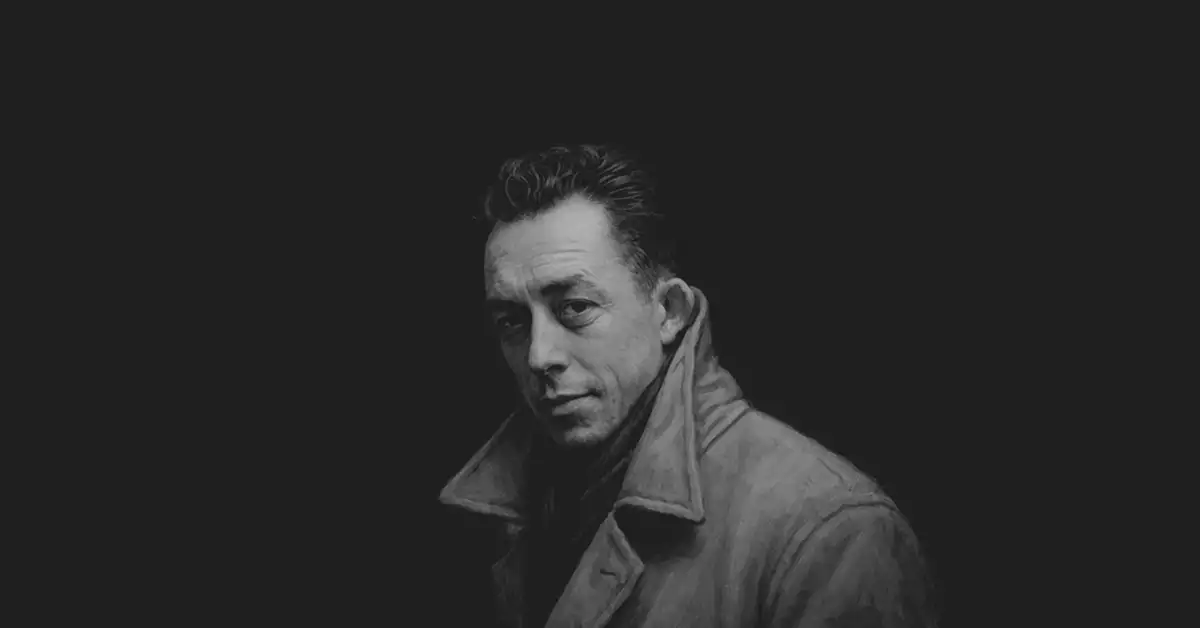
In 1943, Jean-Paul Sartre published a review of The Stranger that is, by any measure, an act of extraordinary literary intelligence. Writing in occupied Paris, under conditions that made philosophical subtlety feel both urgent and slightly surreal, Sartre identified the novel’s formal achievement — the way its style enacts its content, the way Meursault’s flat declarative sentences perform his relationship to meaning — with a precision that remains, eighty years later, largely correct. He called Meursault the absurd man, situating the novel within the philosophical project Camus was simultaneously developing in The Myth of Sisyphus. He offered Camus a label, a school, a position in the philosophical landscape of postwar Europe.
Camus accepted the praise and quietly but persistently refused the label. He was not an existentialist. He had never used the term “absurdist hero.” He did not want the novel filed under Sartre’s categories. The distinction was not vanity — it was precision. The two philosophies, existentialism and absurdism, produce different readings of the same novel. And different readings of The Stranger produce, by now a familiar process, different defendants.
The distinction between existentialism and absurdism is easier to feel than to specify, which is one reason it has been collapsed so often in the decades since. Both begin from the same observation: the world does not provide the meaning that human beings require. Both refuse the easy escapes — religion, ideology, the various forms of what Sartre called bad faith and Camus called philosophical suicide. Both take seriously the condition of a person who sees clearly that the universe is indifferent and chooses to live anyway. So far, the two philosophies walk together.
They diverge on the question of what happens next.
For Sartre, the recognition that the world offers no pre-given meaning produces radical freedom: if meaning is not given, it must be chosen, and the choosing is everything. The existentialist hero is the person who assumes full responsibility for their choices, who refuses to hide behind nature or God or social role or psychological determinism — who acknowledges that they are, in Sartre’s formulation, condemned to be free. Authenticity, for Sartre, is the willingness to own one’s choices without self-deception about their grounds.
Meursault, read through this lens, is an existentialist hero — perhaps despite himself. His refusal to perform grief he does not feel, to claim love he cannot locate, to accept comfort he does not believe in, to pretend that the prosecutor’s moral categories describe anything real: this is the radical authenticity Sartre admires. Meursault will not lie. The court demands that he produce the expected emotions; he does not have them or cannot access them; he refuses to manufacture them. In Sartrean terms, this is courage — the courage of refusing bad faith even when bad faith would save his life.
Camus’s absurdist reading of the same character is different enough to matter. For Camus, the recognition that meaning is unavailable does not lead to radical freedom — it leads to revolt. The absurd condition is the permanent confrontation between the human need for meaning and the world’s silence. The absurdist response is not to choose meaning (existentialism’s move) or to manufacture transcendence (religion’s move) but to live within the confrontation without resolving it. To keep the tension open. To refuse both the false exit of faith and the false exit of despair.
The Meursault who emerges from this reading is different from Sartre’s. He is not heroic in the sense of heroically choosing. He is heroic in the sense of heroically remaining — remaining in the sensory present, in the warmth of the sun and the body of a woman and the sound of the sea, without reaching for any framework that would explain why these things matter. He doesn’t need them to matter in a cosmic sense. They are what they are: the texture of a life lived without illusion.
Two philosophical vocabularies. Two Meursaults. Both produced by the same novel. Both, in a sense, correct.
In the spring of 1952, Sartre’s journal published a hostile review of Camus’s The Rebel, the philosophical essay in which Camus argued against historical violence and against the determinism that, in his view, allowed intellectuals to justify terror in the name of liberation. Camus’s argument was essentially: no political end justifies killing people, and the 20th century’s willingness to believe otherwise had produced catastrophe. Sartre disagreed — not simply on the political question, but on the philosophical one underneath it: whether history has a logic that moral individuals are obligated to engage with, even when that engagement requires accepting means that are, in isolation, monstrous.
The exchange that followed between Camus and Sartre was public, personal, and, for both men, costly. The friendship ended. Two of the most significant intellectual presences of postwar Europe spent the last years of Camus’s life in documented enmity, their philosophical differences having become political ones and their political ones having become personal.
This break did not happen in 1942, when The Stranger was written. But it happened before most of the novel’s readers encountered it. Every reader who comes to the novel knowing the Sartre-Camus history — which is every reader who has spent any time with postwar French intellectual history — reads it through the residue of that break. To call Meursault an existentialist is, retroactively, to ally the novel with Sartre’s politics. To insist on the absurdist reading is to maintain Camus’s distinction. The philosophical vocabulary is not innocent of the political one.
What this means for reading The Stranger is something the novel could not have anticipated and cannot control: it has become a text in a debate that postdates it. Its Meursault has been recruited to positions Camus had not yet taken when he wrote him. The existentialist Meursault and the absurdist Meursault are now also, obscurely but genuinely, the Sartrean Meursault and the Camusian one — and those labels carry political weight that the 1942 novel did not intend.
In The Myth of Sisyphus, Camus writes that we must imagine Sisyphus happy. Sisyphus is condemned to push a boulder up a hill and watch it roll back down, forever, without end or purpose. This, Camus argues, is the absurd condition — and Sisyphus’s happiness is the absurdist response: not the happiness of achievement or transcendence, but the happiness of full presence within the struggle itself, the rock and the hill and the muscles and the descent, the whole experience embraced rather than denied.
The question this raises for Meursault is one the novel takes seriously and does not easily answer: can we imagine him happy?
The novel’s final pages suggest something close to it. After the encounter with the prison chaplain, after the rage, after the rage subsides, Meursault experiences something he calls, or the translation renders as, an openness to the world’s gentle indifference. He feels the night, the stars, the smells of summer, and something in him that had been clenched releases. This reads — and Camus almost certainly intended it to read — like the Sisyphean happiness. The absurdist acceptance that the world offers no warmth and that this is all right, that the world’s indifference is not hostile but simply what it is.
But I want to apply some pressure to this reading.
Meursault reaches this peace in a prison cell, the night before his likely execution. His options at this point are: despair, or something else. The “something else” that Camus provides him is the acceptance of the absurd condition, the opening to the world’s indifference. This is presented as a philosophical achievement — the end point of a man who has, finally, arrived at the absurdist position.
But it is also the simplest available response to a situation in which all other options have been removed. It is easier to imagine Sisyphus happy when Sisyphus no longer has the option of setting down the rock and walking away. Meursault cannot walk away. The contentment available to him is the contentment of someone who has no choices left, and calling this the absurdist ideal may be applying a philosophical label to what is, more precisely, the psychology of radical constraint.
The absurdist reading makes Meursault’s acceptance look like wisdom. The more uncomfortable reading makes it look like what happens to a person when they have nothing left to resist.
Here I want to examine what this essay has been doing.
I have been treating the existentialist/absurdist distinction as though it illuminates Meursault — as though choosing the right philosophical label produces a more accurate reading of the character. But this is the series’ recurring error, and I should name it here.
Every system this series has examined does the same thing: takes Meursault, submits him to a vocabulary, produces a reading. The translation machine produces three defendants from one word. The trial produces a murderer from a funeral’s emotional record. The physiological reading produces a heat-compromised body with diminished agency. And now philosophy produces either a Sartrean man of radical freedom or a Camusian man of revolt and presence — two different people, same novel.
All of these systems are illuminating. None of them is adequate. What they share is the structural move of submitting Meursault to a vocabulary he did not choose and asking whether the vocabulary explains him. It explains him about as well as any translation explains an original: partially, with significant losses, and with the system’s own assumptions encoded in what it claims to find.
Calling Meursault an absurdist hero is not wrong. It is not more wrong than calling him a cold-blooded killer, or a colonist’s unconscious, or a man in heat stroke. It is a reading. It illuminates. And it produces a defendant: a man whose fatal act can be positioned within a philosophical system that explains, if not excuses, the distance at which he holds his life.
Camus resisted the label not because it was incorrect but because he knew what labels do. They close things down. They make the novel’s unresolved tensions feel resolved. They give the reader a category to put Meursault in, which is exactly what Meursault, in the novel, refuses to allow the world to do to him.
In a preface Camus wrote for an American edition of the novel, he offered his most compressed account of who Meursault is. He described him as a man who refuses to lie — and said that this refusal, in our world, condemns him to death. He added, in a phrase that has haunted the novel’s reception ever since, that Meursault is the only Christ we deserve.
The claim is startling. Not because it is immodest — Camus is not claiming the novel is as important as the Gospels — but because of what it implies about the category. A Christ is a martyr: someone who dies for a truth that the world cannot accommodate. Not a truth that is strategically useful, or politically effective, or socially necessary, but a truth that is simply, obstinately, what it is — and that costs its holder everything.
What is Meursault’s truth? What does he know that costs him his life?
The honest answer is that the novel does not fully specify this. He knows that he cannot perform emotions he does not have. He knows that the sun was genuinely involved in what happened on the beach. He knows that the chaplain’s certainties are not available to him. These are not grand truths. They are small truths — small, stubborn, intractable.
Whether a man should be executed for holding small stubborn truths about his own experience is the question The Stranger poses without answering. Whether calling him an absurdist hero, or an existentialist man, or the only Christ we deserve, brings us closer to answering it — that question the series has been circling and has not reached.
It may not be reachable. The philosophical labels tell us what tradition Meursault’s silence belongs to. They do not tell us whether his silence was right. They do not tell us whether the world that executed him for it was wrong.
They produce, as every vocabulary produces, a defendant. The original remains in the French.