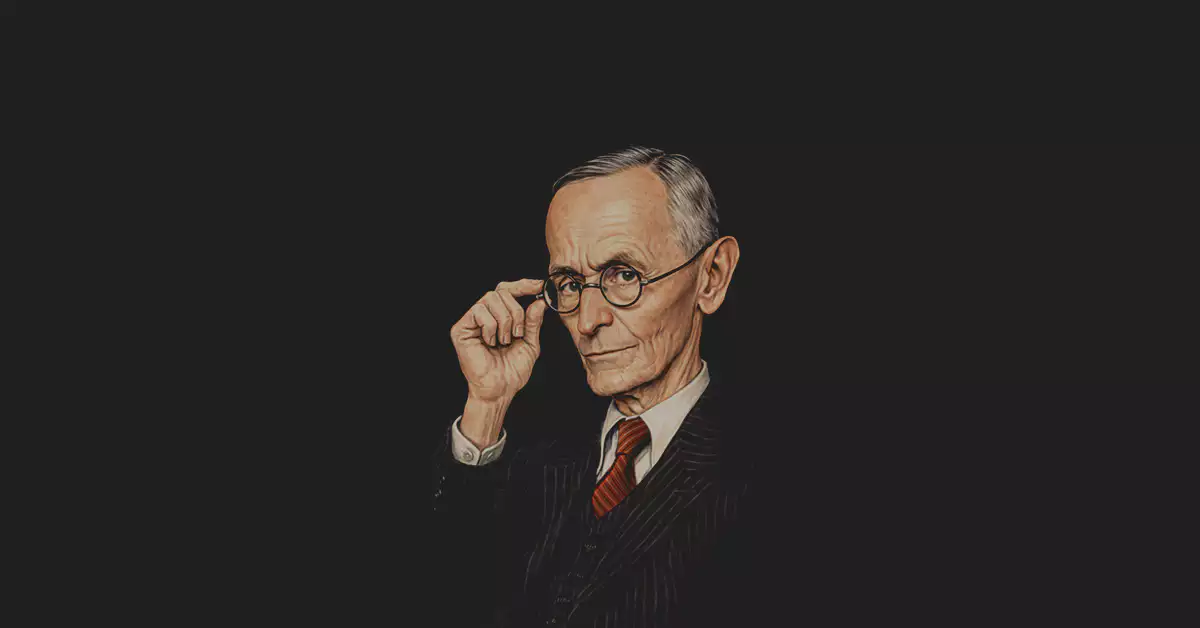
The argument arrives quietly, on a walk home from school, offered by a boy who has never spoken to this other boy before.
Sinclair is eleven and two weeks into a financial arrangement with Franz Kromer, who has discovered that a boast Sinclair made to appear impressive can be used against him. He is paying money he doesn’t have to keep a secret that was never true. The crisis is real and has no exit he can see, and he carries it the way children carry things they cannot explain — invisibly, face arranged normally, the catastrophe running somewhere below his face. Max Demian, who sits in the higher form and is somehow both older and unplaceable, falls into step beside him. They haven’t spoken before. Demian speaks first.
What they talk about is Genesis. The Cain and Abel story. The class has just received it in the standard way — Cain as murderer, the mark as punishment, Abel as righteous victim, the moral architecture complete — and Demian has found something wrong with it. Not dramatically. He offers the correction the way someone offers a thought that has been sitting with them and is now ready to test against another person.
What if the mark was not shame? What if people called it shame because they were afraid of the man who wore it?
The argument runs this way. There was a man with something in him that made the people around him uneasy. Not threatening in any specific sense — not aggressive, not violent in the moment of encounter — but genuinely disturbing in a way that preceded analysis. A quality that ordinary sociability could not accommodate, that people experienced before they had constructed a story about why they felt it. Because people who are afraid without a story to explain the fear will invent one, they did: he killed his brother. God branded him. The mark means this person is a danger. But the mark had been there before the story. The story was made afterward, to render the fear legible, to give the frightened community something to say about the person it could not absorb.
So Cain didn’t kill anyone. Or if he did, the killing was beside the point of what the story is actually about. The story is about how a community manages a person it cannot hold. The mark, reread: not stigma but distinction. Cain’s descendants are not the cursed. They are the people who carry something the ordinary world finds unbearable.
Demian finishes. He turns at the intersection and walks away. Sinclair stands in the street.
He thinks immediately that it’s wrong. Blasphemous, possibly — the kind of thing that sounds daring at eleven and would be identified as heresy by anyone who thought it through. He goes home and reads Genesis again, searching for the flaw in Demian’s reading, and finds he cannot hold onto it. The text does what Demian said it does. There is no verse that refuses him.
What Demian has performed is a specific operation, and it’s worth being precise about what it is. He took the story’s explicit content — the mark, the fear, the punishment — and showed that the content is pointing at something the story isn’t admitting. The manifest meaning is treated not as meaning but as symptom. The symptom is read for the logic it’s concealing. This is the move literary criticism makes when it’s working well: the official account of what a text says is displaced by an account of what the text is doing, which is usually more complicated and often more unflattering to its originators.
The reading is genuinely good. It names something real. Communities do construct stories that convert fear of the exceptional into moral categories — that transform “this person disturbs us” into “this person has transgressed.” The criminal, the deviant, the witch: categories that begin, often enough, with a social need to narrativize unease before the unease can be acknowledged as unease. Demian’s Cain is a general figure. That is not a criticism. Some figures are general because they describe something that actually occurs.
The argument works. The reader who encounters it — at eleven, at fifteen, at twenty-five — feels its pull. It offers a different story than the one they were given. Not truer in the sense of being historically accurate to a Cain who is not available for verification, but better in the sense that more things fit inside it. More of what the reader has noticed happening to people who refuse the usual accommodations, who carry something their communities have to manage through designation before those people have done anything to deserve it.
This is the pull, and it is real. But good arguments in novels are not the same thing as true ones. An argument can describe something accurately and still be doing something other than describing.
Demian delivers the argument while walking. He doesn’t stop to make a speech; he doesn’t establish eye contact for the important parts. His hands, when they move at all, don’t perform the small social adjustments — the emphasis, the apology, the punctuation by which most people regulate how much of themselves they’re sharing — and this quality, in a boy of sixteen or seventeen in the Germany of 1905, would have been immediately recognizable to the first readers of the novel as the posture the Wandervogel movement had spent fifteen years trying to teach: the body held without apology, without the bourgeois managerial relationship to one’s own presence, without the unspoken agreement that social life requires you to make yourself slightly smaller than you are. The Wandervogel — those tens of thousands of middle-class German teenagers who had been walking the hills and forests since 1901, rejecting the cluttered interiors of their parents’ generation, believing they were learning to encounter experience directly — had been practicing exactly this bearing. Demian’s stillness would have felt familiar to them. They had been working toward it.
The problem with the Wandervogel, which became visible after the war when many of its members had been absorbed into organizations whose liberation language pointed somewhere else, was structural. The flight from one system of belonging produced another. What began as a refusal of conformism became, in time, a new conformism with better scenery. The language itself — we see what ordinary people cannot; we recognize each other by a quality they do not share — was highly portable. You could use it to go into the forest. You could use it to go somewhere else entirely.
This is the critique that assembles itself around Demian’s Cain, and it has genuine force. The argument is structurally identical to aristocracy. There are people with the mark and people without it. The people with it know each other. The people without it are, charitably interpreted, afraid of what they can’t comprehend — and, less charitably, beneath consideration. You don’t earn the mark. You have it or you don’t. The gentry didn’t choose their lineage; the Brahmin didn’t earn his caste; Cain’s children didn’t do anything to acquire their mark except be the kind of person who disturbs ordinary people, which is a quality, not an achievement.
A system of belonging that requires no achievement is inheritance. An inherited system that speaks the language of authenticity — that presents itself as the opposite of the closed world it is replicating — is more seductive than ordinary aristocracy, because it has the feel of finally being seen rather than the feel of being admitted to a club.
The critique is real and should not be abandoned. But I have been delivering it too smoothly.
Demian’s Cain is not simply superior. He is frightening. This is a specific claim, and the aristocracy reading slides past it.
Aristocracies claim superiority in terms that are usually expressed as control: refinement, taste, the management of self and circumstance that marks a person as elevated. This is a legible category. People can argue about whether it’s real. And it is, above all, a category the people who inhabit it can explain — the Brahmin knows he is Brahmin, the gentry knows its credentials, the distinction has a name and the name precedes the person.
Demian’s Cain does not know this, or rather: what makes him remarkable is precisely that his quality precedes his knowledge of it. People are disturbed by him before he has understood why. The unease he produces isn’t the unease of encountering someone with established power; it’s the unease of encountering someone who seems to be tracking something you’ve collectively agreed not to track. Think of the student who asks the question no one wants answered — not because she is cleverer, not because she has done the reading more carefully, but because her attention is on something underneath the room’s surface that the room has decided to leave there. Or the child at the table who says what everyone knows and no one will say. Or the person at the gathering who doesn’t laugh at the right moment, not from contempt, not from distraction, but because something beneath the joke is visible to them and the joke was built to cover it. These are not elevated people. They have not achieved anything. What they have is a thinness of the social skin — some boundary between their actual attention and the performed surface of social life is less robust than usual — and this thinness shows, and the people around them feel it, and they do not like feeling it.
Demian’s Cain is this figure. And the story the community tells — the lie Demian says was invented to explain the fear — is the predictable response to exactly this kind of person. When a community encounters someone it cannot absorb through the usual mechanisms, it reaches for narrative. If you cannot integrate the person, you explain the person. You say there is something wrong with them. You say they have done something wrong. This is not unusual. It has a long history, and the history is not pretty.
So the aristocracy critique is real. But there is something in “frightening” that “superior” misses, and the essay has been routing around it.
Here is what the argument produces when it is followed far enough, and what I have been putting off.
Who bears the mark, and who decides?
The novel presents recognition as horizontal — the marked ones find each other the way people who have witnessed the same thing find each other, without explanation. A fellowship is implied: not hierarchy but equality, the meeting of people who were always equal and needed only confirmation. This is how Sinclair understands his relationship to Demian. It is what he carries out of the novel when he looks in the mirror at the end and sees his own face converging with Demian’s.
But the sequence of events in the novel is different.
Demian sees the mark in Sinclair before Sinclair knows he has it. He approaches Sinclair on the walk home — Sinclair hasn’t sought him out, hasn’t signaled anything, hasn’t asked. Demian has been watching, and he has made a determination, and he initiates. The argument moves from Demian toward Sinclair; it does not emerge between them. Later, when Sinclair is being blackmailed and has no exit, Demian intercepts him in the rain and dissolves the blackmailer through means the novel declines to specify. The means are Demian’s; the intervention is his; Sinclair receives it. When Sinclair needs the concept of Abraxas — needs a name for the god who holds darkness and light together — Pistorius supplies it, descending with the framework at the moment Sinclair needs it. When Sinclair produces the painting of the bird breaking from the egg and sends it into the world, the answer comes back from hands that were already watching.
The direction of recognition in this novel is invariant. It moves from the already-marked toward the potentially-marked. Demian descends toward Sinclair; Sinclair never ascends. This direction does not change.
This is not a community of Cain’s children. It is a structure of initiation, in which someone who already knows chooses someone who does not yet know and begins telling him who he is. The selection precedes the recognition. The mark is not identified; it is conferred. And the person who confers it — who decides which confused boy is worth approaching on the walk home from school, which painting is worth sending a message about — is not exercising some neutral capacity for detecting the genuine mark. He is making a choice. He is deciding.
Which means the Cain argument is doing something other than what its form suggests. It presents itself as a corrective — a restoration of dignity to the people the official story punished. What it actually provides is a framework in which a specific person can tell other specific people: you are one of the chosen. The framework makes this feel like recognition, because it produces the experience of being recognized — of finally having words for the thing that has always made you feel separate, of meeting someone who sees what you’ve always suspected about yourself. But this experience is a gift. And the person who offers the gift decides who receives it.
The novel knows something of this. The ending — Sinclair in a field hospital, looking at the man on the adjacent mattress and finding Demian there, receiving from him a message and a final kiss — is usually read as the completion of individuation, the moment when the outer teacher becomes the inner self. But it can also be read as the completion of something else: the moment when the face Sinclair has been given as his ideal finally settles into his mirror. The emergence the novel’s opening sentence promised — the self pressing outward from within, the authentic life that wanted to be lived — ends with a borrowed face.
The reader who finishes the novel and feels recognized, who feels that Hesse has finally given a name to the thing that has always made them feel separate from ordinary people, is not wrong to feel this. The feeling is real. But the question Demian’s Cain cannot answer is not whether you bear the mark. It is: why do you need to know?
And underneath that: who decided you were worth approaching on the walk home?
The argument about Cain describes something true. Communities do punish what they cannot absorb, and the punishment often takes the form of a story about a crime. None of that should be lost. But the argument requires a Demian to deliver it. It requires someone who already inhabits the certainty to walk up beside you and begin. Without that person, the argument is a hypothesis. With that person, it becomes an experience — the experience of finally being seen, of the mark being named. And the experience is what the novel is counting on.
The mark was never waiting to be recognized. It was waiting to be given. This is the thing Demian’s argument, taken seriously, arrives at: the person who offers you the story of your own distinction has already decided something about you.
I have been reading this novel for a long time, and I still find the argument beautiful. That is the part I don’t know what to do with.