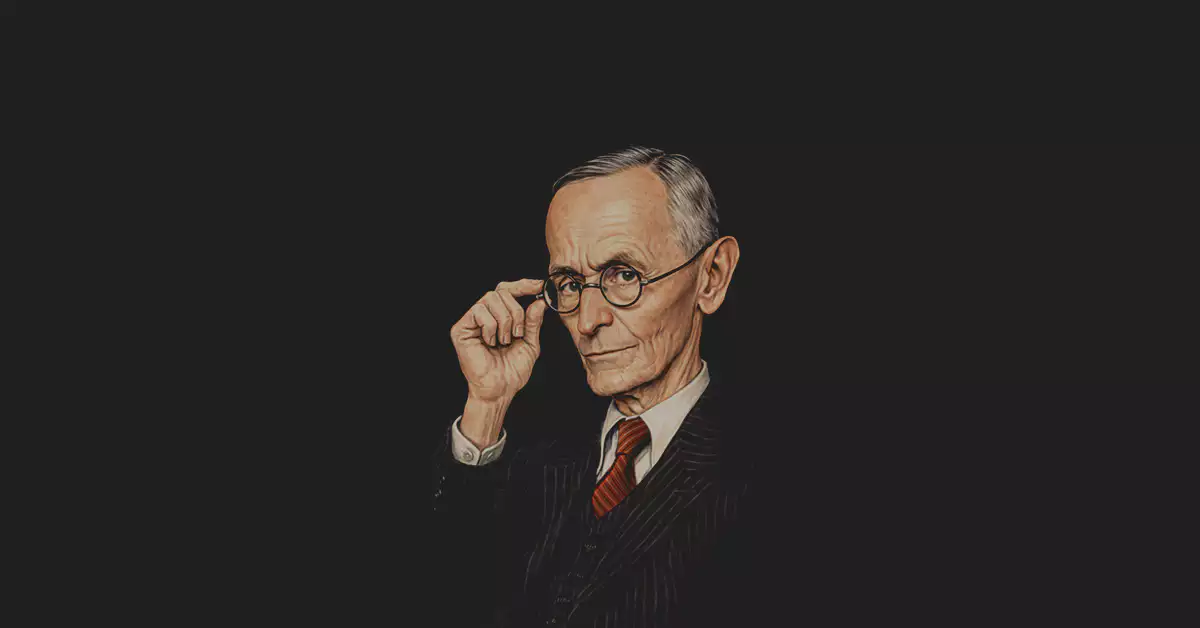
The sentence says nothing about the egg.
This is easy to miss. Der Vogel kämpft sich aus dem Ei. Das Ei ist die Welt. Wer geboren werden will, muß eine Welt zerstören. The bird fights its way out of the egg. The egg is the world. Whoever wants to be born must destroy a world. The destruction is there — muß zerstören, must destroy, the obligation grammatically firm — and the one who breaks out is present, and the world being broken is named. But the sentence says nothing about what happens to the egg. Nothing about what the egg contained, nothing about who it belonged to, nothing about whether the breaking was as necessary as the sentence’s grammar insists. An egg is not empty. The bird forms inside it. The calcium casing and the fluid it protects are not obstacles to the bird’s existence; until the moment they become obstacles, they are what the bird’s existence requires. The sentence calls for the destruction of a life-support system without pausing over this, without noting it, without naming the thing that will be lost when the shell breaks.
The most quoted sentence in a novel full of quotable sentences has traveled so far from its occasion that it reads as pure principle — the kind of statement that seems to have always existed, that seems to predate the author who wrote it. It appears on walls and skin and in phone wallpapers of people who have never read the novel and in the notebooks of people who have read it many times. But in the novel it arrives as a specific document, tucked into Sinclair’s Latin textbook, unsigned, placed there by hands Sinclair doesn’t see. He has sent Demian a painting — the bird pressing through the cracked shell, a figure from a dream rendered in watercolor and oil — with no message, as a kind of petition into silence. The note arrives in response. It names the bird’s destination: God, whose name is Abraxas. And then it ends. The note tells Sinclair where the bird is going. It says nothing about what gets left behind.
This omission is the essay’s opening problem. Not: what does the sentence mean? But: what does it not say, and why does the not-saying matter, and what has it cost the people who received the sentence and took it seriously?
The developmental logic the sentence encodes is real, and the essay has to credit it before examining what it leaves out.
Something that wants to become must break what contains it. The chrysalis is not an obstacle to the butterfly — until it is. The shell of the self, the accumulated arrangements by which a person has learned to exist within the expectations of their particular world, is not always a prison. But it becomes one. And breaking it, which feels from inside like violence, is the condition of becoming something that the shell’s interior cannot produce. This is the logic that drives the Bildungsroman as a form, which is the form Demian works within and works against. Goethe’s Wilhelm, Keller’s Green Henry, Mann’s Buddenbrooks: the German Bildungsroman assumes that the self is shaped through its encounters with the world and that the shaping requires rupture. The shell has to go. The childhood arrangements have to be dismantled. What gets built in their place is the real self, forged through genuine encounter rather than simply given. This is the genre’s promise, and it is the promise Demian’s sentence concentrates into three clauses.
By 1919 the promise was under pressure it had not faced before. Flaubert had been putting pressure on it from within the literary tradition since 1869 — his Frédéric Moreau neither forms nor fails dramatically but simply subsides, talented and empty, into a kind of permanent inconclusion. But the pressure that matters to Demian is external. The war that had ended the previous year was also, in a grotesque sense, a Bildungsroman: a generation of young men sent through an experience designed to forge them. The forge was Verdun and Passchendaele and the Somme, and what it produced was not shaped selves but thirty-seven million casualties. Hesse knew this. He had spent the war in Geneva, writing care packages for German prisoners of war, publicly enough to be denounced in the German press as a traitor. He wrote Demian immediately after the armistice, in three weeks, under a false name, in a state his letters describe as something between grief and fugue.
And yet the egg metaphor does not retract. It insists on the developmental logic even in this context. It says: what looks like destruction is really birth. The world-breaking is the price of genuine life. Whether this is Hesse’s most courageous claim or his most desperate one is a question the essay will return to. For now, note only that the sentence was written by a man who had just watched a world break, and who chose, in response, to write a manifesto about the necessity of breaking worlds.
A monarch butterfly cut free from its chrysalis by a well-meaning hand will emerge with wings it cannot use. The fluid that should be forced through the body and into the wing-membranes during the struggle to exit stays trapped; the wings never properly inflate; the butterfly lives out its brief life on the ground. The struggle to emerge is not incidental to the development — it is the mechanism of it. The resistance of the chrysalis wall is what drives the fluid outward. Remove the resistance and you do not have an easier emergence. You have the shape of a butterfly that will never fly.
This seems at first to confirm the egg metaphor precisely. The difficulty cannot be outsourced. You must break the shell yourself or the breaking means nothing. The resistance is necessary, not contingent. Sinclair must fight his way out or what emerges will not really be Sinclair.
But the butterfly story is about a specific kind of failure: what destroys the butterfly is not hardship but rescue. The chrysalis is cut open by a person who wants to help, who sees difficulty and intervenes, who believes the struggle is the obstacle rather than the mechanism. The butterfly is killed not by its prison but by its liberation.
Sinclair, at every critical juncture in the novel, is rescued.
Franz Kromer’s blackmail — the crisis that opens the novel, the first genuine pressure on the boundary between Sinclair’s two worlds — is dissolved not by Sinclair but by Demian, who approaches Kromer by means the novel declines to describe. Sinclair is told afterward that it’s over. He did not fight his way out. He was carried. The concept of Abraxas, the god who holds darkness and light together, the theological framework Sinclair requires to understand his own development, arrives through Pistorius, who descends from his organ bench with the theology already formed. Sinclair receives it. He does not construct it. The painting of the bird is sent into the dark, and the dark sends back an interpretation — precise, correct, addressed — from hands that were already watching. Eva arrives as the embodiment of everything Sinclair has been unable to name, and she arrives because Demian brought him to her door.
At every stage where Sinclair might develop through genuine, unmediated encounter with difficulty — through sitting alone with the pressure until the pressure produces something — a guide appears with the next framework, the next concept, the next door already opened. The shells are being cut from the outside. And the butterfly metaphor, read carefully, says what this produces: not a bird but the shape of one. An emergence that required no actual struggle may have produced no actual development. The sentence that says the bird must fight its way out contains, in the butterfly story, a refutation of the novel that contains the sentence.
But here the essay has to stop. Because the novel’s ending does not behave the way the critique predicts it should.
If the egg metaphor were simply the naïve developmental optimism the critique treats it as — if the novel genuinely believed that breaking a world produces a free self, and that Demian’s series of rescues constitutes a legitimate path to that freedom — the ending would be triumphant. The bird would have flown. The note said it was flying toward God. Instead: a field hospital somewhere in the wreckage of the First World War. Sinclair wounded. Demian on the mattress beside him, dying or already gone by morning, his final words a whispered instruction about what to do when Demian is no longer available to be called upon. The bird that the note sent toward God has arrived at a casualty station.
This is not what the manifesto described. And the novel knows it.
Demian announced the war with something close to exhilaration: “This is just the beginning,” he said, arriving on horseback with the news, and the news was that the old world was finally breaking. He had been predicting this. The egg metaphor, in the context of the novel’s later sections, begins to scale up from individual development to historical rupture — the world-egg is not just Sinclair’s bourgeois childhood but European civilization itself, and the war is the mechanism by which the shell breaks. This is the moment where the metaphor’s portability becomes dangerous. A sentence about destroying a world to be born, translated from the scale of individual psychology to the scale of industrial warfare, does not translate. Thirty-seven million casualties are not a chrysalis wall. The fluid forced into the wings by the struggle is not the same as the mud at Passchendaele.
The novel’s ending is the place where the sentence meets what it predicted and cannot redeem. Sinclair emerges from the war wounded, alone, looking at a mirror that shows him his own face converging with Demian’s. The egg has broken. The world is destroyed. And the bird that fought its way out is lying in a field hospital, which is not Abraxas, which is not God, which is where you go when the world you destroyed turns out to have been stronger than the self that wanted to break it.
The egg breaks the bird too. This is not in the sentence. The sentence has no vocabulary for this.
The essay has been arguing that the egg metaphor has a specific blindness: it sees the emergence and not the cost, the one who breaks out and not what gets left behind. This is true. But sitting with the fracture — with the ending the sentence cannot absorb — I find something the argument has been missing.
The egg is not only the world.
Das Ei ist die Welt. The egg is the world. But what is Sinclair’s world? Not an abstract social order, not the bourgeois arrangement of German provincial life conceived as a general category. His world is his father’s house. The particular smell of that interior — soap, hymn books, the warmth of a lamp carried up the stairs. His sisters’ voices through the wall. The morning devotions, the Christmas rituals, the quality of light in a childhood room that is recognizable as that specific room and no other. When the sentence calls for the destruction of a world, it is calling, in Sinclair’s case, for the destruction of these things. And these things are not simply a prison. They are also what formed him. The yolk inside the egg is not the enemy of the bird. It is what the bird is made from.
The novel presents this as straightforwardly necessary: the bright world of the father’s house must be left, the childhood arrangements must be dismantled, because they have become a shell. And in a sense they have. You cannot stay inside them forever. The structures that protect you at ten have become confining at sixteen and suffocating at twenty, and the person who never breaks them remains inside a shape that was made for an earlier version of themselves. The developmental logic is not wrong about this.
But the novel presents the breaking as entirely necessary without examining what “necessary” means here — whether the destruction was required by Sinclair’s genuine development or required by the story Demian has been telling him since the walk home from school. There is a Sinclair who might have developed differently. Who might have found his way to Abraxas without treating his father as a shell to be discarded. Who might have held something of the bright world’s warmth alongside the dark world’s depth, rather than accepting the novel’s insistence that having one requires leaving the other. This Sinclair does not appear in the novel. The novel is not interested in him. He is part of what the egg is made of, and the egg must be broken, and the question of what he would have become is absorbed into the necessity of the sentence.
But the self that had to be destroyed in order to become — this is also a loss. The critique of the egg metaphor’s blindness to outward collateral cost runs into the cost that is internal: the constructed Sinclair, the child of the bright world, the son, is also part of what the shell is made of. You cannot break the shell without breaking that. And “that” is not nothing. That is the particular shape of a particular childhood, irreplaceable in the way that only the specific is irreplaceable.
The shells are what the essay has been circling toward, and they are what the ending must sit with.
They are not abstractions. They are the people who remain inside the egg after the bird breaks out.
Sinclair’s father, who drives to the gymnasium when the warning letters arrive, who stands in his son’s room and tries to reach him and cannot find the language, who goes home unchanged and unhelped. He is not a villain. He is a man who loves his son and has no idea what is happening to him and is given no way in. The novel treats his incomprehension as evidence of the bright world’s insufficiency. But it is also just a father who cannot reach his son and knows it, and who will go home to a house that is missing something it cannot name.
Sinclair’s mother, who appears in the opening pages as the warmth of home — the lamp, the hymns, the safety of that specific interior — and who recedes as the novel’s interest moves elsewhere. His sisters, mentioned early and then simply forgotten, living in the bright world as though the novel can find no further use for them. The schoolmates from his first school, the conventional boys with their conventional futures, who disappear from the text as soon as Sinclair’s development begins in earnest. These are the shells. The novel presents their abandonment as the price of becoming — necessary, structural, the egg that had to break — without asking whether they experienced the breaking, without noting that they were inside it too, without pausing to consider that the world destroyed was not only Sinclair’s world but theirs.
The sentence that has traveled so far — on walls and skin and in the mouths of people in the middle of becoming something — tells them that whoever wants to be born must destroy a world. It does not tell them who is in the world. It does not tell them what it was made of. It does not tell them that the people standing inside the egg when it breaks will not be consulted about whether the breaking was necessary.
The necessity the sentence assumes is real in one sense: you cannot stay inside every structure that once contained you. The shell does eventually become the prison, and the bird that never breaks out never becomes a bird. This is true. But “must destroy” is not the same as “must abandon without looking back.” The sentence collapses a genuine developmental claim into a dispensation — a permission not to consider what you are leaving, not to mourn what you destroy, not to ask whether the people inside the egg had another name besides “the world.”
Sinclair’s father goes home. The novel does not follow him there. It has no interest in what he finds when he arrives — the house, the lamp still burning, the room where his son used to sleep. This is the cost the sentence could not hold. It is not named. It is the egg.