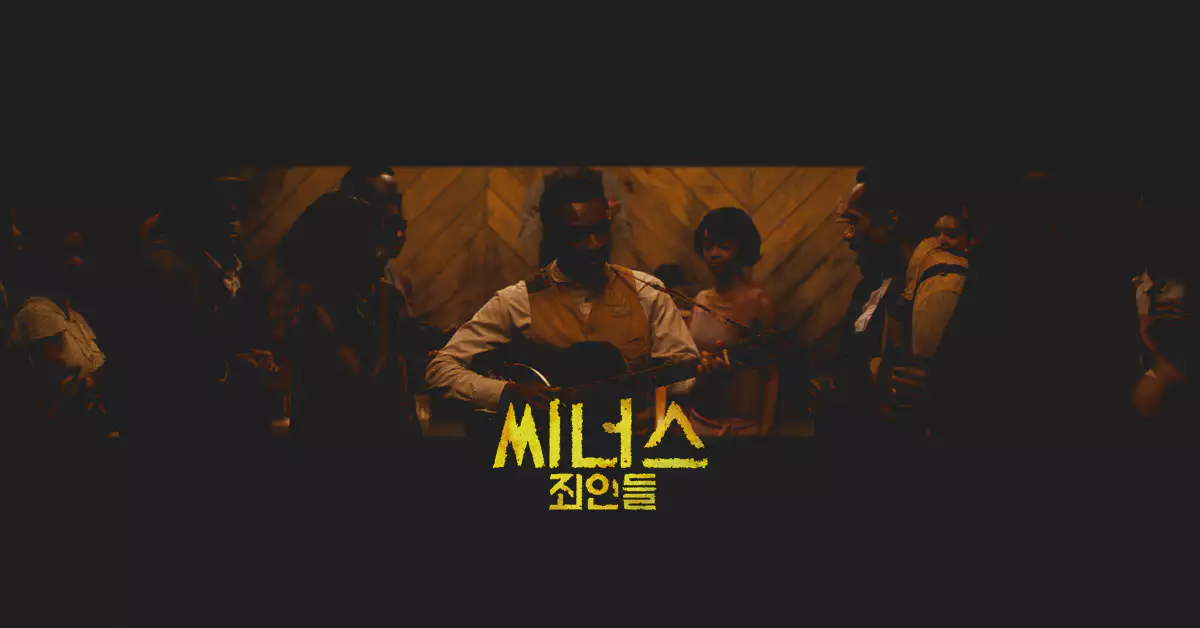
Sinners (2025)
How blues, mortality, and human imperfection shape the emotional and philosophical core of Ryan Coogler’s vampire film
A single note on a guitar and something in the room changes. This is how blues has always worked — not as melody but as atmosphere, not as entertainment but as environment. The note seeps into walls, moves through bodies, unsettles something that had been settled. When the music begins at Club Juke on the night this film is about, it does not merely start a song. It opens something.
The question the film plants in that opening — why are these people called sinners? — is not a moral question. It is a question about who gets to name things, and what happens when you take a name back.
Ryan Coogler has always worked at the intersection of genre and history. Creed used the physics of boxing to examine inheritance; Black Panther used superhero mythology to map the geography of diaspora. Sinners is the most inward of these films, the one most interested in what is irreducibly local and specific: a single night, a single club, a particular community at a particular moment of American time. The setting is 1930s Mississippi — slavery’s formal end long past, its structural aftermath very much present. Coogler does not approach this as material for direct accusation. He approaches it as the conditions within which a space like Club Juke becomes necessary.
Inside that space, the film argues, different rules obtain. What the church calls sin — liquor, dancing, the blues itself — becomes inside these walls the grammar of survival and fellowship. The young guitarist at the center of the film is a preacher’s son, and the film understands what that means. His father’s God offers order and redemption. The blues offers something more complicated: a language for what cannot be redeemed, for what is not asking to be. Unconfessed desire, accumulated grief, the weight of a life that hasn’t gone the way it should have. The blues does not transform these things. It carries them. It says: these are yours, and they are also everyone’s, and that is enough.
This is why the blues has historically been called sinners’ music, and it is not incidental to the film’s title. Blues doesn’t submit to moral architecture. It is, structurally, a music of the body and the wound — nakedly so, in ways that made respectable Christian communities in the American South deeply uncomfortable. If church music points upward, blues stays horizontal, pressed against the earth, against desire, against the texture of a life actually being lived rather than aspired to.
The film builds toward a sequence that makes this argument cinematically. As the music at Club Juke reaches its peak, the camera begins to move through the crowd, and the crowd begins to change. Between the dancers of the 1930s, other figures appear — hip-hop, reggae, contemporary rhythms that hadn’t yet been born on the night in question. Time folds. The small juke joint of 1932 Mississippi contains, latently, every musical form that will grow from it across the next century. The shot makes visible what is usually only claimed: that the blues is not one genre among many but a source — the particular American original from which an enormous amount of what followed derived its DNA.
It is at this moment of maximum expansion that the vampires arrive.
Their leader is Irish. This is not incidental. His songs carry folk music from another island, another history of colonial violence and forced migration. The film is not naive about the parallel — it is deliberate. Black blues and Irish folk are both musics of dispossession, both born in the aftermath of what empire does to people. But the film is equally clear about the difference. The vampires offer a terrible perfection: shared consciousness, collective memory, the end of individual loss because the individual has dissolved into the group. No more “I.” Only “we.” It is an offer that sounds like community but functions like erasure.
Against this, the people inside Club Juke are relentlessly, often painfully, themselves. Twin brothers with blood on their hands. People nursing private griefs. A young man whose talent is real but whose honesty is not. None of them is clean. All of them are distinct. The film’s argument is that this distinction — the rough individuality, the specific failures and specific voices — is exactly what the vampires are offering to take away, and exactly what is worth preserving.
Years later, as an old man, the surviving musician is offered the choice again. Eternal life. He declines. The reasoning the film offers is the one blues has always known: that a life bounded by time is not a lesser thing than a life without limit. The ending is what gives the note its shape. The blues is music that knows it will stop; that knowledge is not a flaw in the music but its whole structure, the reason any of it is felt rather than merely heard.
He looks back at that night and says what the film has been saying throughout: it was a catastrophe, and it was the best night of his life. Blues holds both of these inside a single chord. It always has.
Sinners is, finally, a film about the uses of imperfection — about why human community, built from failure and argument and desire and grief, is not a flawed approximation of something better but the thing itself, the only version that actually exists. Sinners, by the logic of this film, are not people who have fallen from grace. They are people who are present in their own lives, which is the only place grace, if it exists at all, ever actually lands.
— Connected Perspectives
Deep dives into the visionaries and their latest cinematic worlds