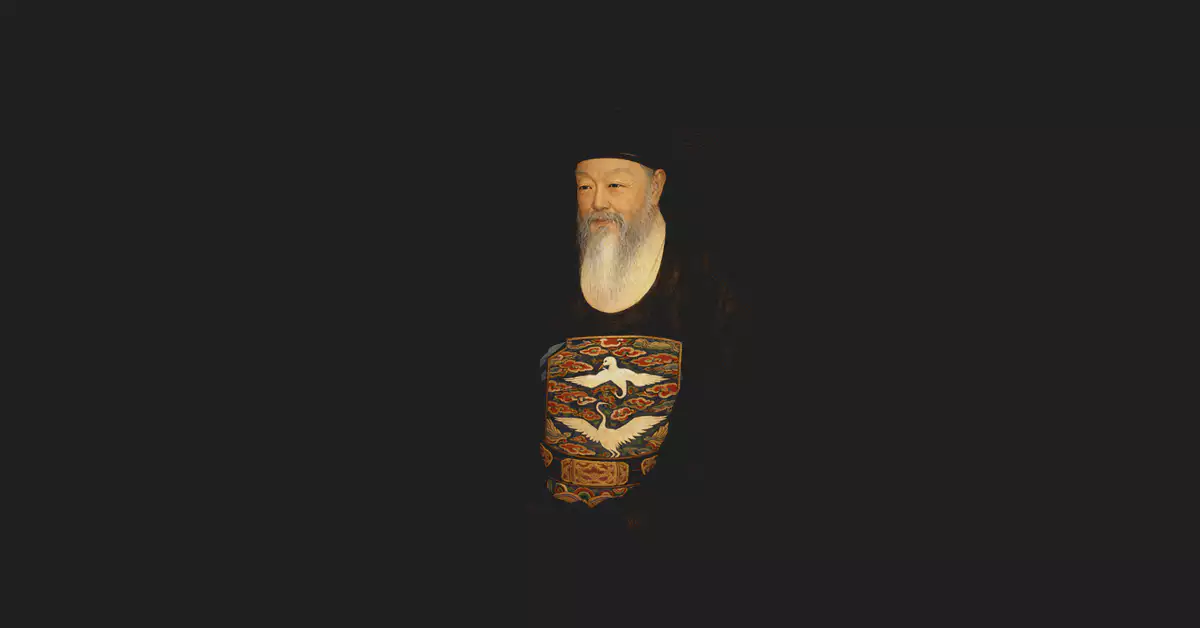
An Introduction to the First Complete English Translation of Korea’s Greatest Scholar-Artist
This is the series introduction to Kim Jeong-hui: The Complete Poems, a full English translation of the poetry contained in Volumes 9 and 10 of the Wandang Jeonjip (완당전집 / 阮堂全集), the collected works of Kim Jeong-hui (1786–1856). The series comprises twenty-two installments and translates every poem in both volumes, with historical context and reading notes for each work.
What the Wandang Jeonjip Is
The Wandang Jeonjip — the Complete Works of Wandang — is the primary collected edition of Kim Jeong-hui’s writings. Wandang (완당 / 阮堂) was one of several pen names Kim used throughout his life; others included Chusa (추사 / 秋史), the name by which he is most widely known today, and Sinam (시암 / 詩庵), which translates roughly as the Studio of Poetry — a self-designation that points toward the literary seriousness this series is designed to illuminate.
The full Wandang Jeonjip runs to many volumes and encompasses correspondence, theoretical essays on calligraphy and epigraphy, colophons on paintings and rubbings, and miscellaneous prose alongside the poetry. Volumes 9 and 10, which this series translates in their entirety, contain Kim’s surviving poems: 152 numbered entries in Volume 9 and 221 in Volume 10. Because many entries contain multiple poems under a single title — sequences of two, three, four, or more — the actual count of individual poems across both volumes is considerably higher, approaching six hundred in total.
These poems were written in classical Chinese (hanmun / 漢文), the literary lingua franca of the Joseon educated class. They were composed for a readership steeped in the classical tradition of the Tang and Song dynasties, and they are dense with allusion, formal precision, and the kind of intertextual reference that rewards specialist readers while remaining, for those patient enough to follow the notes, startlingly direct in their emotional core.
No complete English translation of this body of work has previously been published. This series is the first.
Kim Jeong-hui as Poet
For most readers who encounter Kim Jeong-hui at all, the encounter begins and ends with his calligraphy. The visual force of Chusache — the style he developed over decades of engagement with ancient stone inscriptions — is immediate and overwhelming in a way that his poetry simply is not. The poems require preparation. They ask something of the reader before they give something back.
This asymmetry has consequences. In the century and a half since his death, the calligraphy has become the dominant lens through which Kim is understood: the rough strokes, the deliberate asymmetry, the aesthetics of the eroded and the incomplete. The poetry, by contrast, is more often cited than read. It is present in Korean literary scholarship and in popular accounts of his life, but it has not crossed the language barrier in any sustained way. The result is a significant distortion — not a misrepresentation exactly, but an incompleteness. A reader who knows only the calligraphy knows something extraordinary. A reader who also knows the poems knows a different extraordinary thing.
Where the calligraphy externalizes its tensions — puts the evidence of force meeting resistance visibly on the surface for anyone to see — the poetry internalizes them. The formal surface of Kim’s verse is often composed to the point of coldness, the classical apparatus deployed with impeccable control. Beneath that surface, in the gaps between allusions and in the precise selection of image, something else is present: the record of a consciousness that has been pressed to its limits and is holding its form through will rather than ease. Understanding the poems changes how the calligraphy looks. Understanding the calligraphy changes how the poems sound.
What the Two Volumes Contain
Volume 9 gathers poems from across Kim’s pre-exile life. The earliest works are connected to his formative intellectual relationships — above all to his encounter with leading Qing dynasty scholars during his 1809 diplomatic visit to Beijing, which reshaped his understanding of calligraphy, epigraphy, and the Chinese literary tradition entirely. Poems addressed to or inspired by scholars such as Weng Fanggang (翁方綱, pen name Tanxi / 覃溪) and Ruan Yuan (阮元, pen name Yuntai / 芸臺) appear throughout the volume and require some context to read; that context is provided in each installment’s notes.
Volume 9 also contains poems addressed to Korean literary friends and colleagues, poems written on paintings, poems written at temples and on mountain excursions, occasional verse in response to a borrowed book or an unexpectedly fine meal, and a number of poems that resist easy categorization — works that seem to arrive from nowhere and depart just as suddenly, leaving behind a specific image or a specific quality of attention that is recognizably Kim’s.
Volume 10 moves into later territory, including the years of his Jeju Island exile (1840–1848). The shift is visible. Poems from the exile period — identifiable by their references to 瀛洲 (the old literary name for Jeju), 大靜 (Daejeong, the village of his confinement), and the figures of the island world — have a different texture from the earlier work. The allusive apparatus does not disappear, but it thins. What remain most clearly are the images themselves: cold, dry, spare, and precise in a way that extended isolation tends to produce in writers who were always, underneath the erudition, watching the world very closely.
How This Series Is Organized
The series proceeds in twenty-two installments across two sub-series.
The Volume 9 sub-series runs eight installments covering poems 1 through 152, plus an introductory overview of the volume. Each installment covers approximately fifteen to twenty poem entries from the source text.
The Volume 10 sub-series runs twelve installments covering poems 1 through 221, plus an introductory overview. The installments covering poems 94 through 130 represent the exile-period core — the most widely discussed section of the collection in Korean scholarship, and the section most likely to interest readers who have arrived at this series through an interest in Kim’s life or visual art.
Within each installment, poems appear in the order they appear in the source text, without reordering by theme or date. This preserves the experience of reading through the Wandang Jeonjip as a collection rather than as an anthology organized by the translator’s priorities. The source’s internal order is itself a kind of meaning.
A Note on the Translation
Every poem in this series is translated in full. No lines are omitted. Where a poem entry contains multiple poems, all are translated. The originals are reproduced in their source text (hanmun) immediately before each translation.
The translations aim for literary fidelity rather than either strict literalism or free adaptation. Classical Chinese regulated verse depends on tonal patterns, parallel couplets, and sonic textures that English cannot reproduce. Rather than attempting formal equivalence — which would produce English that sounds like neither good Chinese nor good English — the translations preserve the structural logic of the originals (parallelism becomes syntactic parallelism; compression stays compressed) while finding English rhythms that carry the emotional weight of the Chinese without falsifying it.
Classical allusions are translated at their surface level — the poem says what it says — and explained in the reading notes. This approach assumes that a reader encountering Su Dongpo’s name in a Kim Jeong-hui poem deserves to know both what the reference says and what it carries. The translation handles the first; the notes handle the second.
The translations in this series are original to Cinemawords and have not been published previously.
Where to Begin
Readers approaching Kim Jeong-hui’s poetry for the first time are encouraged to begin with the Volume 10 introduction and then move to Parts 5 and 6 of the Volume 10 series — the installments covering the exile period poems, which are both the most emotionally concentrated and the most contextually self-contained works in the collection.
Readers interested in the full arc of Kim’s literary life, including his formation as a poet through his engagement with Chinese scholarship and the Korean literary culture of his era, should start from the beginning: Volume 9, Part 1.
Either path leads eventually to the same place. Kim Jeong-hui spent his life in a single extended argument with the classical tradition — testing it, absorbing it, pushing it to its limits, and discovering that those limits were more interesting than the comfortable interior. The poems, read in sequence, are the record of that argument. They are not always easy. They are, when they work, irreplaceable.