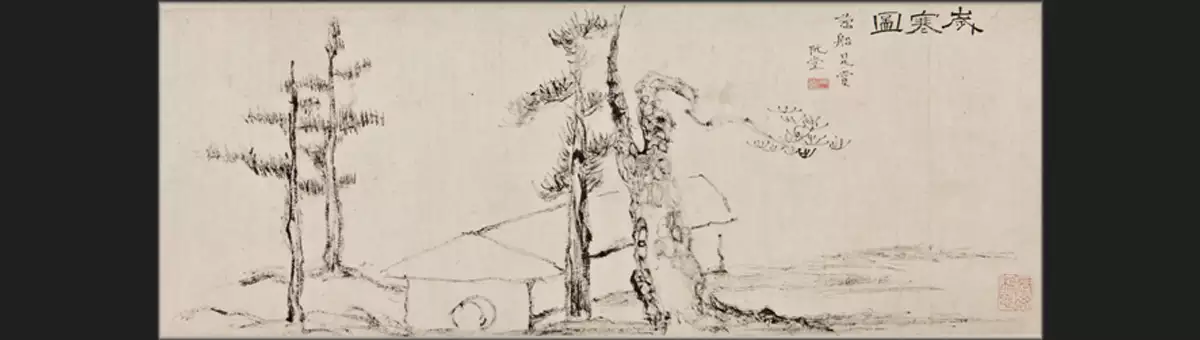
Source: National Museum of Korea
How Korea’s Most Radical Calligrapher Turned Exile Into an Aesthetic Philosophy the West Wouldn’t Discover for Another Century
There is a moment, standing before a work of calligraphy by Kim Jeong-hui, when the eye refuses to settle. The strokes do not flow. They press, stall, splinter. A line that seems about to complete itself suddenly twists away from resolution, like a sentence that knows its own ending would be a lie. For a viewer raised on the Western tradition — or even on the cleaner, more ceremonial idioms of East Asian brushwork — the initial response is often discomfort. This does not look finished. It does not look controlled. It barely looks intentional.
That discomfort is exactly the point.
Kim Jeong-hui (1786–1856), known by his pen name Chusa, is one of the defining figures of late Joseon intellectual and artistic culture — and one of the least known outside East Asia. In Korea, his name carries the weight of legend: the scholar who spent years cataloguing ancient stone inscriptions, the political exile who found his most radical voice on a remote island, the man who developed an entirely new calligraphic style so personal and so strange that his contemporaries sometimes called it grotesque. In the broader history of world art, however, he remains largely invisible. This is a gap worth examining. Because what Chusa understood about beauty — its relationship to fracture, to resistance, to the specific pressure of a body moving through time — anticipates questions that Western modernism would not seriously begin asking until the twentieth century.
The Weight of Old Stone
To understand what Chusa was doing, it helps to understand what he was reacting against. The dominant calligraphic culture of the late Joseon period was organized around model books — beop-cheop, carefully reproduced compilations of classical Chinese masters, most notably Wang Xizhi, the fourth-century figure whose elegant, fluid script had functioned for over a millennium as the gold standard of East Asian brushwork. Learning to write meant learning to imitate these models with increasing precision: smooth transitions, balanced proportions, strokes that moved without hesitation from beginning to end. The aesthetics of control, refinement, and legibility were inseparable from each other.
Chusa studied these models. He mastered them. And then he turned his attention elsewhere.
During his time in Beijing — he traveled there as a young man accompanying a diplomatic mission — he encountered the world of epigraphy: ancient inscriptions carved into stone monuments, steles, and bronze vessels from the Han dynasty and the Northern Wei period, two thousand years old and showing every year of it. The surfaces were eroded. The original brushwork, translated imperfectly into stone by craftsmen and worn further by centuries of weather, had shed whatever smoothness it once possessed. What remained was something rawer: strokes that carried the memory of a body’s movement without the movement’s elegance. Lines that were powerful precisely because they had been damaged.
For most scholars of his era, these inscriptions were objects of historical study. For Chusa, they became a visual education in a different kind of beauty. He began to understand the model-book tradition not as the pinnacle of calligraphic achievement but as a kind of aesthetic narrowing — a culture that had gradually confused one particular form of refinement with beauty itself. The cracked stone, by contrast, told a different story: that presence could survive imperfection, that a stroke could carry more life through its roughness than through its finish.
This insight would take decades to fully metabolize. When it did, it produced Chusache — the Chusa style.
The Grammar of Resistance
What distinguishes Chusache from the calligraphic traditions it descended from is not eccentricity for its own sake. It is something more considered: the deliberate introduction of resistance into the act of writing.
In conventional calligraphy, the brush is understood as an instrument of transmission — thoughts, characters, rhythms — moving across the paper with as little friction as possible. In Chusache, the brush encounters the paper. It presses down unevenly. It halts. It drags. The strokes are not smooth conduits of intention but physical events in their own right, with textures and weights that vary unpredictably. A horizontal stroke may begin with force and then thin almost to nothing. A vertical may stiffen mid-movement as though the ink has decided not to cooperate. The result is a script that does not so much represent a mental state as record a bodily one — the exact pressure of a hand, the specific resistance of a particular afternoon.
This is why Chusa’s calligraphy does not read the way most calligraphy reads. Before the eye extracts meaning from the characters, the body responds to the sensation of the marks. There is something almost sculptural about the way his strokes occupy space, something that resists the purely optical. Viewers do not merely see these works; they feel the weight of them.
The Island and the Empty Room
In 1840, Kim Jeong-hui was exiled to Jeju Island following a court intrigue. He was fifty-four years old, one of the most celebrated scholars in Joseon, and suddenly alone on the southern edge of the known world, separated from books, colleagues, patrons, and the entire infrastructure of the literary culture that had defined his life. He remained in exile for nearly nine years.
The exile years produced what most critics regard as the culmination of the Chusa style. The connection is not merely biographical. Something more precise happened: cut off from the social performance of scholarship, stripped of the audience that had always been implicit in his work, Chusa stopped writing for anyone who might have expectations. The remaining traces of display — the small flourishes of erudition, the gestures toward established taste — gradually fell away. What was left was writing at its most stripped: marks on paper that had no reason to please.
The period’s masterwork, Sehan-do — translated variously as Cold Winter Landscape or Landscape After the Season — is not, properly speaking, a landscape at all. A single building. A handful of pine trees. Enormous, deliberate emptiness. In the tradition of Korean and Chinese literati painting, landscape was typically the stage on which the harmony of mind and nature could be demonstrated — technically accomplished, compositionally resolved, legible as an emblem of cultivated sensibility. Sehan-do refuses all of this. Its emptiness is not meditative in the serene sense; it is exhausted. The image does not demonstrate harmony. It asks what remains when harmony is no longer available.
The inscription that accompanies the painting is not separate from the image but continuous with it. For Chusa, painting and calligraphy were never entirely distinct activities — both involved the movement of a loaded brush across a surface, both organized space into rhythm, both left behind not a copy of something seen but the trace of an act. In Sehan-do, this unity reaches its clearest expression. The handwriting and the image breathe together. To look at one is to be already inside the other.
What the West Took Another Century to Ask
Abstract Expressionism is usually dated to New York in the 1940s and 1950s — the moment when Western painting decisively shifted its interest from representation to the act of making itself, when the gesture of the artist, the physical record of a body in motion, became the subject rather than the vehicle of art. The affinities between that movement and East Asian calligraphic traditions have been widely noted, though the nature of that relationship remains genuinely contested — a matter of parallel intuition as much as direct exchange.
The parallel with Chusa, who worked a full century earlier, belongs to the same category of conversation. It is not a matter of influence — there is no direct line. It is something more interesting: a parallel discovery. Both arrived, by different routes and under different pressures, at a similar conviction: that the most powerful mark a brush can make is not the most controlled one, and that the visible evidence of a body’s struggle with a surface can carry more expressive weight than any illusion of effortless mastery.
The difference is that Chusa arrived there through an unusually rigorous engagement with tradition rather than a rejection of it. He had absorbed more classical Chinese calligraphy than almost anyone alive, studied more ancient inscriptions, developed a more detailed theory of historical style. His radicalism was not the radicalism of someone who had found tradition insufficient and walked away from it. It was the radicalism of someone who had gone so far into tradition that he emerged on the other side of it — in a place where the rules no longer held, not because he had abandoned them but because he understood them completely enough to see where they broke.
The Stroke That Does Not End
There is a quality to Chusa’s best work that resists description but not feeling. Looking at his calligraphy, and especially at Sehan-do, one has the persistent sensation of being in the presence of something unfinished — not abandoned, not failed, but genuinely open, still in motion. The ink is dry. The paper is centuries old. And yet the lines do not close. They hold their tension the way a breath holds before it is released.
This, perhaps, is the deepest thing Chusa understood: that closure is a convention, not a truth. The model-book tradition had built its entire aesthetic on the idea that a well-executed stroke completes itself, that mastery means bringing each mark to its proper resolution. Chusa spent his life studying that tradition carefully enough to know it was a beautiful fiction. His own strokes refuse the fiction. They end because the paper ends, not because the movement does.
In an era that has become increasingly fluent in the idea that marks and traces carry meanings that finished images cannot, Chusa’s work looks less like historical artifact than like an argument that was ahead of its time and is still being made.