Wuthering Heights (2026)
The body before language. The question is whether any camera can get there.
The film begins in darkness. What we hear before we see anything is a rhythmic, strained breathing—a creaking that might be mattress springs, might be something else entirely. The ambiguity is deliberate and brief: the sound belongs to an execution, not a seduction. A man is being hanged. But Emerald Fennell has already done, in those few seconds of auditory uncertainty, what Brontë’s novel required hundreds of pages to accomplish. She has placed desire and death in the same acoustic space, made them temporarily indistinguishable, and left open the question of whether we can tell them apart by sound alone.
I keep returning to that opening. Not because it resolves anything—it doesn’t—but because it names, with more precision than much of what follows, what the film is actually attempting. Not to show desire. To show what desire sounds like before you know what you’re hearing. Before naming. Before the interpretive apparatus arrives to organize sensation into meaning. This is an ambitious goal for a film, which is by definition an art of images and sounds arranged into sense. The ambition is also, I think, the source of both the film’s genuine power and its most significant evasion.
Fennell has said she wanted to capture the sensation of reading the novel at fourteen—not the architecture scholars have since mapped onto it, but the feeling of first contact, before criticism arrived to explain what that contact was. The fourteen-year-old’s experience and the novel’s actual construction are different objects, and the distance between them is not cost-free. But let the claim stand for now, because it does describe something Linus Sandgren’s cinematography genuinely pursues.
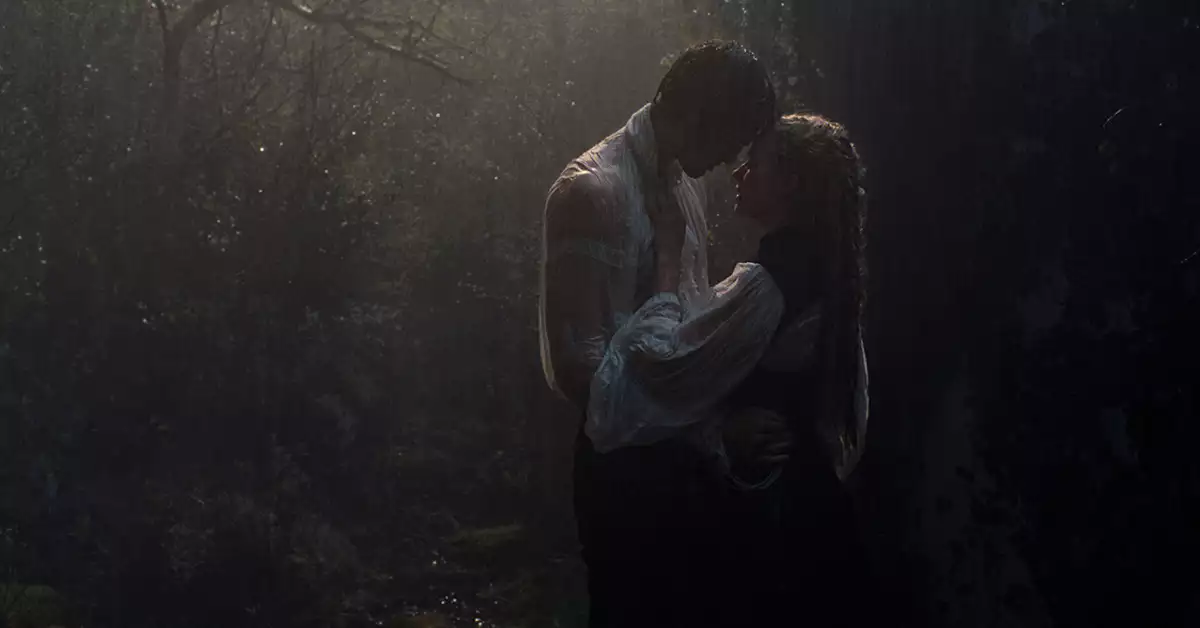
The camera lives close to surfaces. The grain of stone under fingernails. The specific texture of wet earth after rain. The temperature differential visible in breath meeting cold air. When Margot Robbie and Jacob Elordi occupy a frame together, the photography seems less interested in their faces than in the quality of the space between their bodies—the charged distance, the way proximity alters the surrounding atmosphere. This is photography of adjacency. Of the moment before contact, and the moment of contact, and what both feel like at the level of the skin.
This is a real formal achievement. Sandgren refuses the camera’s conventional retreat into significance—the meaningful glance, the reaction shot, the pull-back to show characters against landscape that mirrors their emotional state. He holds his ground. What results, in certain scenes, is something very close to what Fennell is reaching for: the image of desire before it has been converted into something to be interpreted. Robbie is doing something specific here that I find difficult to name. Not acting, exactly, or not only acting. A kind of physical conviction—the absolute certainty that the body she is inhabiting has its own logic, and that she is not going to override it with technique.
And yet.
The film also contains: red floors of such insistent intensity they feel projected rather than photographed; costumes that appear to have been constructed from latex and cellophane; walls in Catherine’s bedroom that match her skin tone with its blue-vein marbling; a dining table overflowing with food rendered in an aesthetic that reads as contemporary art installation; Charli XCX.
None of this is accidental. Fennell is not making errors. The anachronism is intentional, the excess is calibrated, the design choices have been carefully constructed to produce their effect. But what effect, exactly?
The film’s claim is that it strips away the Victorian novel’s elaborate mediations—its sublimation of desire into landscape, metaphysics, souls fused beyond death—in order to reach desire’s material truth. What it actually does is strip away one set of mediations and install another. Victorian sublimation is replaced by contemporary aestheticization. The desire that emerges is not unmediated; it is mediated through a very specific contemporary vocabulary of what intense wanting should look like on screen in 2026. The red floor is not a transparent window. The latex gown is not neutral. Every frame that achieves the rough, tactile presence Sandgren is pursuing exists inside a film that has built one of the most elaborately aestheticized environments in recent prestige cinema.
I am not certain this is a failure. But I think it needs to be named, because the gap between the film’s claim and its practice is where the most interesting questions live.
There is another thing the film does with its mediations that is harder to address without sounding like the wrong kind of critic.
Heathcliff, in Brontë’s novel, is not simply a dark, brooding romantic lead. He is racially and colonially illegible within the categories available to the English countryside where he appears—described variously as possibly “gypsy,” as possibly connected to Liverpool’s colonial docklands, as something the other characters cannot classify and therefore cannot fully contain. This illegibility is not texture or atmosphere. It is structure. The violence directed at him by Hindley, the contempt of the Lintons, the specific form of his eventual revenge—all of it is determined by what he is and by the impossibility of placing him within the systems that would otherwise organize him. The novel’s radicalism, such as it is, runs through this structural positioning. Remove it, and something specific disappears—not from the story but from under the story, from the foundations.
Jacob Elordi’s Heathcliff is physically enormous, emotionally complex, and intermittently devastating. He is also, as Fennell presents him, a pure erotic force: an object of desire whose power derives from intensity rather than from social position. The racial ambiguity that makes Brontë’s Heathcliff dangerous in a historically specific way has been converted into something more general: the outsider whose mystery is erotic rather than structural, whose menace is personal rather than systemic.
I have been trying, since seeing the film, to decide what to make of this. The film is not pretending to be a historical reconstruction. It has explicitly abandoned that project. Maybe demanding that it maintain the structural function of Heathcliff’s ambiguity is demanding that it be a different film than it is trying to be.
But I notice that Heathcliff’s universalization moves in a particular direction: toward maximum erotic availability. The universality on offer looks very much like a specific standard—one from which historical particularity has been removed in order to produce a certain kind of desire object. This is not a neutral removal. And it is not accounted for by the argument that fidelity to the novel was never the point.
I am leaving this unresolved because it is not resolved.
Somewhere around the middle of the film I caught myself measuring it against what I wanted it to be rather than what it was trying to do, and had to stop and sit with that for a moment.
The self-interrogation that follows is not comfortable but seems necessary. Fennell’s stated project—recovering the sensation of first encounter, before interpretive frameworks arrived—is not nothing. It is, in fact, what a great deal of the most interesting recent filmmaking is attempting: a return to the body as the primary site of cinematic meaning, against the hegemony of plot and psychology and the well-made dramatic arc. On those terms, even a partial success matters. And this film achieves partial successes that are genuine.
The scenes where Sandgren’s photography finds what it’s looking for—where the aesthetic apparatus quiets and something more raw briefly surfaces—are real. They exist. They are difficult to produce, and they occur in a film that is also sometimes strangled by its own beauty. The question is whether the occasional presence of that rawness is sufficient—whether a film that achieves its most difficult ambition intermittently deserves to be judged by its intermittent achievements or by what it fails to sustain.
I do not have a settled answer to this question. I notice that I am more forgiving of its failures when I remember the scenes that worked, and less forgiving when I think about what those scenes were working inside.
The Charli XCX contribution is the most clarifying element in the film, and the strangest.
The synth textures, the processed vocals, the specific contemporary quality of the emotional landscape these songs create—none of this is what you expect from the Yorkshire moors in the early nineteenth century. Which is presumably intentional. The music is not trying to recreate a period; it is trying to recreate a feeling. And the feeling it recreates is recognizably contemporary: desire that is simultaneously overwhelming and somehow knowing about itself, that understands it is being aestheticized even as it insists on its own reality.
This is the most honest thing about the film, because the music admits what the images sometimes try to deny: that the desire being filmed is not Catherine and Heathcliff’s desire, recovered from beneath Victorian repression. It is our desire—contemporary, mediated, aware of itself as an aesthetic experience—looking at two very beautiful people in a very expensive production and recognizing something in the intensity of their wanting that rhymes with something in us. The music does not pretend otherwise. It plants its roots in the present tense and says: this is where we actually live.
The visual language of the film is less willing to make this admission. It keeps reaching for something rawer, something pre-aesthetic, something that feels like discovery. The music reveals what the images are already doing, whether the images know it or not. A production designer can build a room that claims to be a Victorian moor; Charli XCX cannot pretend to be from the nineteenth century, and doesn’t try.
What the film is most honest about is also what it cannot quite say directly: that we may no longer have access to unmediated desire—if we ever did. That what Brontë’s first readers experienced as raw and transgressive was always already being processed through the cultural forms available to them. That Fennell’s fourteen-year-old self was not reading beneath the mediation but through a different one, one that felt like absence because it was so ambient it had become invisible.
The opening sound returns here, as it should. A man is being executed, and it sounds, for a few seconds, like something else. Once you know what you’re hearing, you can’t unknow it. But you also can’t fully unhear the first impression. Both things remain audible simultaneously: what the sound is and what it briefly was, layered on top of each other, irresolvable.
This is the condition the film describes better than it knows. Every frame is both what it is—a carefully constructed aesthetic object—and what it briefly seems—something raw and prior to construction. The film keeps filming surfaces: the grain, the texture, the sheen of fabric, the specific quality of wet skin. Reaching for something underneath. Finding more surface. Which might be all there ever was, or might be evidence of the difficulty of the attempt, or might be the attempt itself.
I haven’t settled which. The film, as far as I can tell, hasn’t either. It ends where desire in cinema so often ends: with the body in motion, the door closed, and whatever was being reached for still just out of frame.