One Battle After Another
Comedy, revolution, and the body’s long argument with itself in Paul Thomas Anderson’s One Battle After Another
Something strange happens at the center of One Battle After Another. You find yourself laughing during scenes where you expected to feel the weight of political consequence, and you find yourself, much later, unable to explain exactly when the comedy became something else entirely.
This is worth following. Paul Thomas Anderson is not a filmmaker who deploys humor by accident, and yet the comedy here is peculiar—not the dark vaudeville of There Will Be Blood, not the tender absurdism of Punch-Drunk Love. It doesn’t serve to reveal character in the conventional sense. It arrives instead to reveal a position: the position of a man who believed, or once believed, that he was on the right side of history, and who now cannot charge his phone.
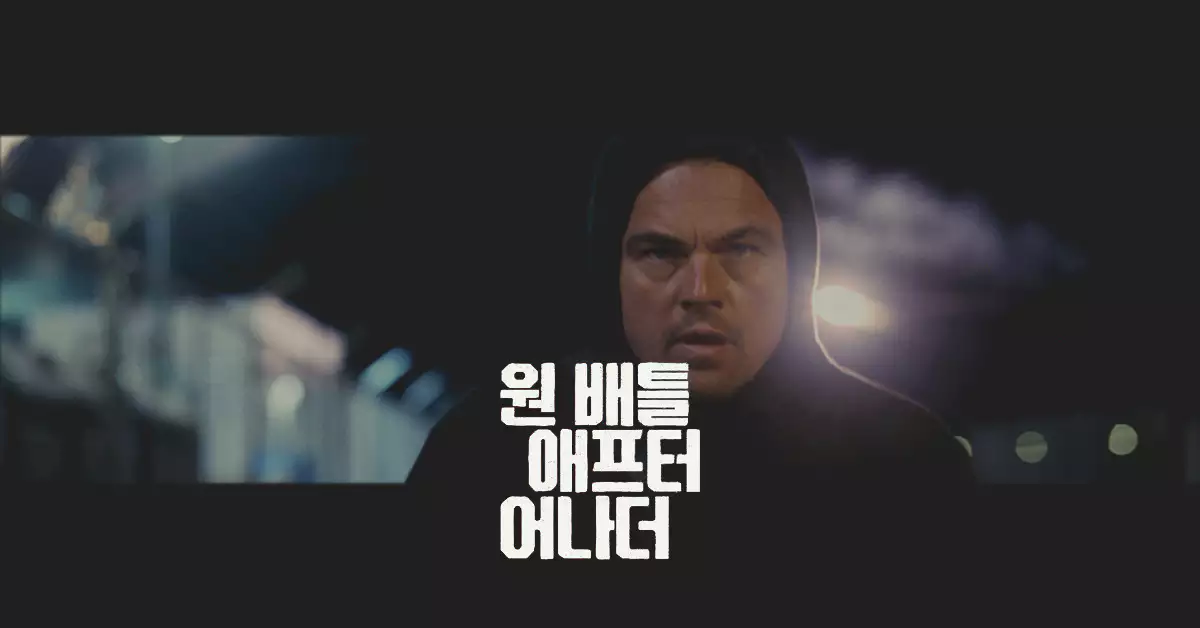
That man is Bob Ferguson, formerly Pat Calhoun, formerly Ghetto Pat, explosives specialist and member in erratic standing of a revolutionary collective called the French 75. Leonardo DiCaprio plays him as a study in misaligned urgency—always moving, always reacting, always slightly behind whatever the situation currently requires. His body communicates tremendous effort and minimal result. When the plot demands a password from sixteen years ago, he cannot produce it. When it demands speed, he delivers something that approximates speed, in the way that a memory of running is not running. The joke, if it is a joke, is that this man—this particular man—is at the center of a film about the survival of revolutionary politics across generations.
Why him?
The obvious answer is comic relief, and comic relief is never quite the wrong answer. But Anderson seems genuinely interested in something more specific—what political aspiration looks like when it can no longer maintain its own grandeur. When the spectacular gesture is over and what remains is just a person, slower than before, failing to keep up with the generation that inherited his failure. Bob’s obsolescence is not his flaw alone. It is the residue of a particular theory of historical change: one that imagined transformation arriving fast and undeniable, like an explosion, and discovered instead that it leaves behind something quieter and more ambiguous. More tender, even. Tenderness being the last thing you expect from a film this loud.
But I am outrunning myself. That is the problem with One Battle After Another: it keeps moving, and any attempt to pin it into an argument risks losing it entirely.
Before Bob’s comedy, there is Perfidia’s certainty. Teyana Taylor plays her as pure forward motion—a body so committed to its own trajectory that the camera can only follow, never predict. The French 75’s raids in the film’s first movement feel like extensions of her body more than of any ideology: the way she walks across a bridge before an operation, unhurried, as if history has already confirmed what she’s about to do. She does not merely create spectacle. She generates it. The explosions the French 75 produces—government offices reduced to light, transmission towers sending darkness across a city—these feel like projections of her will, her insistence that the world be otherwise. The request she makes of Bob before an early operation—something to look at, something to see—treats spectacle and revolution as inseparable. And for a while, they are.
The film’s first fracture arrives from above. When a helicopter appears during a failed getaway, Perfidia—who has spent the film’s first movement deciding where to look, when to run, what to destroy—suddenly becomes an object of someone else’s looking. The music, which has been surging through the film with almost reckless generosity, vanishes. Swallowed by rotor noise. What remains is geometry: a cool aerial grid, a small figure below, running and then not running. She has been made into a spectacle without having chosen it. The subject has become the subject matter.
After her arrest, Perfidia narrows to an absence. A voice in a letter. A residue in other people’s memories and in the girl she left behind. The woman who could determine the shape and timing of an image disappears from the film’s visual field and does not return to it. This could be read as a failure of the film’s imagination, a woman’s story displaced by the men who inherit her problems. I am not ready to dismiss that reading. But what I want to notice is the structural fact: Perfidia’s disappearance is not an ending. It is the first term in the film’s real argument. The question One Battle After Another is building toward is not what happened to Perfidia—it is what gets left when someone of that force and certainty is simply removed from the picture.
Sixteen years pass in the space of a title card. In Baktan Cross, where Bob and his daughter Willa now live under false names, resistance is organized not through spectacular gestures but through a karate teacher named Sergio St. Carlos.
Benicio del Toro plays Sergio with a quality I struggled to name for most of the film and eventually settled on as unhurried conviction—not slow, not passive, but in a different relationship to urgency than everyone else onscreen. Where Perfidia carried her certainty forward at maximum velocity, Sergio has learned something that looks, at first, like its opposite: how to wait. How to read the situation longer than the situation wants to be read. His instruction to Willa—to think of waves, to find the movement already present in the world and align with it rather than against it—is not a counsel of passivity. You can drown in a wave. Understanding it is not the same as surrendering to it. But it requires a different kind of intelligence than the intelligence of force, and a longer memory than the intelligence of spectacle.
Sergio is the film’s most important figure because he represents what revolutionary duration actually looks like after you strip away the image of it. He runs no operations visible to us. He makes no public gesture. He is not building toward a moment; he is sustaining a condition. His home is a sanctuary not because he has organized it as one but because he has become one—through years of simply not leaving, not stopping, not confirming the defeat that power keeps announcing. When he dances in the street during a police encounter, arms spread wide, unhurried in a way that seems almost designed to get himself killed, what we’re watching is not absurdism. It is a man who has found a form for surviving something that was not supposed to be survived, and who is performing that form in full view of the thing that wants him to stop.
Anderson positions this against a group called the Christmas Adventure Club, a white-supremacist cabal that operates from a sealed room and never leaves it. Men who have chosen not to move. The visual grammar is blunt: they are already dead. The contrast is less ideological than kinesthetic—a film about bodies in motion drawing its political lines between those who still move and those who insist on controlling movement from a room where no movement is required of them.
Here I should probably stop and interrogate what I am doing.
I have been writing about One Battle After Another as though it is primarily a film of ideas—as though Anderson is interested in giving his politics philosophical form, and I am here to decode it. But this is only partly true, and the part that isn’t true is more interesting. The film’s opening raid on the immigration detention center works before it means anything. The intercutting between action and consequence, the way the imprisoned become the guards and the guards the imprisoned in a single visual reversal, the music doing things to your nervous system that your intellect hasn’t caught up with yet—none of this operates through argument. It operates through sensation. Through the experience of watching power reverse itself in real time and finding it, against all ironic distance, thrilling.
Revolutionary aesthetics has always lived in this compromised space. The film that makes you feel liberation before you can think about whether the liberation is real, whether the means justify whatever follows, whether you are being manipulated by your own desire for things to be otherwise—this is not new. It is probably unavoidable. Anderson is not innocent of it. The French 75’s violence is beautiful. He makes it beautiful deliberately. When the transmission tower goes dark and the lights go out across a city, there is something that registers as awe, even though what we are watching is an act of sabotage against shared infrastructure.
The bank robbery sequence reveals where this leads. The French 75 performs revolution as theatrical gesture—climbing on desks, announcing their own power, becoming the spectacle they wanted to create. One gunshot ends it. A guard’s body. The faces of people who have just encountered the thing the image could not contain. The music stops. Anderson does not editorialize. He simply shows what happens when the spectacular gesture meets its own consequences, and how little resemblance those consequences bear to the image that produced them.
This is not the same as saying the film is cynical about its revolutionaries—or rather, I kept telling myself that while watching, and I am less sure I believe it now. There is a version of compassion for failed radicals that functions as a form of distance: a willingness to love something precisely because you’ve already decided it failed, because failure has rendered it safe to love. I don’t know if that’s Anderson’s position. But I notice that the film is most visually confident, most formally assured, when its revolutionaries are most defeated. It may be that defeat is simply what he knows how to film.
Willa survives this ambiguity. She may be its way out—or rather, its way forward, which is not the same thing.
Chase Infiniti plays her with a quality I kept trying to name and eventually settled on as calibrated readiness: not innocent, not purely reactive, not the vessel for what the older generation failed to complete. Someone who has absorbed a great deal without being defined by any of it. She has absorbed Perfidia’s force without Perfidia’s need to be seen. She has absorbed Sergio’s teaching without yet having had to spend it. What she has absorbed, specifically, is the wave—which the film’s final chase sequence tests against everything that came before.
I want to be careful here, because I’ve been making it sound like the sequence is legible as argument, and it isn’t, quite. Michael Bauman’s telephoto compression flattens the landscape until distance becomes almost unintelligible; the editing refuses to establish the geography that conventional chase filmmaking relies on. What you get is less a scene than a physical sensation: two objects moving through space according to different internal logics, and the barely articulable question of which logic has more in common with the road they’re both on. Willa does not try to outrun the car behind her. She tries to understand what the road is actually doing, which is not what it appears to be doing at speed. The sequence is not about technique. It is about reading—the same thing Sergio was teaching, now at sixty miles an hour with her hands in restraints.
She wins. Barely. Messily. With something that looks like accident and isn’t.
This is what the film means, I think, by transmission: not the transfer of ideology but the transfer of a way of moving, a way of reading forces larger than yourself without being paralyzed by them. And yet—transmission is still too clean a word. Willa didn’t learn the specific thing Sergio knew she would need. She learned something more like a direction of attention, and then she found herself in a situation where that direction, accidentally, was enough. Whether that is wisdom or luck or something the film cannot tell apart from either, I genuinely do not know.
Afterward, there is a quiet room. Willa teaches Bob to use a smartphone. The scene reverses something that must have happened sixteen years earlier: a father passing his daughter some artifact of an organizational infrastructure she had no context for, some object invested with the trust and secrecy of a vanished network. Now the direction runs the other way. She teaches him how to navigate a present he has fallen behind. The exchange is not poignant. It is awkward. Bob is a bad student. Willa has places to be.
She gets in a car. The door closes, the engine starts, and Anderson cuts before she has traveled anywhere.
Not at the moment of arrival. Not even at the moment of departure. At the moment of intention—before the action confirms or fails to confirm what that intention was worth. It is among the most elliptical endings Anderson has made, and what makes it strange is that it refuses even the gesture of motion. We see Willa decide to go. We don’t see her go. Whatever she’s carrying toward Oakland, whatever form the next battle takes—that is not something the film claims to know.
I keep returning to the laughter, and I keep arriving somewhere different.
There was something in watching Bob Ferguson fail at the basic tasks of his own story—the password, the breath, the charger—that started as comedy and I assumed became something else. Recognition, I said. The recognition of a problem without a clean solution. But reading back what I wrote, I’m not sure the laughter became anything. I’m not sure it stopped. Even at the end, in the quiet room where Willa teaches Bob to take a photograph of himself, there is something comic in it. The wrong man, still wrong, being patiently helped by the person he was supposed to be protecting.
What if the comedy isn’t the vehicle for something more serious? What if it’s the thing itself?
What if what gets transmitted between Perfidia and Bob and Sergio and Willa—across this chain the film traces with such structural deliberateness—is not wisdom, not posture, not a form of resistance, but the comedy of not quite knowing what you’re doing, carried forward with enough conviction that it produces something that looks, from certain angles, like a movement? This would be a darker film than the one I’ve been describing. It would mean the broken baton has always been broken, and everyone running with it has always known, and the transmission is less inheritance than shared improvisation in front of an unsympathetic audience.
I don’t know if Anderson believes this. I’m not sure I know if I believe it. The film does not resolve the question—which might be honesty, or might be the one place where its formal assurance fails it. Anderson ends the film before Willa reaches the protest, before we can see whether what she’s carrying does anything. The door closes, the engine starts, and we are returned to the problem the film opened with: a person in motion, headed somewhere, for reasons that are real and insufficient and continuing.
Still running. Whether that is the same as still fighting—that, the film declines to tell us. And so, finally, do I.