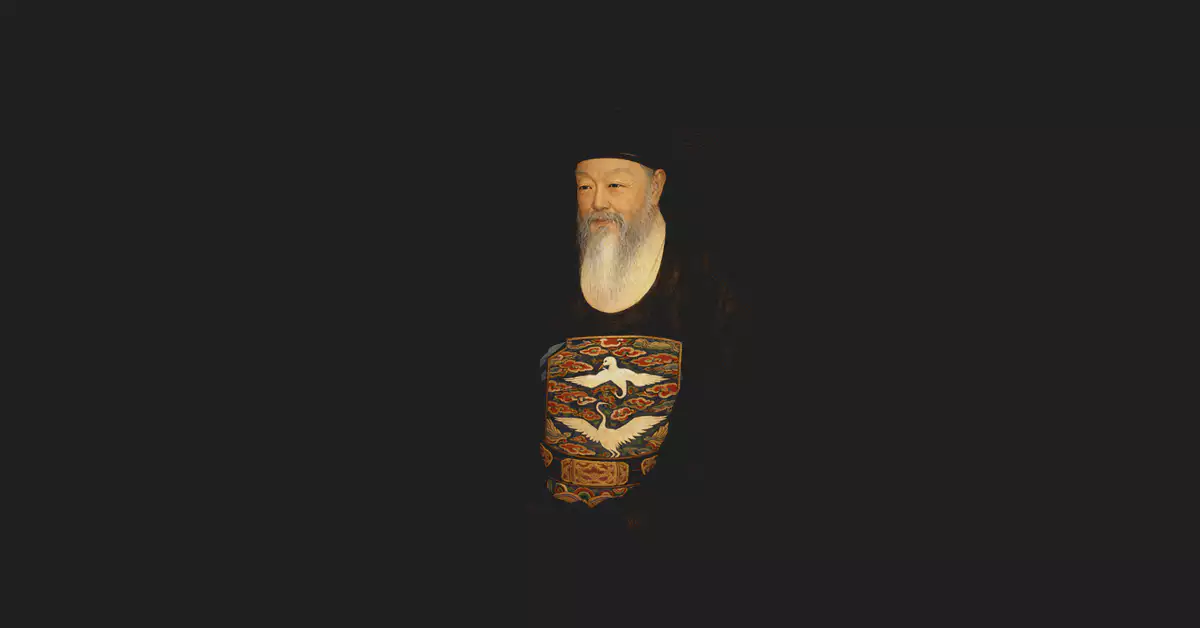
A Complete Introduction to Korea’s Most Revolutionary Scholar-Artist
Most people who encounter the name Kim Jeong-hui come to it sideways — through a reproduction of Sehan-do in a museum catalogue, through a fragment of his calligraphy on a gallery wall, through a footnote in a book about East Asian art that trails off before it properly begins. The introduction is rarely enough. The work demands more than a footnote can hold.
Kim Jeong-hui (1786–1856), known by his pen name Chusa, was a calligrapher, epigraphist, poet, and scholar of the late Joseon dynasty whose influence on Korean art and intellectual culture is difficult to overstate — and whose work remains almost entirely unknown in the English-speaking world. This is a significant gap, not because global recognition is any measure of artistic value, but because what Chusa achieved was genuinely unusual in the history of world art: a radical aesthetic revolution conducted entirely from within tradition, by someone who understood that tradition more deeply than almost anyone alive.
He did not reject the past. He went so far into it that he came out somewhere no one had been before.
Who Was Kim Jeong-hui?
Born in 1786 into an aristocratic family of the Joseon yangban class, Kim Jeong-hui grew up in an environment where scholarship was not merely an occupation but the primary measure of a man’s worth. He was educated in the classical Chinese texts that formed the backbone of Joseon intellectual life and showed, from an early age, the kind of restless, wide-ranging intelligence that refuses to stay inside the assigned curriculum.
The event that would shape the rest of his artistic life happened in 1809, when the young Kim accompanied his father on a diplomatic mission to Beijing. He was twenty-three years old. The Chinese capital was then the center of the gojunghak (evidential scholarship) movement — a rigorous, empirical approach to classical scholarship that prioritized evidence, inscription, and material artifact over received interpretation. Kim Jeong-hui had the intellectual equipment to engage this world at the highest level, and he did. He formed relationships with leading Chinese scholars, immersed himself in the study of ancient epigraphy, and returned to Joseon carrying an education that no Korean institution of the era could have provided.
What he had learned, in essence, was how to look at broken things.
The Encounter with Old Stone
The great turning point in Kim Jeong-hui’s aesthetic development was not a philosophical argument but a physical experience: handling ancient stone inscriptions. In Beijing, he had access to rubbings from Han dynasty steles, Northern Wei cliff inscriptions, and bronze vessels whose surfaces had been eroded by two thousand years of weather and handling. For most scholars, these objects were texts — sources of historical and linguistic data. For Kim Jeong-hui, they were also something else entirely: evidence of what mark-making looks like when it has been forced through the medium of stone, worn by time, and stripped of everything inessential.
The calligraphic model-book tradition that dominated Joseon artistic culture — organized around the elegant, fluid scripts of Wang Xizhi and other classical Chinese masters — suddenly appeared to him in a different light. Not as the pinnacle of the art, but as one particular aesthetic choice: a choice that had come to be confused with beauty itself. The weathered inscriptions suggested a different possibility. Roughness, asymmetry, resistance — these were not failures of execution. They were evidence of force.
This insight took decades to fully work through. When it did, it produced Chusache: a calligraphic style so personal and so strange that Kim Jeong-hui’s contemporaries sometimes called it grotesque, and that later generations would recognize as one of the most significant aesthetic achievements in the history of East Asian art.
Chusache: The Art of the Unfinished Stroke
To encounter Chusache for the first time is to experience something unsettling. The strokes do not flow. They press into the paper, stall, and resume. A horizontal line may begin with concentrated force and then thin almost to nothing. A vertical may stiffen mid-movement, as though the ink itself has decided to resist. Nothing resolves cleanly. The eye searches for the point of completion and cannot find it.
This is not accident. It is the result of a specific theory of what mark-making can do.
In the dominant calligraphic tradition, the brush was understood as an instrument of transmission: the writer’s intention, moving through ink and paper toward the reader with as little friction as possible. In Chusache, the brush encounters the paper. The friction is not eliminated; it is cultivated. The strokes do not represent a mental state — they record a physical one. The exact pressure of a hand. The specific weight of an afternoon. Looking at Chusa’s calligraphy, you feel the marks before you read them. There is something almost sculptural in the way they occupy space.
The theoretical underpinning of this approach was Chusa’s concept of seokgi — the spirit or energy of stone. He believed that the model-book tradition, for all its elegance, had produced a calligraphy that was too smooth: too free from the resistance and irregularity that give marks their vitality. The ancient inscriptions he had studied in Beijing retained, even through the medium of stone and across centuries of erosion, a quality of aliveness that the polished copies in model books had lost. Chusache was his attempt to recover that quality for the living brush.
The results are, to contemporary eyes, almost confrontationally modern. There is something in Chusa’s best calligraphy that rhymes with what Abstract Expressionism would discover a century later: the idea that the visible evidence of a body’s struggle with a surface can carry more expressive weight than any illusion of mastery. This parallel is not a matter of influence — there is no direct line — but of a parallel discovery, made under entirely different conditions, in an entirely different tradition.
The Exile and What It Produced
In 1840, Kim Jeong-hui was exiled to Jeju Island.
The immediate cause was a court faction dispute. The deeper cause was the same thing that has always made genuine intellectuals dangerous to political establishments: he said what he thought. He was fifty-four years old, at the height of his scholarly reputation, and suddenly transported to the southernmost and most isolated point in the known world of Joseon — a wind-battered island where his books, his correspondents, his students, and the entire infrastructure of the literary culture that had sustained him were gone.
He remained there for nearly nine years.
Most accounts of Chusa’s exile emphasize the suffering, which was real. But the more interesting story is what the exile did to his work. Cut off from the social performance of scholarship — from the audience that had always, even unconsciously, shaped his production — Kim Jeong-hui stopped writing for anyone who had expectations. The remaining ornaments of display gradually fell away. Chusache entered its final and most powerful phase: stripped of everything except the essential, marks on paper that had no reason to please.
The masterwork of this period — and arguably the most important single work in Korean art history — is Sehan-do, completed in 1844. It is a small ink painting: a single building, four pine trees, and an expanse of empty space that takes up most of the picture plane. That is all. In a tradition that often used landscape to demonstrate the harmony of a cultivated mind with the natural world, Sehan-do refuses harmony entirely. Its emptiness is not serene. It is exhausted. The painting does not show what remains when the world is at peace; it shows what remains when everything else has been taken away.
The calligraphic inscription that runs alongside the image is not a caption. It is part of the same breath. For Chusa, calligraphy and painting were never fully distinct activities — both were the movement of a loaded brush across a surface, both organized space into rhythm, both left behind not a representation of something seen but the trace of an act. In Sehan-do, the two forms achieve their most complete unity. The writing and the image move together. To enter one is to be already inside the other.
The Poetry
Kim Jeong-hui’s poetry is less celebrated than his calligraphy, and the reasons are partly practical — the language barrier, the density of classical Chinese allusion — and partly the result of the calligraphy’s overwhelming visual force. When something looks the way his brushwork looks, it tends to dominate the conversation.
But the poetry is essential to understanding the full range of his mind.
It is built on a foundation of classical learning so dense and wide that it can feel opaque to readers approaching without context. Han dynasty epigraphy, Tang poetic conventions, Song Neo-Confucian philosophy, the full apparatus of East Asian literary tradition — all of it is present in his verse, not as display but as the actual medium of his thought. He did not quote the tradition; he thought in it.
What makes the poetry remarkable is not this learning but the way it fractures under pressure. The exquisitely controlled scholarly surface of his verse is always, if you read carefully, barely containing something else: a grief that cannot be spoken directly, a loneliness that the classical idiom is not quite equipped to hold. Chusa never abandons the form — in even his most desolate late poems, the structure holds — but the form is clearly working against enormous counter-pressure. The tension between the two is where the poetry lives.
His elegiac verse — poems written for the dead, poems written out of loss — represents some of the most emotionally concentrated writing of the late Joseon period. These are not sentimental works. They are precise, even cold in their surface manner. The feeling comes through in the gaps: in what is omitted, in where the syntax strains, in the image that appears once and does not return.
A Philosophy Built on Contradiction
The deepest thing about Kim Jeong-hui is also the hardest to articulate: he was simultaneously the most learned man of his era and the most willing to follow learning into territory where it ceased to provide comfort.
He believed in the authority of antiquity — he spent decades arguing that the classical Chinese tradition contained standards of calligraphic excellence that his contemporaries had lost sight of. And yet his own work arrived at a place that looked, to contemporary eyes, like the opposite of classical authority. The roughness of Chusache. The exhausted emptiness of Sehan-do. The cold, stripped quality of his late poetry. None of this resembles what he theoretically admired.
The explanation is not contradiction but completion. Chusa went so far into tradition that he reached its limit — the point where every formal convention is so fully understood that it becomes transparent, and what remains is the raw fact of a mark on a surface, a line in space, a body that was once alive and left a trace. He did not arrive at this place by rejecting the past. He arrived by taking it more seriously than anyone else was willing to.
This is perhaps the most portable lesson his work offers. The most radical departures from tradition are not always made by those who dismiss it. Sometimes they are made by those who take it at its word.
Legacy and Rediscovery
In the decades after Chusa’s death, his reputation underwent exactly the kind of reassessment that his work seemed to invite. He had always been controversial — the “grotesque” assessment from his contemporaries did not disappear overnight. But gradually, and then with increasing speed in the twentieth century, the scale of what he had achieved became undeniable.
Korean artists working in the twentieth century repeatedly found themselves returning to Chusache as a resource: not a model to imitate but a demonstration that formal radicalism and deep historical grounding were not opposites. East Asian modernism, in its various national forms, was partly built on this discovery. International scholars of East Asian art began to situate him alongside the major figures of the broader tradition. Sehan-do, now held in the collection of the National Museum of Korea, is regularly cited as one of the supreme achievements of Korean visual culture.
The belated Western encounter with Chusa is still, in most respects, in its early stages. His name is known to specialists. His work appears in survey exhibitions of East Asian art. But the sustained critical attention that his achievement merits — the kind of engagement that would place him alongside Sesshu or Hokusai or Shen Zhou in the vocabulary of a generalist educated reader — has not yet arrived.
It will.
Where to Begin
For readers coming to Kim Jeong-hui for the first time, Sehan-do is the natural starting point — not because it is representative of everything he did, but because it concentrates the essential questions his work raises into a single, unforgettable image. From there, the calligraphy opens up differently: what seemed strange at first begins to seem inevitable.
His poetry requires more preparation, both linguistic and contextual, and rewards it proportionally. The elegiac poems in particular — spare, compressed, written against enormous internal pressure — offer a dimension of the man that the calligraphy alone cannot provide.
Taken together, the calligraphy, the poetry, and the theoretical writings that connect them form one of the most coherent and demanding artistic bodies of work to emerge from the East Asian tradition in the nineteenth century. The work does not simplify on closer acquaintance. It deepens.
That is, in the end, the reliable sign.
Explore the Kim Jeong-hui Archive
Essays, translations, and archival writings on Kim Jeong-hui (Chusa), Korean calligraphy, exile literature, and classical poetry.
Critical Essays
Complete Poems Translation Series