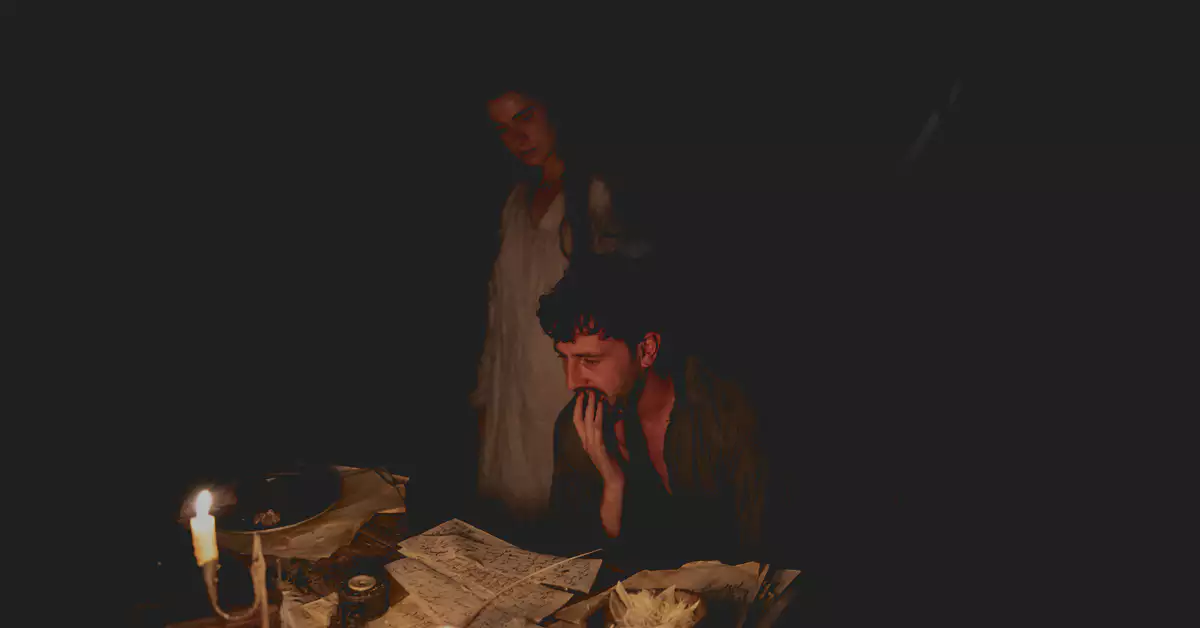
Hamnet (2025)
A close reading of Hamnet, exploring grief, memory, and how personal loss becomes Shakespeare’s Hamlet.
The opening image gives the film away, if you know how to read it. The camera descends through a forest canopy — branches layered over branches, light coming through in fragments — and finds a woman on the ground below, curled into herself, arms and legs drawn inward. The posture is unmistakable: it is the shape of something not yet born. This is Agnes. And before a single line of dialogue has arrived, Chloé Zhao has stated the film’s central argument: that grief and birth share the same form, that the body in extreme loss assumes the position of beginning, that a story about a child’s death is always also a story about what that death made possible.
Hamnet is a film that refuses its most obvious subject. William Shakespeare — playwright, cultural monument, the man whose name the film’s title almost contains — appears in the early sections as a peripheral figure. He writes. He travels. He is frequently absent. The camera does not follow him with any special attention, does not treat his movements as the organizing principle of the story. That position belongs to Agnes, played by Jessie Buckley with an intensity that never announces itself, that simply accumulates until you realize the film has been building something enormous inside a very quiet frame.
This choice is the whole argument. A film centered on Shakespeare would have been, inevitably, a film about genius — about a great mind acquiring the raw material that would become a masterpiece. Zhao makes a different film entirely: one that asks what that raw material actually was, what it felt like from the inside, and at what cost it was gathered. At the center of that question is a boy named Hamnet, who died at eleven years old, and whose father wrote a play called Hamlet some years afterward. The film does not claim to know what passed between these two facts. It claims only that the passage is worth imagining, and that the imagination of it is its own kind of truth.
Agnes, in Buckley’s rendering, is a person whose relationship to the natural world is not mystical but bodily — not a quality of the spirit but a form of knowledge carried in the hands and the skin. She moves through forest with the ease of someone for whom landscape is not scenery but information. She trains hawks. She reads illness. What the village reads as strangeness the film reads as attunement: a person so continuously present in the physical world that she perceives what others miss. In her understanding, life and death are not opposed categories but adjacent ones — continuous, mutually constitutive, separated by a threshold rather than a wall. A hawk dies and she holds ceremony and looks upward. Someone leaves and she understands it as movement rather than absence.
It is this understanding that makes Hamnet’s death, for Agnes, a specific kind of catastrophe. Not the rupture of a natural order — death belongs to the natural order she has always known — but something more precise and more terrible: the experience of an event too large to be witnessed alone. Will is in London when the boy dies. He is not there. And the thing Agnes cannot survive, more than grief itself, is the isolation inside it — the fact that the heaviest moment of her life has no witness on her side.
The film’s middle section is organized around this gap, and around the misunderstanding it produces. Agnes reads her husband’s departure — his continued work, his plays, his distance from Stratford — as a form of abandonment. From inside her stopped time, his moving time looks like flight. She does not yet have the information that would let her read it otherwise.
That information arrives in the theatre. Agnes comes to London and watches Hamlet performed for the first time. On stage, a ghost addresses his son — commands him to remember, makes of memory an obligation and a vow. The film understands something in this moment that it has been preparing throughout: that the direction of the words is not what it appears. A ghost speaking to a son about being remembered is, underneath that surface, something else entirely — a father addressing the son he failed to reach, finding in the formal structure of a play the only grammar available for what he could not say directly. I remember you. I could not find another way to say it.
Agnes watching this is Buckley’s most sustained work in the film, and it carries everything the film has built. The realization that moves across her face is not simple forgiveness or reconciliation. It is the more complicated recognition that her husband’s grief was real and enormous and traveled in a direction she couldn’t see — that it entered the writing, that his guilt became the structure of a tragedy, that the distance between Stratford and London was not flight but the specific distance a certain kind of mourning requires.
The final sequence extends this outward. The audience in the theatre reaches toward the stage. What began as one man’s private catastrophe — a boy dead at eleven, a father in London, a wife left alone with stopped time — has moved through the machinery of art into hundreds of strangers who share nothing except this moment and what it makes them feel. Private loss has become, through the medium of a play, a common experience. The name of a child who died in the sixteenth century is spoken aloud in a theatre, and everyone in the room feels the weight of it.
This is what the film means when it quietly asks why art exists. Not as a rhetorical question but as a real one, posed in the space between Agnes and the stage. Art exists because some losses are too large for private carrying. Because some feelings find their full shape only when they are witnessed by strangers. Because the dead cannot speak for themselves, and the living sometimes find that the only language adequate to grief is a language that requires an audience, a stage, a formal structure — the consent of others to let the feeling become real.
Hamnet is not a film about Shakespeare’s genius. It is a film about the conditions under which genius, if that word is even the right one, becomes necessary — about the specific human circumstances that make a certain kind of art not a choice but a requirement. The letters that separate Hamnet from Hamlet are minimal. The distance they encode is not.
In the final darkness, the name is spoken once more.
Hamlet. And somewhere inside that name, still, the boy it came from.
— Connected Perspectives
Deep dives into the visionaries and their latest cinematic worlds