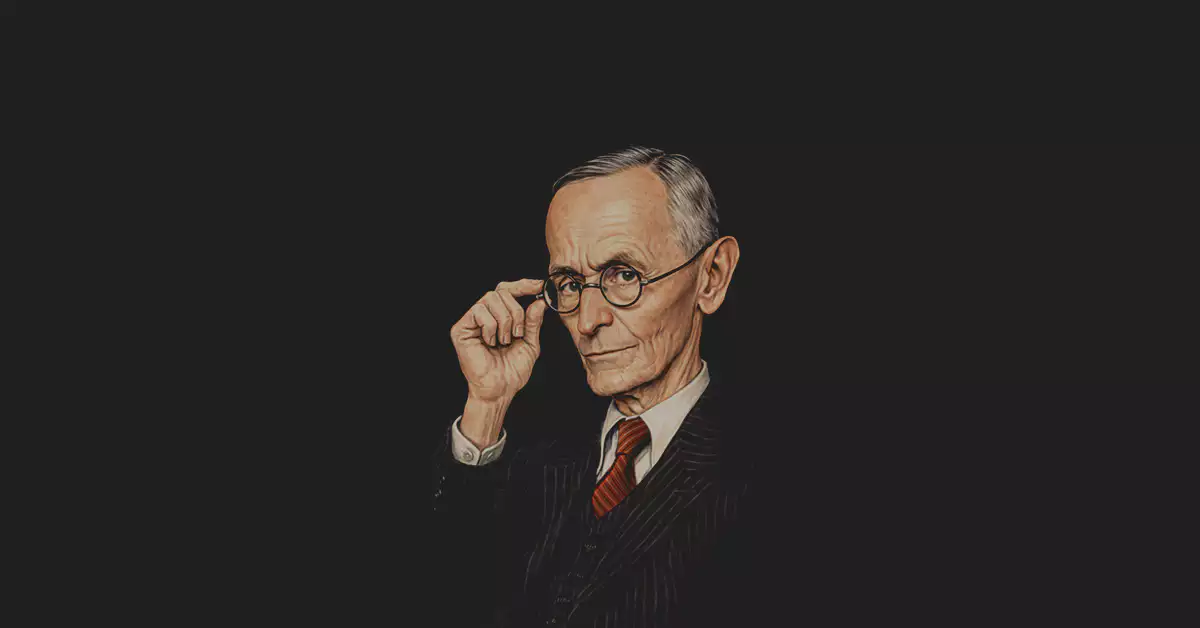
The novel ends twice.
First: a field hospital somewhere in the war. Sinclair has been lying wounded on a mattress for a period of time the novel leaves vague — hours, days, the duration blurred by the kind of consciousness that surfaces and submerges. The man on the adjacent mattress is Demian, who should not be there, who may be dying, who leans close in the dark and says something about what to do when Demian is no longer available to be called upon. Sinclair receives it as a kiss. In the morning, the man beside him is a stranger. He has never been Demian.
Second: Sinclair looks into what the novel calls a dark mirror and sees his own face. The face has become Demian’s face. The development is complete. The teacher is inside the self.
The ending is presented as fulfillment. Everything the novel has been building — the two worlds, the mark of Cain, Abraxas, the three guides, Eva, the war and the wounding — has been moving toward this convergence. Sinclair entered the novel divided, unable to hold his inner life without spilling it into shame, unable to name what he was. He leaves it carrying, inside his own reflection, the face of what he most needed to become. This is what the novel calls individuation. This is what it calls finding yourself.
The essay begins here and refuses to call it finding.
Not because nothing happened — something happened, and the series has been precise about what. But because the face Sinclair finds in the dark mirror is not the face the novel’s opening sentence promised him. Ich wollte ja nichts als das zu leben versuchen, was von selber aus mir heraus wollte. I wanted only to try to live what wanted to emerge from inside me. What emerges, at the end, from inside Sinclair is Demian’s face. And the essay, which has been following the novel from the walk home from school to the field hospital, wants to know how Demian’s face came to be waiting inside the mirror.
The arc of the novel is a curriculum, and the series has traced it in detail: Demian provides the first framework at eleven, Pistorius the theological practice at seventeen, Eva the embodied ideal in early adulthood. At each stage Sinclair receives what he needs from someone who has it ready. The development moves from external crisis (Kromer’s blackmail) to internal crisis (dissipation) to internal integration (Abraxas) to the embodied ideal (Eva) to the final integration (the mirror). The movement is real. Something changes in Sinclair across the novel’s two hundred pages that cannot be dismissed.
But the specific thing that changes is not the emergence of a self that was always inside. It is the construction of a self from materials provided from outside. Demian gave Sinclair language for his experience. Pistorius gave him a practice and a theology. Eva gave him the image of the thing he was searching for. What Sinclair assembles from these materials is genuinely his — he lives in it, he fights for it, he is wounded in the war while carrying it. But the materials were given.
The novel’s opening sentence describes a project of emergence from within. What emerges, at the end, in the dark mirror, is the accumulated gift of a sequence of charismatic others, held inside the self and called the self. This is what the series has been circling toward, and the final mirror is where the circling stops. The face in the glass is Demian’s face. Not metaphorically. Not as a symbol of something. Demian’s face, which the novel presents as Sinclair’s face, because Demian’s face has been shaping Sinclair’s self-understanding since the first sentence Demian ever spoke to him, on a walk home from school, about the children of Cain.
A mirror that shows you yourself requires, first, that you have some independent sense of what yourself looks like — something the mirror can confirm rather than constitute. If you have no independent sense, the mirror doesn’t show you yourself. It shows you what has been reflected back at you by the faces that were most attentively watching.
The first mirrors are not glass. They are faces. The infant who looks at the mother’s face and builds its first concept of itself from the reflection it finds there is doing the only thing available to do — there is no other source of self-knowledge at that stage, no prior image to bring to the encounter. Winnicott argued in 1967 that this moment — the infant looking into the mother’s face and finding itself there, because the mother is mirroring back the infant’s own state — is the origin of self-experience. The mother who is present and attuned reflects the infant. The infant sees itself. The first self is a reflection in another face.
But if the mother is absent, or depressed, or preoccupied with something that is not the infant, the infant looks into her face and finds something else. It finds her mood. Her withdrawal. Whatever is happening in her inner life that is not an attention to the infant. And the infant who grows up with this kind of looking builds a different relationship to mirrors — looks outward, into faces, for the confirmation that was not reliably provided in the first one, because the inner image never quite stabilized into something it could trust.
This is not Sinclair’s situation in any direct sense. His mother is not absent. His childhood is not traumatic in the clinical vocabulary. But the structure of what Winnicott is describing runs under the novel’s developmental logic like an underground river.
From the moment Demian falls into step beside Sinclair on the walk home from school, Sinclair has been looking into Demian’s face. And what Demian’s face reflects back at Sinclair is specific and consistent: you are one of the marked. You carry something that ordinary people find unsettling. You belong to the side of the Cain children, not the Abel children. You have been feeling the pull of the dark world not because you are weak or sinful but because you were built to feel it, because your eyes are open in ways that closed eyes cannot see. Every encounter with Demian confirms this reflection. Every subsequent guide extends it. Pistorius reflects back: your inner life is serious, your dreams are trustworthy, you are the kind of person who should attend to what arises in the dark. Eva reflects back: you have been searching for the right thing, and the form of what you were searching for is real, and here it is, in a doorway, waiting.
Sinclair has been building his self-image from these reflections for twenty years of his life. By the time he reaches the dark mirror in the field hospital, the image inside is settled. It looks like Demian’s face because Demian’s face, over twenty years, is what looking at yourself has meant. The mirror confirms what the reflections built.
If the mirror shows you someone else’s face, you have not found yourself. You have found the person who was shaping your reflection all along, now inside rather than outside. The integration is real. But what has been integrated is not what the novel’s opening sentence promised.
Here the essay has to stop and take the best available objection seriously, because the objection is not easily dismissed.
The Jungian reading of the ending says: this is exactly what individuation looks like, and the series has been misreading what Demian is. Demian is not a person in the ordinary sense — or not only a person. He is Sinclair’s inner figure, the idealized self that the psyche projects outward onto significant others during the period before it can integrate what the projection represents. The work of individuation, for Jung, consists precisely in withdrawing such projections — recognizing that the figures onto whom you have projected your own inner content are screens, not people, and taking back what you put there. When Sinclair looks in the mirror and sees Demian’s face where his own face should be, he is not seeing a borrowed face. He is seeing the completion of a retrieval. The inner figure that was housed in the outer world, in the actual person of Max Demian, has come home. The projection has been withdrawn. The shadow is inside.
This reading has genuine force. The phenomenology of projection is exactly what Sinclair experiences: the uncanny sense that Demian knows him better than he knows himself, the feeling that Demian is always ahead of him, the recurring encounters that seem too precisely timed to be coincidence. These are characteristic experiences of encountering one’s own projected material — the projected figure seems to know you because the projected figure is made from your own psychic substance.
And the Jungian reading has a further advantage: it explains the novel’s conclusion without requiring the conclusion to be a failure. On the Jungian account, Sinclair finding Demian’s face in the mirror is the success the novel has been building toward. The development was individuation. The face belongs to Sinclair. The series’ critique has been applying the wrong standard.
The essay must hold this in view, because it is a serious reading and deserves a serious response. The response is not that the Jungian reading is wrong. It is that the Jungian reading cannot settle the question it appears to settle.
If Demian is Sinclair’s native inner figure — native to Sinclair’s psyche, emerging from within — then the face in the mirror is genuinely Sinclair’s own, and finding it there is finding himself. But if the inner figure that Sinclair calls Demian was shaped from outside, by the actual Max Demian who walked up beside Sinclair on a specific afternoon in a specific small German town and began talking about Genesis — if the “inner” Demian was built from the outside in rather than discovered within — then the Jungian vocabulary has not resolved the problem. It has translated it. The question is no longer whether the face in the mirror is Sinclair’s projected inner figure. The question is whether the projected inner figure is native or installed. And this question — the crucial question the novel’s opening sentence rests on — is one the Jungian framework, which assumes the inner figure is native, cannot answer by assumption.
The mirror shows Demian’s face. The Jungian reading says this is Sinclair’s face, retrieved. The series says: where did Demian’s face come from, inside Sinclair? And how did it come to look exactly like the face of the boy who fell into step beside him on the walk home from school?
The essay must now turn this question against itself, because the question implies a standard the essay cannot maintain.
All self-knowledge is constructed from internalized images of significant others. There is no self-concept that develops in a vacuum, that builds itself from nothing, that emerges purely from within with no contribution from the faces that were most attentively watching. The self that the novel’s opening sentence calls what wanted to emerge from inside — this self, wherever it is, was also built from encounters, also shaped by faces, also indebted to people who showed it something it could not have found alone. There is no other way to be a self. The critique of Sinclair’s development cannot become a demand for a development that needed no one.
And yet the series has been insisting that something is worth examining in Sinclair’s development specifically — not because it was guided, but because of what the guidance produced and what the novel fails to examine. The distinction is not between guided and unguided development. It is between development that knows its own sources and development that does not.
Sinclair ends the novel with Demian’s face inside him and calls this himself. The novel does not show Sinclair knowing that the face arrived from outside, that the mirror he has been looking into for twenty years was Demian’s face before it was any other face, that what felt like the emergence of an inner truth was also the installation of an outer image. The novel does not show Sinclair examining the source of the self he has found. It shows him finding the self and calling it found.
Does knowing the source free you from it? Almost certainly not automatically. You cannot simply think your way out of an image that has been building since you were eleven, cannot decide not to see what the mirror has been showing you for twenty years. Awareness is not freedom. But it is the beginning of a different relationship to the image — a relationship that is honest about what it contains, about who gave it to you, about the specific morning in a specific town when a boy you had never spoken to fell into step beside you and began telling you who you were.
The self-knowledge the novel’s opening sentence promised — the direct access to what wanted to emerge from inside — is not what Sinclair finds in the dark mirror. What he finds is something more complicated and more ordinary: a self built from encounters, carrying the faces of the people who shaped it, capable of being lived in but not quite owned, not quite purely his. This may be the only kind of self available. But calling it that — calling it what it is — is what the novel does not do.
The novel ends before the rest of Sinclair’s life. The field hospital, the dark mirror, the face — and then silence. We don’t know what Sinclair does with what he found. We don’t know if the integration holds across the decades that follow the war, if Demian’s face in his mirror is something he can live with well or something that constrains him in ways he can’t quite see. We don’t know if he eventually examines the source of the image, or if the image simply persists, as internalized images tend to do, shaping how he sees himself without announcing its own presence. The novel ends at the moment of arrival and does not follow the arrival into the life that follows.
The essay ends before the novel.
Not in the field hospital. Not at the dark mirror. Earlier — before Eva, before Pistorius, before the painting of the bird and the message about Abraxas, before the dissipation and the conversion and the years of difficult formation.
On a walk home from school. Sinclair is eleven years old and carrying, invisibly, a crisis that has no vocabulary yet. The blackmail, the lie, the gap between who he is supposed to be and what he has already become — all of it running under his face, which is arranged normally. A boy falls into step beside him. This boy has been visible across the classroom for weeks as someone who holds himself differently, who has a quality of attention that does not look for confirmation from the people around it. He begins to talk. Genesis. Cain. The mark that was not shame but distinction.
Sinclair listens. The language arrives for something he has been feeling without language. He receives it. He turns it over all evening. He reads the text again looking for the flaw and cannot hold onto it.
He does not know, in this moment, what has been given to him. He does not know that the face of the person speaking to him will become, over the next twenty years, the face he sees when he looks for himself. He does not know that the mirror in a field hospital in a war he cannot yet imagine will show him this face and call it his own. He only knows that the language fits. That what he has been carrying has a name. That the boy walking beside him seems to see something in him that no one else has seen.
This is the moment the essay ends on. Not the answer. The question, held in its earliest form, before the development that follows it: a boy looking for himself, finding someone else’s language waiting there, receiving it, not yet knowing what it will become.
Whether that moment was the beginning of his search or the end of it — whether the framework given on that walk home opened something that was genuinely Sinclair’s or closed something that might have been — is the question the novel leaves open, and the question the series, after eight essays, still cannot close.
It can only leave it there, on that street corner, where the boy has just received something and does not yet know what he has received.