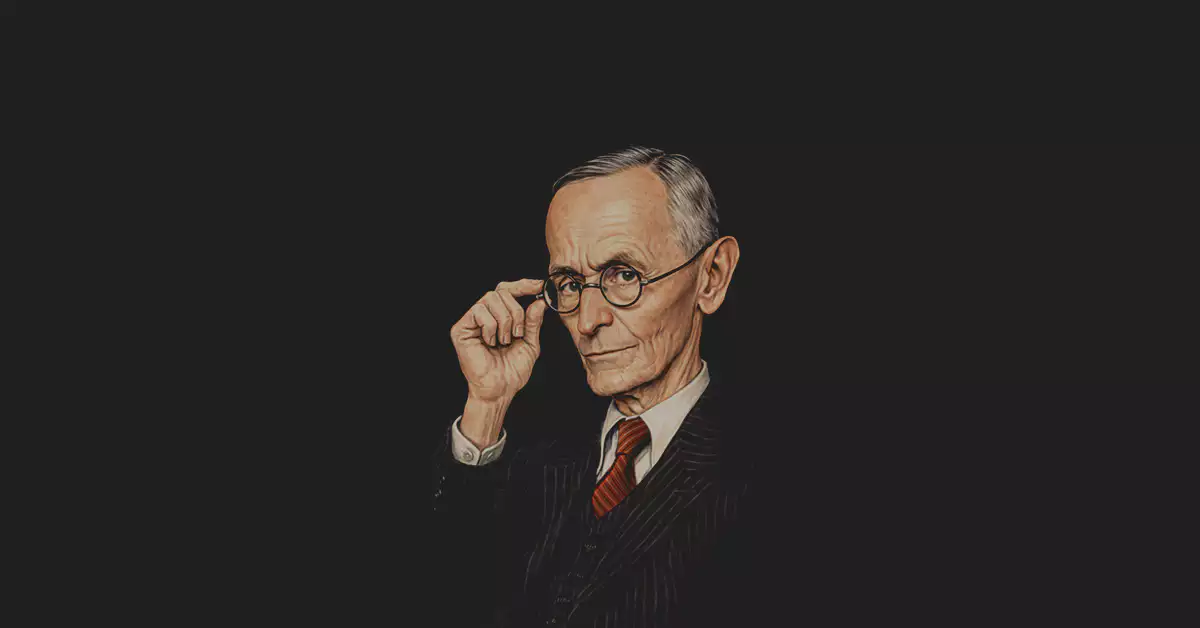
The god who encompasses both good and evil has worshippers in this novel, and the question worth asking is: what exactly do they do?
Pistorius plays the organ in a church that no longer uses him for services. He leads Sinclair through visualization exercises in the dark, teaches him to attend to what surfaces in the inner space without prompting, studies the Gnostic and alchemical literature with a devotion that eventually gets him identified as antiquarian. He builds a small fire and performs quasi-ceremonial rituals in his rooms. He takes Abraxas seriously as a practice — as something that imposes demands, requires a response, changes what you are capable of paying attention to.
Demian and Eva hold a household that attracts people who carry something the ordinary world cannot absorb. They talk. They receive visitors. The atmosphere is one of intentional attention, of people who have agreed to notice their inner lives seriously. Eva tells stories about love. Demian discusses the coming war with the certainty of someone who has read the signs correctly.
Sinclair paints, attends to his dreams, follows the face that assembles itself in his sleep until he finds it in Eva’s doorway, feels recognized, comes to understand — or comes to accept the suggestion — that his inner life has been pointing toward something real.
None of this is obviously different from what these people would be doing without the name Abraxas. Pistorius was playing the organ before Abraxas arrived. Demian was charismatic and marked before the theology gave him a framework for it. Eva embodied whatever she embodies independent of what it is called. Sinclair was painting and dreaming and searching before Pistorius provided the god who encompassed both kinds of experience.
What Abraxas changes, looking at the practices, is the name. The god arrives in the novel and names something that was already occurring. This is not nothing. Names matter; they allow practices to be recognized, shared, continued. But naming what you already are is less than transformation. And transformation is what the novel claims.
The theological claim is interesting, and the essay has to credit it before examining what it fails to deliver.
Abraxas is the god who holds both good and evil — who refuses the conventional moral division that declares half of experience legitimate and half forbidden, that assigns darkness to the devil and light to God and asks the believer to live in one half while managing the other. This division, which Sinclair identifies with his father’s bright world and which the novel tracks as the root of Sinclair’s developmental problem, is what Abraxas is supposed to dissolve. The worshipper who genuinely takes Abraxas in is supposed to stop experiencing their inner life as divided — stop performing the suppression of one half in order to maintain access to the other. The dark drives are not to be expelled or sublimated or converted into permitted channels. They are to be included. The god includes them. Worshipping the god who includes them means including them in yourself.
This is a genuine theological move. It has a history that runs from the Gnostic traditions through the alchemists through the Romantics through Nietzsche’s transvaluation of all values, and in each iteration the move is the same: the conventional moral hierarchy excludes something real, and the exclusion costs the person their wholeness. The god who encompasses both is the god who costs you your division, which is also the thing you were using to stay comfortable. Losing your division is terrifying. It is also, arguably, the condition of genuine development.
Demian makes this argument to Sinclair during their conversations at the gymnasium, with a clarity that has been running as an undercurrent since the Cain argument. The god you worship determines what you can know about yourself. A god of pure light produces a self with a large shadow and no language for it. A god who encompasses both produces a self that can at least begin to look at the whole.
The argument is good. What the essay keeps returning to is whether the argument produces anything in the people who accept it.
The worshippers of Abraxas in the novel live in their base drives in a particular way — they hold the drives as present rather than expelled, which is not the same as acting on them indiscriminately, which is the mistake most critics of this kind of theology make in reading it. What Abraxas requires is not licentiousness but integration: the drive is acknowledged, included in the picture of the self, given a place in the structure rather than assigned to the shadow. The base drives hold up the higher ones; they don’t replace them. The higher functions depend on what they rise from, and what they rise from must be seen clearly if the higher functions are to be genuine rather than performed — like the serpent legs of the Gnostic deity, without which the rooster head has nothing to stand on. The Basilidean Gnostics, the second-century sect from Alexandria who gave Abraxas his form, depicted their god exactly this way: a human torso carrying a rooster’s head above and snakes where the legs should be, standing on the drives that sustain the alertness. The name, in the Greek numerological system they used, sums to 365 — one for each day of the year, the full count of solar time incorporated into the deity’s identity. This is a god of totality, and he is far more specific, far more strange, and far more demanding than the abstraction Hesse’s characters discuss.
Hesse borrowed the name. He did not borrow the image. The Abraxas of Demian has no body — he is described in terms of what he holds rather than what he looks like, defined by his function (encompassing darkness and light) rather than his form. The novel took a concrete, peculiar, materially imagined deity and made him into a principle. This is understandable — the historical Abraxas would distract from the novel’s psychological argument — but it costs something. The Basilidean Gnostics gave Abraxas serpents for legs because they believed that the honesty of a theology is visible in whether it incorporates or suppresses the drives. The serpents are not decorative. They are load-bearing. Hesse’s Abraxas is all rooster head, all higher function and principle, and the drives he is supposed to hold are present only as abstractions — darkness and light, not the actual serpents that make the standing possible.
This does not invalidate the theological move. But the historical deity throws the novel’s version into relief. The Gnostics were not content with a god who encompassed both good and evil as a description. They built him. They gave him a body that made the structure visible. That body is more honest than the abstraction, and the abstraction is what the novel works with.
Here is where the framework has to fracture, because the pattern the essay has been building — Abraxas ratifies rather than transforms, names what is already there rather than producing something new — runs directly into Pistorius, and Pistorius complicates it.
Pistorius is the most devoted Abraxas worshipper in the novel. He is the one who takes the god seriously enough to build a practice around him, to study the sources, to attempt the integration the theology demands, to sit with the contradiction rather than resolving it. He is the one for whom Abraxas is not a name but an obligation. And he is the one who fails. Sinclair identifies him as antiquarian — as someone who lives in the archive of Abraxas rather than in the living god — and the identification is correct. Pistorius knows everything about how people have historically approached the integration of darkness and light, and he cannot do it himself. There is a gap between his knowledge and his life, and the gap is the definition of his limitation.
Sinclair’s dismissal of Pistorius is therefore, in the light the essay has been casting, a dismissal of the person who took Abraxas most seriously. The person who believed the god could change something, who tried to let the god change something, who was destroyed by the attempt — this is the person declared insufficient for the next stage. Pistorius failed at Abraxas precisely because he believed in Abraxas. He staked something on it. The god did not deliver.
Now consider Demian and Eva, the people the novel presents as the successful Abraxas worshippers. What is their relationship to the practice? They don’t seem to have one. They don’t study the sources. They don’t perform exercises. They don’t appear to struggle with the integration of their base drives and their higher functions, because they appear to have been integrated before the concept arrived. Demian has always held both darkness and light in his bearing — since the walk home from school when Sinclair was eleven, the character has moved through the world as someone for whom the division has simply never applied. Eva embodies the archetype effortlessly, without apparent effort, without the gap between ideal and practice that defines Pistorius.
This is a suspicious achievement. Abraxas is supposed to be the god who costs you your division. Demian and Eva appear to have arrived without a division to lose. They were already what Abraxas requires, before Abraxas was named. The name, for them, is an afterthought — a confirmation of what they already were, not a transformation of what they were into something else.
The pattern holds, then, but sharper. Abraxas confirms the already-formed (Demian, Eva) and destroys the aspiring (Pistorius). The people who needed it most are the ones it cannot help. The people who didn’t need it are the ones who seem to embody it. The god who was supposed to transform has instead revealed a prior hierarchy — between those who were born with the integration and those who will spend their lives failing to achieve it.
But the essay cannot stop there. Because the argument has been using “change behavior” as the standard for whether Abraxas works, and this standard needs to be examined.
Does a religious or philosophical concept need to produce observable behavioral change to be meaningful? The question is not rhetorical. There are serious traditions of thought — in mysticism, in certain strands of philosophy, in the psychology of depth — that hold that the value of a concept is not in what it makes you do but in what it makes you able to see. A concept that changes how you hold your experience — that gives you a way to include what you were previously excluding, to look at what you were previously averting your gaze from — may be genuinely transformative without producing any change that an outside observer could detect. The transformation is internal. It alters the quality of attention, the texture of self-knowledge, the relationship between what is conscious and what is not. None of this is visible from outside.
Abraxas, on this reading, is not a program. It is a way of holding contradiction. It does not tell you what to do when your darkness surfaces. It tells you to stop pretending the darkness is not yours. This is different from producing a different behavior. It is producing a different relationship to your own behavior, a different quality of honesty about the full range of what you contain.
This is not nothing. The person who can look at their own drives without routing them through a system of permission and prohibition — who can acknowledge them as theirs without either acting on them indiscriminately or suppressing them back into the shadow — may be living with a kind of honesty that produces something, over time, that cannot be measured by external behavior but is not for that reason absent.
The essay believes this. And yet: Sinclair’s Abraxas, in practice, seems to be primarily an aesthetic experience — an intensification of his inner life, a deepening of the quality of attention he pays to his dreams and impulses, without a corresponding deepening of his relationship to the people around him or his understanding of his own patterns of dependency. The integration Abraxas is supposed to produce would look like a Sinclair who could hold both the darkness and the light without needing a guide to tell him which was which. The novel ends with a Sinclair who sees Demian’s face in his mirror. The darkness and the light have been integrated, but what they have been integrated into is someone else’s image of him. If Abraxas succeeded, it succeeded quietly, in a way that left the essential structure of Sinclair’s dependency unchanged.
Names matter. But what this name named was already there. And what the practice was supposed to produce arrived, if at all, in a form the practice cannot take credit for.
The deity the Basilidean Gnostics worshipped does not look like anything Hesse’s characters describe.
He stands on legs that are serpents — thick, scaled, grounded. The snakes are not an ornament and not a warning. They are the foundation. The body they support is human, robed, carrying the power that comes from having the drives below rather than behind. Above the body: the rooster’s head. The rooster who crows at dawn, who announces the day, who marks the boundary between the unconscious night and the conscious light not by eliminating one but by standing at the threshold between them and calling out. His name, in Greek, counts the days. He is the god of the full year, of every day that the year contains, including the days you would prefer not to have included.
He is not a principle. He is a god, specific and strange, demanding enough that the people who imagined him gave him a form rather than a definition. The form is the argument. The serpents do not symbolize the base drives. They are the base drives, made structural, made visible, incorporated into the divine body so that the worshipper cannot pretend they are separate from what they are worshipping.
Hesse found this god and took his name and made him into a concept. The concept is interesting. The novel that contains the concept is serious and worth reading and has something to say about the cost of the division between darkness and light. But the god the Gnostics built was stranger than what the novel inherited from him — stranger and more demanding and more honest about what integration requires. The serpents are still there, in the history, waiting for the concept to catch up to the body it borrowed its name from.
The essay leaves the god there: rooster-headed, standing on his serpents, specific in a way the abstraction has not managed to be.