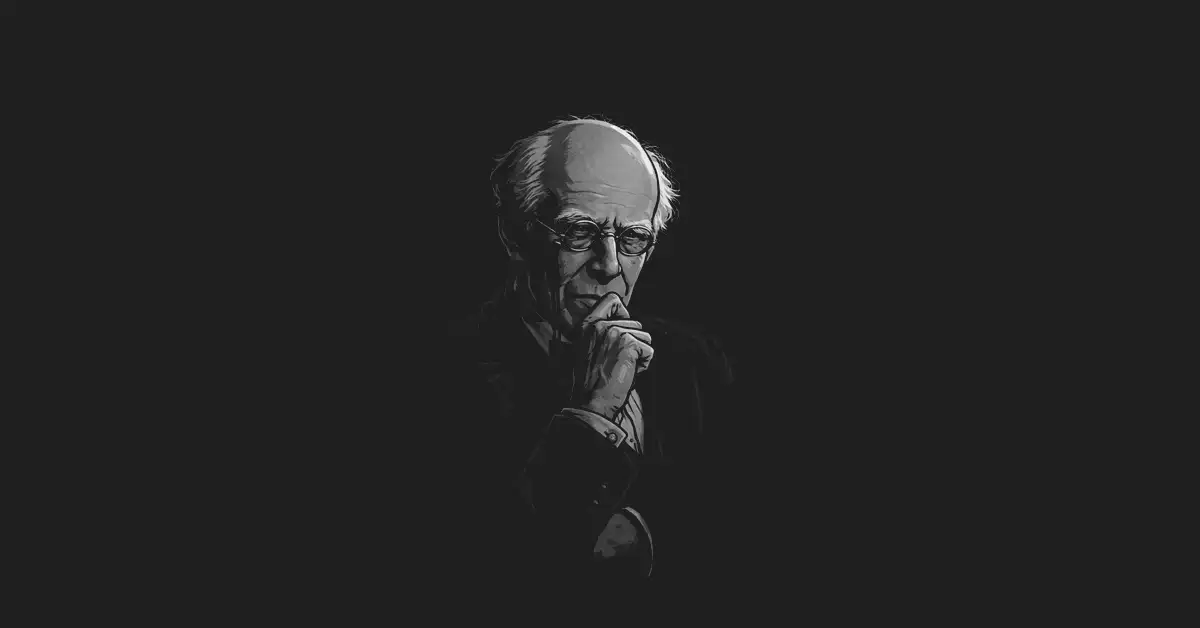
The Empty Stage Is Not Empty: Stanislavski and the Logic of Action as Emotional Premise
Nothing has happened yet on stage. The actor is standing, but that standing does not yet belong to a character; it is merely the physical equilibrium of a human body. The light falls flat across the face, and the lines have not yet crossed the lips. Yet in that suspended instant, an invisible question cuts through the air: If I were in these circumstances, what would I do? This conditional sentence is the unseen hinge that turns acting from the external to the internal, from representation to experience. What Konstantin Stanislavski bequeathed was not a technique, but a way of organizing the world around that question.
In late nineteenth-century Moscow, the theatre remained captive to an excess of surfaces. Emotions were signaled through exaggerated gestures, and characters were consumed as social types. The actor existed to “show” feeling to the audience, not to live it. What Stanislavski attempted at the Moscow Art Theatre was the dismantling of that tradition. He sought to return acting to the status of a psychological fact. Emotion, he insisted, should not be the result of expression, but the product of conditions. In other words, the actor does not manufacture emotion; he constructs the circumstances in which emotion becomes inevitable.
This shift was not merely a technical adjustment but an overturning of ontology. The actor is no longer a conduit for text, but a living condition in itself. What Stanislavski called the “given circumstances” is not simply the information contained in a script, but the totality of a world in which the character breathes, judges, and falters. Within that world, the actor is always in action. The essential question is not whether one feels, but what one is trying to do. Action here exceeds physical movement; it is the vector of will, the trajectory of desire.
Stanislavski’s system is often reduced to a doctrine of inner truth, yet its core lies in the tension between the external and the internal. He cautioned against summoning emotion directly. Instead, he approached it through action. An actor attempting to play sorrow does not strive to reproduce sorrow itself. He places himself within the act of trying to recover what has been lost, or resisting its acceptance. Emotion emerges as the byproduct of that action, as a delayed consequence. In this sense, acting ceases to be the expression of feeling and becomes a process unfolding in time.
This line of thought finds particular clarity in the plays of Anton Chekhov. Chekhov’s characters do not collapse in moments of dramatic upheaval, but erode gradually within a time that appears, on the surface, to contain nothing at all. To capture these minute fissures, Stanislavski forbade external excess and demanded internal duration. The character does not cry out, yet within that silence, collapse has already begun. The actor’s task is to endure this invisible transformation. Emotion is not an explosion, but an accumulation.
It would be a mistake, however, to regard Stanislavski’s system as a simple pursuit of “naturalness.” What he sought was not the imitation of nature, but the construction of truth. Every element on stage—body, voice, space, time—had to function within a structure of necessity. Truth, in this sense, is not identical with factual accuracy; it is the condition under which the audience comes to believe. The actor does not need to feel truth in any private sense; he must build the system that makes it perceivable as such.
From this point, Stanislavski’s work extends into nearly every current of twentieth-century acting. Lee Strasberg radicalized it through affective memory, Stella Adler reoriented it toward the discipline of imagination, and Sanford Meisner sought truth in the immediacy of relation with the other. Though these approaches diverge, they share a common inquiry: how can the actor move beyond appearing real to existing, on stage, as if real?
Stanislavski’s legacy lies in leaving that question open. His system was never a closed doctrine, but a field of continuous revision and experiment. In his later years, he turned critically away from his earlier emphasis on emotion and moved toward the logic of physical actions. This was not a retreat, but the furthest extension of his thought. Emotion is unstable; memory is fickle. Action, however, can be repeated, structured. And within that repetition, something that appears accidental—truth—begins to occur.
The actor still stands on stage. But now that standing is no longer empty. He leans toward a purpose, assumes a world, and waits for a feeling that has not yet arrived. The audience watches that waiting. And at a certain moment, when it no longer appears as acting but as a form of being, the question Stanislavski left behind becomes present once more. Acting is no longer a matter of what it is, but of when it begins to come alive.