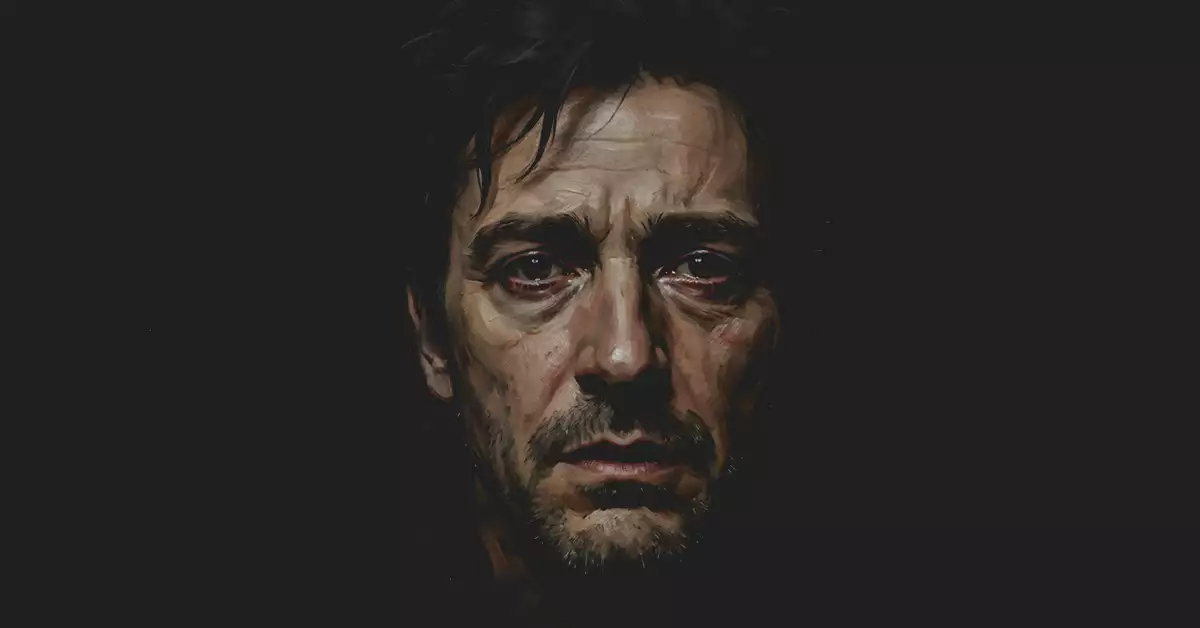
The Camera Holds on a Face: What Remains After Emotion Has Passed Through
The camera holds on a face. The line has ended, yet the eyes continue to search, as if feeling their way through something just out of reach. The emotion has passed; what remains is a slight delay, a faint tremor, a density that resists explanation. The actor appears to be doing nothing. And yet, within that very stillness, something is happening. Emotion is not being expressed; rather, what lingers on the screen is the trace left behind after emotion has moved through. What we call Method acting may, in the end, be a question of this residue.
The moment Method acting is reduced to a technique, it is already misunderstood. It is less the name of a particular style or training system than a practice through which the actor reconfigures the relationship to the self. The question is no longer how emotion is to be shown, but under what conditions it comes into being. This subtle shift altered the entire landscape of acting in the twentieth century.
Its point of departure is often traced to Konstantin Stanislavski. Yet the repeated invocation of his name as doctrine often obscures what matters most. He did not seek to establish a style, but to create the conditions under which acting could attain the same density as life itself. Emotion was not something to be performed, but something that had to arise necessarily. The actor’s task was not to reproduce feeling, but to make sense of the circumstances from which feeling would inevitably emerge. The core of acting, in this view, lies not in expression but in premise, not in result but in process.
As this line of thought moved to the United States, it intensified and shifted direction. Around the Actors Studio, a new culture of acting took shape, one that found its most radical articulation in the work of Lee Strasberg. Emotion came to be understood not as the product of external conditions but as something to be excavated from deep within. Actors dug into memory, wound, and desire in search of emotional sources. In the process, acting moved away from representation and toward exposure. The boundary between role and self blurred, and the actor’s interior became a kind of laboratory.
At this point, Method acting shifts from an aesthetic into an ethical question. What is authenticity? How “real” must emotion be? These questions extend beyond the domain of acting into the ways in which human beings come to understand themselves. In the postwar period, as faith in authority and social codes eroded, truth was no longer located in external structures but sought within the individual. Method acting became a way of embodying that historical sensibility.
Thus the emergence of Marlon Brando marks not merely a stylistic shift, but a transformation in the very mode of human presence on screen. In A Streetcar Named Desire, his body ceases to function as an instrument for conveying meaning. It reacts, wavers, resists control. His lines do not arrive as completed sentences but spill out before thought has fully taken shape. What the audience witnesses is not performance, but the passage of emotion through a body.
This transformation deepens in the work of James Dean. He often appears lost within the scene. His hands fail to settle; his gaze refuses to fix itself. Yet it is precisely this instability that gives his presence its vitality. He does not construct a character; he reveals the degree to which that character fails to align with the world. His acting is not a finished form, but the process of form coming undone.
In Robert De Niro, this trajectory takes on a more rigorous intensity. The oft-repeated story that he drove a taxi in preparation for Taxi Driver matters less for its factual detail than for its underlying structure. It is not an attempt to imitate reality, but to enter the temporal rhythm of another existence. The actor suspends the habits of everyday identity and allows another cadence to take hold. Acting becomes not the execution of a role, but a transformation of being.
Yet all of this returns us to a single question. Where does the truth of emotion reside? Must one suffer in order to portray suffering? The remark attributed to Laurence Olivier—addressed to Dustin Hoffman—“Why don’t you just try acting?” crystallizes the tension. It is less a joke than a provocation: how far must acting approach lived experience before it ceases to be acting at all?
Cinema offers no resolution. Instead, it prolongs the question. The camera enlarges the human face, amplifying its smallest variations. Exaggeration is easily exposed, but the slightest trace of truth can expand into something overwhelming. For this reason, the essence of Method acting lies not in intensity but in density—not in how strongly something is felt, but in how subtly it remains.
The face on screen is no longer a mere extension of theatrical expression. It becomes a landscape, a terrain across which emotions pass, leaving fleeting traces behind. Method acting is the search for the conditions that make such traces possible. The actor turns inward, yet that interior is never stable. It is a space of constant transformation, disintegration, and reformation.
The practice thus rests on a fundamental paradox. The actor must become another without entirely disappearing. Emotion must feel real without becoming personally destructive. Method acting unfolds within this impossible balance.
There are moments when an actor does nothing at all, and yet we see more. Speech falls away, the body grows still, and the face can no longer conceal what passes across it. The camera lingers. In that silence, cinema arrives at a peculiar truth: that the human interior resists complete expression.
Method acting is the most persistent attempt to approach that impossibility. It is not a technique for reproducing emotion, but a way of experimenting with the conditions under which emotion comes into being.
And the experiment is not yet over.