Wuthering Heights (2026)
A cinema of touch and presence, where desire sheds symbolism and insists on the body as its only truth
Emerald Fennell is not adapting Wuthering Heights. She is using it — clearing away the Victorian scaffolding, the accumulated reverence, the novel’s own elaborate defenses against the rawness at its center — to reach what was always underneath. That thing is desire. Not the kind that elevates itself into theology or landscape, but the kind that precedes all of that: the desire that lives in the body before it has found any language to describe itself, that arrives through dirt and skin and the specific weight of proximity before it arrives as thought.
This is a precise artistic decision, and it carries consequences the film both embraces and evades.
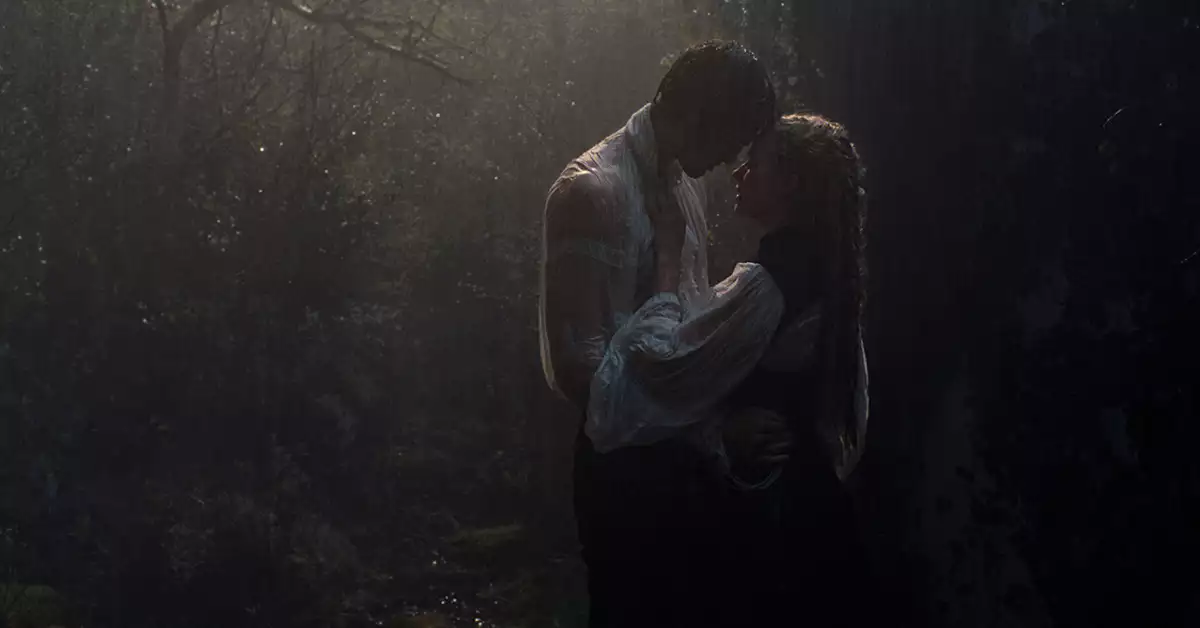
Brontë’s novel sublimates relentlessly. The love between Catherine and Heathcliff is so intense it cannot bear direct expression; it keeps converting itself into metaphysics, into weather, into the language of souls fused beyond death. The Victorian novel had no other available grammar for what it was trying to say. Fennell literalizes. The camera does not symbolize desire — it documents it. Dirt under fingernails. Breath arriving too fast. The specific pressure of one body against another. Margot Robbie and Jacob Elordi are not asked to translate feeling into performance; they are asked to be present in their bodies, and Fennell holds the camera on that presence with the patience of someone who knows that sustained attention is itself an argument. There is something almost pre-verbal about the way Elordi occupies a frame — he functions as mass, as atmosphere — and Robbie meets that with something rarer in actors given roles like this: the absolute conviction that she could do anything and get away with it. These are not tasteful people operating in a tasteful film. The refusal of taste is the whole point.
Saltburn already established the logic. That film understood desire as fundamentally somatic — a matter of fluids and proximity, of one body’s surface transgressed by another — and located it within the pressurized theatre of English class anxiety. Wuthering Heights relocates the same preoccupation to gothic landscape. The ritual is continuous; the staging is wider.
What the film does with this intensity is where the argument begins to complicate. Fennell’s mise-en-scène has always pushed toward the decorative — spaces designed for visual impact rather than historical coherence. The red floors of Catherine’s marital estate, the costumes that tip past period accuracy into theatrical silhouette, the light that reads as painted rather than atmospheric — all of it declares the same formal intention. This is not a reconstruction of a world. It is an ornamentation of a feeling. History recedes to backdrop; politics dissolve entirely. What remains is love, offered as the film’s sole and unqualified subject.
That insistence is culturally significant in ways the film may not fully intend. Prestige filmmaking over the last twenty years has grown deeply reluctant to treat romantic love as a primary subject — has learned to approach desire sideways, to qualify it, to arrive at every declaration already holding the ironic distance that signals sophistication. Every romance becomes a critique of romance. Every love story embeds its own skepticism. Fennell refuses that structure. She makes the film that insists, with the stubbornness of conviction rather than naivety, that desire is real and enormous and deserves to be looked at directly, without the protective apparatus that contemporary cinema has built around feeling to make it safe to admit.
The great melodramas knew this. Sirk and Minnelli did not hedge. They gave emotion the full resources of the medium — color, space, music, performance — and produced something that respectable critical opinion found embarrassing precisely because it was working. The embarrassment was the proof. Fennell is operating within this tradition. She has decided that excess is not a problem to be managed but the condition of honest engagement with her subject — that a story about this kind of love demands this kind of intensity, and that formal restraint in the service of critical detachment would be the real failure of nerve.
The film’s problems are real, and naming them is not the same as dismissing it. The production design, for all its beauty, eventually begins to compete with the performances it exists to frame. There are extended stretches in the second half where the set is more present than the people inside it — a significant problem when the film’s entire argument is that this love matters because it is embodied, because it exists in these particular bodies and nowhere else. The visual environment becomes so insistent that the characters begin to look like very attractive figures arranged inside a very expensive idea.
The casting question runs deeper. Brontë’s Heathcliff is racially and colonially ambiguous not as texture but as structure — his position outside English categories of race and class determines every act of violence directed at him and every act of violence he returns. Converting him into pure erotic force, however convincingly realized, removes something the novel was not using decoratively. Fennell’s stated position — that she is recreating the sensation of reading the book at fourteen, not the architecture scholars have since mapped onto it — is a legitimate artistic claim. It is also a claim that happens to be convenient. The fourteen-year-old’s experience of the novel and the novel’s actual construction are not identical, and the distance between them is not cost-free.
But the question the film opens and does not close is neither about fidelity nor casting. It is about what it would take for contemporary cinema to return to love — genuinely, not as subplot or symptom — as a subject capable of carrying serious formal ambition. Would that require the entanglement with social reality that gave the melodramas their weight? Or is there a legitimate path toward what this film attempts: making desire as materially present on screen as an object in the physical world — not symbolized, not contextualized, simply there?
Fennell does not resolve the question. She places it in the frame and holds still.
The hill. The wet grass. The dirt at the ends of fingers. Perhaps this is always where desire begins — before language, before meaning, before the interpretive machinery arrives to explain what the body already knew. And in the moment a film recovers that sensation and refuses to look away, something that had appeared to be gone — a genre, a form of sincerity, a conviction that feeling is a subject worthy of the medium’s full attention — begins its slow, uncertain return.
— Related Critique
Expanding the discourse on visceral cinema and genre
— The Aesthetic Lineage
Tracing the genealogy of excess and the instability of pleasure