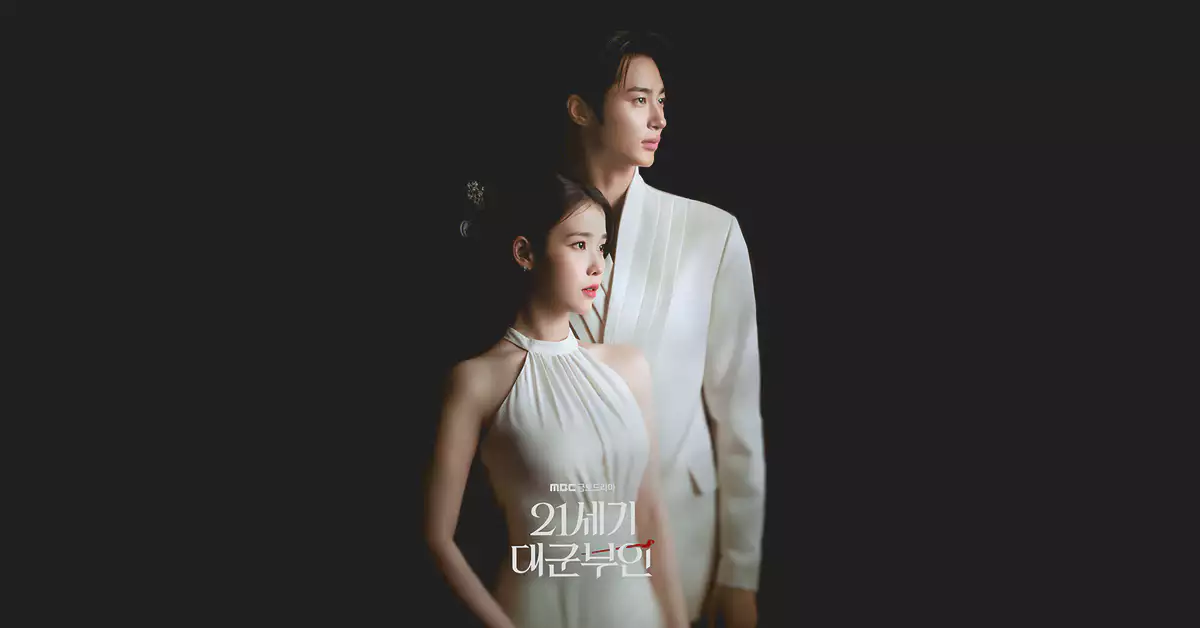
Perfect Crown
Perfect Crown Cast, Characters & Relationship Chart Explained
Note: The drama is officially titled ‘Perfect Crown’ in English, while its original Korean title is ’21st Century Grand Princess Consort’ (21세기 대군부인).
Some dramas begin with an image. Others begin with a question. What if, at this very moment, a king existed in the Republic of Korea? Imagine a palace rising somewhere between gleaming glass towers and high-rise apartments, where the language of democracy circulates as everyday speech, yet someone is still addressed as “Your Highness.” On screen, the vision feels at once unfamiliar and eerily recognizable: a world where smartphone notifications coexist with court rituals, where the temporality of the present is overlaid with the lingering architecture of feudal order. This strange layering of time is the point of departure.
A Kingdom in the Present — The Fault Line of the World
The series opens by bending a sentence we think we know. In reality, Korea is a democratic republic. Here, it is a constitutional monarchy. The National Assembly and executive offices remain, but alongside them stands a royal family; the ultimate symbol of authority is not the vote, but bloodline. What matters is that this premise does not function as mere fantasy. It presents itself as an alternate history born from a subtle divergence: a crown prince who did not die, a monarchy that did not vanish. In this version of history, the royal institution survives the passage into modernity, not as a relic but as a central axis of legitimacy.
The most unsettling contradiction lies in class. On the surface, the structures of a contemporary economy remain intact. Yet beneath them, an older hierarchy persists. Wealth does not equal nobility. Even the most powerful conglomerate heirs remain, in the eyes of tradition, commoners. This dissonance is not decorative—it is the engine of the drama. It raises a question that echoes beneath every interaction: Where does power come from? From money? From political office? Or from something decided at birth?
The Architecture of Power — Three Axes
Power in this world is divided into three domains: royal lineage, political authority, and capital. The monarchy retains symbolic dominance; politics operates through modern institutions yet cannot fully escape royal gravity; capital, embodied by conglomerates, commands the material landscape.
The drama gains its momentum from the friction among these forces. The monarchy possesses legitimacy without economic control. Capital wields immense wealth but lacks hereditary status. Politics governs through systems, yet remains entangled with the crown. At the center of this unstable geometry stands a figure who refuses to accept the limits imposed upon her.
Seong Hee-joo(IU) — The Will to Break Rank
Seong Hee-joo is, by all measurable standards, a victor. She is the daughter of the nation’s most powerful conglomerate, brilliant, ruthless, and nearly unbeatable. Yet her defining trait is not what she has, but what she lacks.
In this world, she is a commoner—and worse, an illegitimate one. No amount of wealth grants her entry into aristocratic circles. In the marriage market, her achievements evaporate. Corporate titles and financial dominance mean nothing against inherited status.
This contradiction generates her force. She is not a character who accepts defeat. Her credo—better to win dirty than lose clean—operates less as personality than as survival logic. For her, marriage is not romance but strategy, a mechanism for reconfiguring her place in the social order. If class is a wall, she intends to shatter it. And she sets her sights on the highest possible prize: the royal family.
Prince Ian(Byeon Woo-seok) — The Gravity of Suppressed Power
If Hee-joo’s desire moves upward, Prince Ian’s burns inward. As the king’s second son, he occupies an ambiguous position: removed from direct succession, yet never outside the orbit of power.
He was once volatile, driven by fierce ambition and temper. But the court feared him. His identity was reshaped, his intensity suppressed, his life narrowed into restraint. He learned to contain the very impulses that defined him.
History, however, rarely allows such containment to remain intact. When his brother dies and a child ascends the throne, Ian becomes regent. He does not sit on the throne, yet governs in its shadow. The nickname follows him inevitably: a modern echo of the usurper archetype.
He appears to reject power, but never fully relinquishes it. His life is suspended at the edge of decision, a perpetual hesitation between withdrawal and domination. It is precisely at this threshold that he encounters Hee-joo—a woman who does not hesitate, who pursues victory with unapologetic clarity.
Prime Minister Min Jung-woo(Noh Sang-hyun) — The Calculus of Politics
Between monarchy and capital stands political authority, embodied by Prime Minister Min Jung-woo. He is the heir to a lineage of governance, a man shaped by institutions and legacy.
Yet he resists easy categorization. At times he performs as a guardian of the establishment; at others, he gestures toward disruption. His ideological position shifts, or seems to, rendering him unreadable.
This ambiguity is not merely tactical—it defines him. He withholds himself, operating behind layers of performance. And yet, there is one relationship that cuts through the opacity: his bond with Prince Ian. Their shared history introduces a volatile intimacy into the larger structure of power, where personal loyalty collides with institutional conflict.
Queen Yoon Yi-rang(Gong Seung-yeon) — The Preservation of Order
If Hee-joo embodies rupture, Queen Yoon Yi-rang embodies continuity. Born into a lineage that has repeatedly produced queens, she is less an individual than the culmination of a tradition.
Her life is not chosen but inherited. She has learned to move without sound, to conceal emotion, to exist as a symbol. Hers is a life shaped entirely by expectation.
Yet within that composure lies a forbidden thought: Ian. She has imagined an alternate alignment—one in which he, not another, stood at the center of her life. The impossibility of that desire only intensifies its danger.
Three Powers, No Resolution
The narrative is sustained by the tension among its three dominant forces: monarchy, capital, and politics. None can fully absorb the others. The monarchy lacks economic control. Capital lacks hereditary legitimacy. Politics lacks symbolic authority.
This imbalance ensures that power remains contested, never settled. Each character moves within this fractured system, seeking to complete what is structurally incomplete.
Desire and Lack
Every central figure is defined by absence. Hee-joo desires status. Ian desires freedom. Jung-woo desires power. Yi-rang desires love.
These absences propel them forward. The drama returns, again and again, to an ancient question: why do humans cross forbidden boundaries?
The answer feels almost mythological. We are descendants of Prometheus, who stole fire, and Pandora, who opened the box. Transgression is not an anomaly—it is inheritance.
Power — Given or Taken
In the end, the series unfolds as both romance and political allegory. The relationship between Hee-joo and Ian is not simply emotional; it is structural. Their union destabilizes the very hierarchy that defines their world.
One is born with nothing that matters and seeks everything. The other is born with everything that matters and cannot choose what to do with it.
As their trajectories converge, the drama leaves its central question suspended, unresolved, and quietly insistent:
Is power something one is born into—or something one must seize, even if it means breaking the world that refuses to grant it?
— Editor’s Choice: K-Content Insights
Exploring the unique energy of Korean storytelling