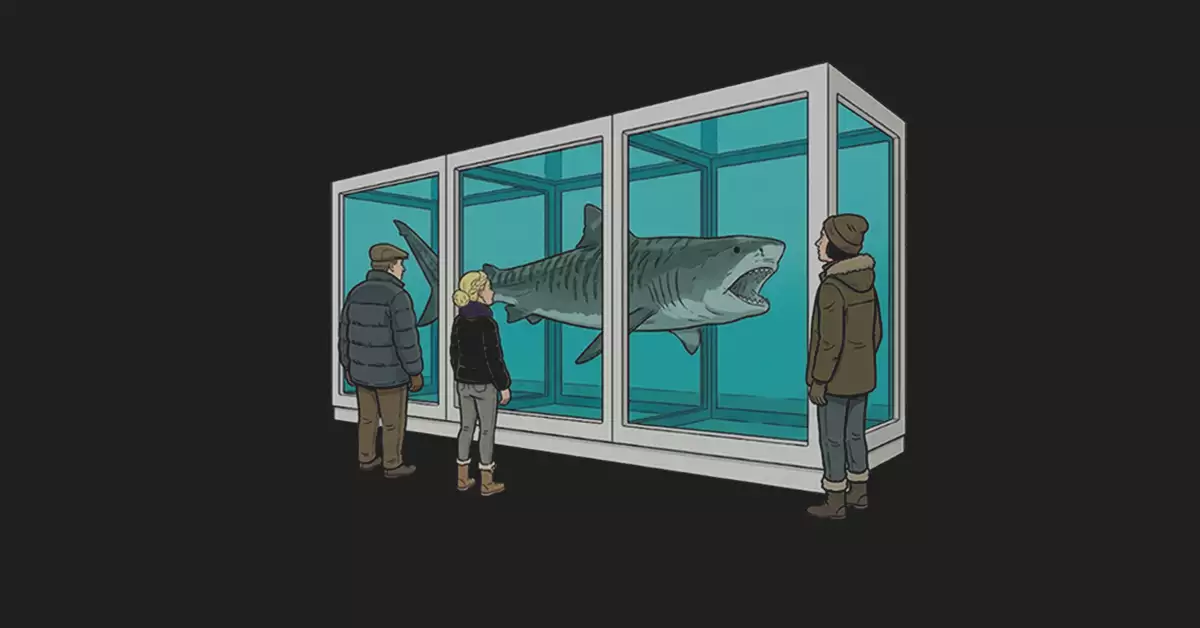
Inside The Physical Impossibility of Death in the Mind of Someone Living and the uneasy alliance between mortality and the art market
There is something almost soothing about a dead shark. It cannot lunge. The teeth, so perfectly engineered for violence, stay where they are. The water around it — formaldehyde, not water — holds everything in suspension, and the illusion is close to perfect: a predator in repose, frozen mid-thought. Damien Hirst titled the work The Physical Impossibility of Death in the Mind of Someone Living, a sentence so cumbersome it seems designed to collapse under its own weight. And yet it works. It captures something true about the experience of standing before the piece — the way the mind slides off the fact of the death, refuses to fully grip it, keeps reverting to the animal’s former aliveness. The shark looks dangerous. It is not. That gap is where the whole work lives.
Hirst was born in Bristol in 1965 and grew up in Leeds, the son of a car salesman. He studied at Goldsmiths, University of London, and in 1988 organized Freeze — a warehouse exhibition of student work in the Surrey Docks that is now cited as one of the founding moments of the Young British Artists. The YBAs were not a coherent movement in any ideological sense; they were a social network, energized by shared opportunism and a willingness to be brash. What Hirst understood earlier than most was that attention itself was a medium. The choice of subject matter, the scale, the institutional context, the press reaction — all of it was material. The shark arrived three years after Freeze, commissioned by Charles Saatchi for fifty thousand pounds, and it established the template that Hirst would spend the next three decades elaborating: a physically imposing object that makes an unanswerable claim on your attention, surrounded by a title that converts the experience into philosophy.
The YBA generation operated under conditions that shaped their sensibility in ways that are easy to overlook. Thatcher’s Britain had restructured the relationship between culture and market in ways that were still settling. The art world Hirst entered was one in which collectors like Saatchi wielded influence that had previously belonged only to institutions, and in which the line between cultural prestige and financial speculation was becoming productively blurry. Hirst did not resist this environment. He studied it. His career can be read as one long, meticulous experiment in what the art market will accept — not with the disgust of a critic, but with the fascination of a participant who has positioned himself on both sides of the transaction simultaneously.
This is where the serious arguments about Hirst begin, and where they tend to circle without resolution. The Spot Paintings — grids of uniform colored circles, produced in their hundreds by studio assistants — raise the question directly. Is Hirst commenting on the seriality of mass production, the vacancy of decoration, the arbitrariness of aesthetic value? Or has he simply discovered a format that sells? The honest answer is probably that these readings are not alternatives. They are the same thing described from different positions. The paintings are genuinely vacuous and genuinely valuable. The vacuity may be the point. The value is certainly the point. The work operates in the space between those two facts and dares you to decide which one to believe.
For the Love of God (2007) makes this explicit in the most operatic way possible. A platinum cast of an eighteenth-century human skull, purchased by Hirst from a London taxidermist, encrusted with 8,601 diamonds including a pear-shaped pink diamond set into the forehead. The production cost was reported at approximately fourteen million pounds; the asking price was fifty million. The skull is extraordinary to encounter in person — it radiates light in a way that no photograph reproduces, simultaneously sacred and grotesque, a reliquary for no particular saint. The theological overtones of the title press further: for the love of God is an exclamation of exasperation, the thing you say when something has exceeded comprehension. The skull asks you to consider whether the object before you is a vanitas — that long tradition of memento mori imagery, the skull as reminder of mortality — or whether it has so thoroughly commodified that tradition as to evacuate it of meaning entirely. Hirst offers no guidance. He charges fifty million pounds and waits.
The 2008 Sotheby’s auction, Beautiful Inside My Head Forever, was the most audacious move in a career defined by audacity. Bypassing his own galleries entirely, Hirst consigned 223 new works directly to auction, generating sales of approximately £111 million over two days — the largest single-artist auction in history at the time. The timing was grotesque in its precision: Lehman Brothers filed for bankruptcy the same week. The art market shivered. Hirst’s auction did not. There is no neutral way to narrate this fact. Either it confirms that the top end of the art market operates in a reality entirely insulated from ordinary economic consequence, or it represents a masterwork of Hirst’s central theme — the way desire, luxury, and the fear of death are bundled together into a single irrational transaction — performed at the scale of the financial system itself.
The critical response to Hirst has hardened over time into a familiar set of positions. He has too much money; his ideas ran out in the 1990s; the studio-production model is dishonest; the market that sustains him is a closed loop of wealthy collectors inflating one another’s holdings. These criticisms are not without substance. But they tend to assume that the game Hirst is playing is the same game as, say, Gerhard Richter or Cy Twombly — that the work is meant to reward sustained formal attention, that the maker’s hand is the relevant unit of authenticity, that sincerity is the criterion. Hirst has never seemed interested in that game. His work is conceived at the level of the concept and the installation; it is designed to be encountered once, forcefully, and then remembered rather than returned to. The question is whether that is a limitation or a deliberate choice that has its own integrity.
What Hirst gets right, and what his detractors often miss, is the phenomenology of death under late capitalism. We are a culture that has sequestered dying in hospitals and care facilities, that has outsourced the handling of the dead to a professional class, that consumes images of mortality primarily through entertainment — crime drama, action film, news footage — in which the deaths are either fictional or at sufficient geographical remove to remain abstract. Into this context, Hirst places a real dead thing, in a gallery, and asks you to stand close to it. The formaldehyde smell, in the early exhibitions, was reportedly present. The scale of the tiger shark forces an almost physical confrontation — the animal is larger than you, and the glass provides only a conceptual barrier. The discomfort this produces is not manufactured. It is the discomfort of proximity to something the culture has worked very hard to keep at a distance.
Whether that discomfort adds up to a sustained artistic vision, or whether it is a single good idea stretched across an entire career, is a question Hirst’s retrospectives have not yet settled. His paintings from recent years — the cherry blossoms, the oils on canvas that represent a return to more conventional mark-making — have been received with qualified respect at best and gentle condescension at worst. The formal qualities do not match the conceptual ambition of the early work, and the reversal seems to confirm what some suspected all along: that the ideas were always stronger than the craft, and that without the ideas operating at full intensity, the craft has nowhere to hide.
But the shark remains. Hirst had to have it replaced — the original deteriorated — and the replacement is, in one sense, a different work. In another sense, it is exactly the same work, because the work was never about that particular shark. It was about the concept the shark was made to hold: the impossibility of really believing that you will die, even while standing in front of evidence that everything dies. That concept has not deteriorated. It is, if anything, more urgent than it was in 1991, in a cultural moment when death has become simultaneously more visible — through pandemic, through climate anxiety, through the daily violence of news cycles — and more thoroughly aestheticized, monetized, and managed than ever before.
The glass tank is still there. The shark floats in it, motionless and inexhaustible, and the question it asks has never been adequately answered: what exactly are we doing when we look at this, and what does it say about us that we paid to get in?